


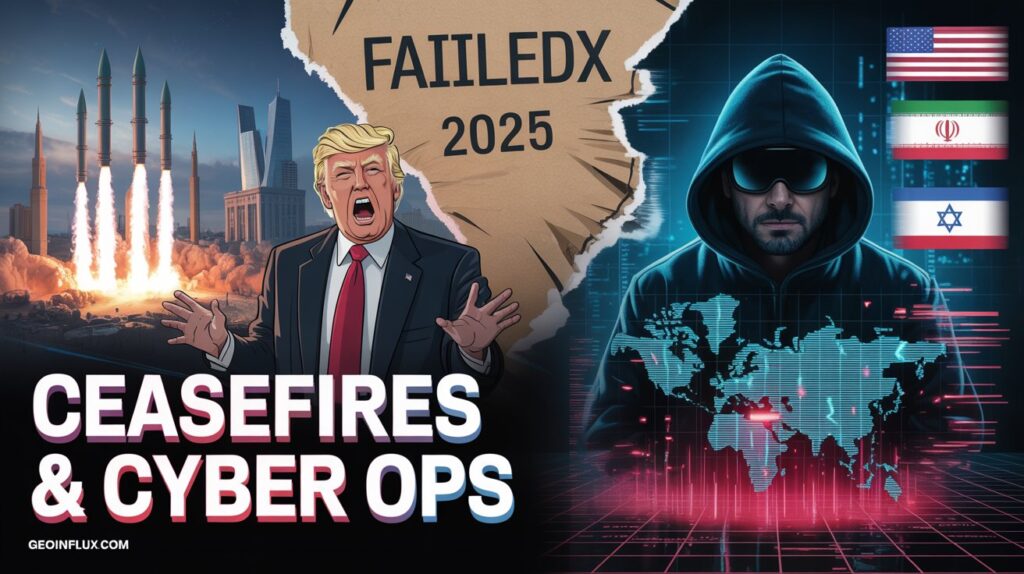
Explore Geopolitics 2025 — from fragile Israel–Iran ceasefires and Iran’s Strait threats to NATO cyber defenses, AI-driven warfare, and Trump’s strategic pivot. Discover key risks shaping the global order
🌍 Introduction: Ceasefires, Cyber Ops & a New Global Order
2025 geopolitics has entered uncharted territory. After a tentative ceasefire brokered by Trump, Israel–Iran tensions remain volatile (gsdn.live). Simultaneously, cyber operations—from Iran’s influence campaigns to NATO’s digital defenses—are shaping state conflicts. The result? A hybrid battleground where diplomacy and data collide.
Latest post: New GST 2.0 Rates 2025 Reform: Two-Slab Structure (5% & 18%). What Gets Cheaper, What Gets Costlier.
🕊️ Israel–Iran Ceasefires 2025: Fragile Peace Under Pressure
Israel–Iran ceasefires 2025: A 12-day war brought US‑led strikes on Iran’s nuclear sites and rigorous aerial duels. Trump announced a ceasefire, but missile exchanges continued (thetimes.co.uk). Analysts dub it a diplomatic victory, yet warn the truce lacks enforcement and may unravel (theaustralian.com.au).
Also Read:
- Why India-Bangladesh Border Tensions Are Rising Again in 2026?
- Can You Get a High-Paying Tech Job in the AI Era of Mass Layoffs with Free MIT Courses? (2026 Guide)
- India’s Rotating Detonation Engines Breakthrough: Is This the End of Jet Engines?
- Trump NATO Exit Strategy: The Secret Prelude to an Israel-Turkey War in 2026?
- BLA Naval Attack Jiwani 2026: The Saudi-Pakistan SMDA Activation and UAE Debt Crisis Explained
⚔️ Iran’s Leverage: Strait Threats & Proxy Warfare Post‑Ceasefire
Iran threats Strait Hormuz: Despite the ceasefire, Iran retains multiple escalation options:
- Disruption at the Strait of Hormuz using naval mines and drones (businessinsider.com).
- Launch missile attacks on US bases in Qatar and beyond (businessinsider.com).
- Mobilize proxy groups like Hezbollah and the Houthis (businessinsider.com).
💻 Cyber Ops Rise: Iran Hacks, NATO Defenses & AI Escalation
geopolitics cyber operations 2025: The post-ceasefire era sees cyber warfare intensifying. Iran-backed hackers targeted U.S. campaigns and Israeli infrastructure (researchcentre.trtworld.com). NATO is reinforcing cyber defenses on its eastern flank (gsdn.live). AI-enhanced cyberattacks—MAICAs—threaten critical systems (arxiv.org).
🧭 Trump’s Role: From Ceasefires Architect to Cyber Strategist
Trump cyber geopolitics 2025: Trump’s strategic pivot includes:
- Securing a ceasefires in the “12-Day War” (thetimes.co.uk, apnews.com).
- Advocating for regime change via nuclear diplomacy slogans like “Make Iran Great Again” (en.wikipedia.org).
- Pressing Gulf allies to revive nuclear talks and end Tehran’s proxy networks .
- Framing NATO talks on cyber cooperation as part of his new global order.
🔮 Global Risks & Ramifications in 2025
2025 geopolitics risks
1. NATO Escalation Threat
If US forces are hit, NATO may trigger Article 5, expanding the conflict (businessinsider.com, apnews.com).
2. Proxy Warfare Surge
Oil markets are vulnerable if Iran targets the Strait. Proxy groups could ignite secondary conflicts across the Middle East (businessinsider.com).
3. Tech Cold War
Cyber operations—driven by AI agents and quantum hacking—shape power dynamics. The US, China, Russia, and Iran leapfrog in the cyber arms race .
4. Strategic Asian Risk Zones
India-Pakistan ceasefires tensions and NATO cyber concerns parallel Middle East unrest (en.wikipedia.org).
📌 Summary: Ceasefires & Key Trends in 2025 Geopolitics
| Trend | Insight |
|---|---|
| Israel–Iran ceasefire | Fragile, yet diplomatically significant |
| Iran’s leverage | Strait disruption, proxy mobilization |
| Cyber ops surge | Iran hacks, NATO digital countermeasures |
| Trump’s pivot | Ceasefire + cyber dominance theme |
| Global risks | NATO Article 5, oil markets, cyber cold war |
| Regional echo | South Asia ceases, hybrid threats intensify |
🧠 Final Insight: The New Geopolitical Frontier
2025’s geopolitical landscape is defined by hybridity—military operations entwined with cyber and digital influence. States wield missiles and algorithms alike. The future lies in mastering both domains: hard power and coded warfare. Stay alert—this frontier demands strategic vision and digital resilience.
❓ FAQs on Geopolitics 2025
1. What is the Israel–Iran ceasefire of 2025 and why is it considered fragile?
The Israel–Iran ceasefire 2025 was brokered after a brief but intense conflict often referred to as the “12-Day War.” The truce, announced with U.S. involvement, temporarily halted missile exchanges and airstrikes across the region. While hailed as a diplomatic breakthrough, experts caution that the ceasefire remains fragile for several reasons.
First, there is no robust enforcement mechanism in place. Unlike formal peace treaties, this agreement relies on verbal assurances and shifting political interests. Both Israel and Iran continue to accuse each other of violations, with sporadic rocket fire and drone incursions reported along contested borders.
Second, Iran retains multiple tools of escalation. These include disrupting maritime trade in the Strait of Hormuz, mobilizing proxy groups such as Hezbollah and the Houthis, and launching missile strikes on U.S. and allied bases in the Gulf. Each of these options gives Tehran leverage, allowing it to pressure opponents without breaking the ceasefire outright.
Third, regional actors remain divided. While the U.S. promotes the truce as part of its wider Middle East strategy, countries like Saudi Arabia and Turkey view it with suspicion, fearing that Iran could use the lull to strengthen its proxy networks.
Finally, the broader context of geopolitics 2025—including cyber warfare, oil market volatility, and shifting alliances—makes the situation unstable. Peace in the region is therefore better described as a pause in hostilities rather than a long-term resolution.
2. How do cyber operations shape geopolitics in 2025?
Cyber operations are no longer a secondary battlefield; they are now central to global geopolitics in 2025. States increasingly use cyber tools for both defensive and offensive strategies. Iran, for example, has ramped up hacking campaigns targeting U.S. election systems, Israeli infrastructure, and global oil markets. These attacks blur the line between traditional conflict and covert warfare.
NATO, in response, has strengthened its eastern flank with new cybersecurity frameworks. Member states coordinate through joint exercises, AI-driven monitoring, and quantum-resistant encryption protocols. The goal is to counter state-sponsored attacks before they cripple energy grids, financial systems, or critical defense communications.
AI has become the biggest force multiplier in this cyber race. So-called MAICAs (Machine-Assisted Intelligent Cyber Agents) are capable of launching precision intrusions at speeds humans cannot match. When paired with disinformation campaigns on social media, they allow states to influence both battlefield outcomes and public opinion.
For smaller countries, cyber capabilities are a cheaper alternative to conventional military power. Instead of investing billions in fighter jets or tanks, governments can fund hacker units that cause strategic disruption worldwide. This dynamic has democratized conflict but also made it more unpredictable.
In short, cyber operations in 2025 are shaping geopolitics by leveling the playing field, intensifying great power rivalries, and expanding the scope of hybrid warfare.
3. What role does Donald Trump play in the 2025 geopolitical landscape?
Former U.S. President Donald Trump has reemerged as a key figure in geopolitics 2025, particularly in the Middle East and in shaping cyber strategy. His role began with direct involvement in negotiating the Israel–Iran ceasefire after the 12-Day War. Trump publicly framed the truce as proof of his diplomatic skills, presenting it as a victory that stabilized the region—at least temporarily.
Beyond ceasefire diplomacy, Trump has pivoted to cyber strategy. His advisors have been promoting the concept of a “Cyber NATO,” arguing that digital defense should be treated as collective defense under Article 5 of the NATO treaty. Trump also positioned himself as a critic of Iran’s cyber campaigns, advocating more aggressive countermeasures.
Interestingly, Trump’s rhetoric includes slogans like “Make Iran Great Again,” which simultaneously target regime change advocates and Iranian reformist audiences. His approach reflects a mix of populist messaging and geopolitical maneuvering.
Regionally, Trump has urged Gulf allies to resume nuclear talks while demanding tougher action against Tehran’s proxy groups. These moves suggest a broader strategy of using cyber diplomacy as both a pressure tool and a way to shape the global order.
Trump’s role in 2025, therefore, is not limited to a single ceasefire. He positions himself as both a ceasefire architect and a cyber strategist, blending traditional diplomacy with the emerging battlefield of digital conflict.
4. Why is the Strait of Hormuz a flashpoint in geopolitics 2025?
The Strait of Hormuz is one of the world’s most important maritime chokepoints, carrying roughly 20% of global oil shipments. In geopolitics 2025, it has once again become a flashpoint due to escalating Iran–Israel tensions and the fragile ceasefire in the region.
Iran uses the Strait as both a defensive shield and a bargaining chip. By threatening to mine waters or deploy swarm drones, Tehran can disrupt global oil supplies, creating pressure on international markets. This strategy allows Iran to assert leverage without directly engaging in full-scale war.
For the U.S. and its allies, keeping the Strait open is a strategic necessity. Any disruption could send energy prices skyrocketing, destabilizing economies in Europe and Asia. Naval patrols from the U.S., UK, and regional partners are therefore a constant presence, increasing the risk of accidental clashes.
Beyond oil, the Strait is symbolic. It represents Iran’s ability to influence global trade and highlights the vulnerability of maritime infrastructure. In 2025, with energy security already strained by conflicts in Eastern Europe and Asia, the Strait of Hormuz remains one of the most sensitive geopolitical flashpoints in the world.
5. What are the biggest risks in global geopolitics 2025?
The year 2025 presents a wide spectrum of global risks. Analysts identify five key ones shaping the geopolitical landscape:
- NATO Escalation Threat: If U.S. or allied forces are attacked, NATO could invoke Article 5, dragging Europe into wider conflict.
- Proxy Warfare: Iran-backed groups such as Hezbollah and the Houthis could ignite secondary wars across the Middle East.
- Tech Cold War: AI-driven cyber operations and quantum hacking deepen rivalries between the U.S., China, Russia, and Iran.
- Oil Market Volatility: Disruption at the Strait of Hormuz could destabilize global markets.
- Asian Flashpoints: India–Pakistan ceasefire tensions and South China Sea disputes mirror Middle Eastern instability.
Together, these risks illustrate a shift toward hybrid conflict, where conventional battles, cyber warfare, and energy disruption intertwine. For governments and businesses alike, preparing for 2025’s risks requires balancing hard power with digital resilience.
Updated September 2025
📚 References
- Iran’s post-ceasefire leverage (theaustralian.com.au, businessinsider.com)
- Trump brokers ceasefire & nuclear talks


