


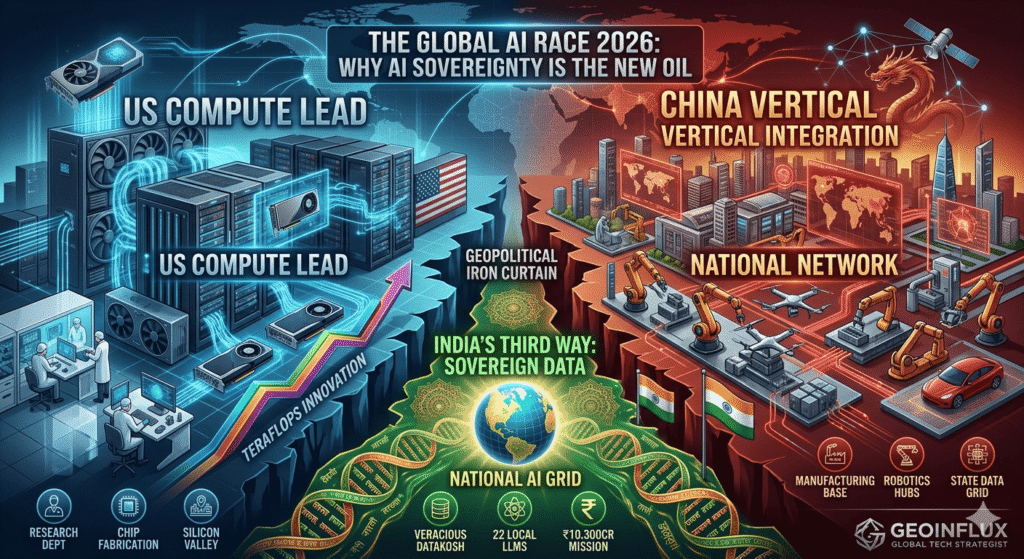
The Global AI Race 2026: In today’s era of Artificial Intelligence, where the world is battling for AI Sovereignty to win the Global AI Race, the US and China battle for GPU dominance, while India’s “Third Way” strategy is redefining the Global AI Race. Explore why AI Sovereignty is the definitive resource of 2026.
Quick Take: The Shift to Algorithmic Autonomy
The Global AI Race has shifted from a corporate competition into a high-stakes geopolitical arms race. In 2026, “AI Sovereignty” is the primary goal for world powers. Nations are no longer content with using foreign-hosted models; they are racing to build sovereign Large Language Models (LLMs) trained on local data and powered by domestic GPU clusters.
While the US maintains a lead in raw compute power through Silicon Valley, China’s vertical integration and India’s “Data Dividend”, fueled by the India AI Mission, are rapidly closing the gap. This isn’t just about economic growth; it’s about who controls the algorithms that govern national defence, global finance, and digital identity.
Countries without their own AI stack risk becoming “digital colonies” in an era where data is the fuel and compute is the refinery.
The Three Pillars of the 2026 AI Race
Latest on Geoinflux





To understand the current power balance, we must examine the three pillars of modern national strength:
- Compute Sovereignty: The hunt for H100S and next-gen Blackwell chips. In 2026, national power is measured in Exaflops.
- Data Protectionism: Nations are “fencing off” their citizens’ data. This prevents foreign AI from training on unique cultural and behavioural datasets, ensuring that domestic models remain the most accurate for local use.
- Algorithmic Diplomacy: This is the use of AI exports and “Model-as-a-Service” as a tool for international influence. Much like oil in the 20th century, AI is now the primary lever for securing trade deals and military alliances.
US vs. China: The Compute Iron Curtain
The divide between Western and Eastern AI ecosystems is now a permanent fixture of 2026.
- The Silicon Shield: Strict export controls on high-end chips have forced China to pivot entirely to domestic silicon, with Huawei and Baidu leading the way. This has created a “bifurcated internet” where Western and Chinese models rarely interact.
- The Innovation Lead: While the US dominates the “frontier” of general AI research, China is winning in vertical integration, embedding AI into the physical world through robotics, smart cities, and a fully automated manufacturing supply chain.
India’s Role: From Service Hub to Sovereign Power
India is no longer just the world’s back office; it has become a Sovereign AI Power.
- The India AI Mission: With a budget of over ₹10,300 crore, the mission has successfully onboarded over 38,000 GPUs available at a subsidized rate of just ₹65 per hour. This has democratized access for startups that were previously priced out of the race.
- Vernacular AI Mastery: While Western models struggle with cultural nuance, India is building Sovereign LLMs in 22 regional languages. These models are trained on AIKosh, a national dataset platform with over 5,500 datasets across 20 sectors.
- India AI Impact Summit 2026: Held in New Delhi, this summit saw 91 countries sign the New Delhi Declaration, shifting the global conversation from AI “risk” to AI “impact” and developmental priorities for the Global South.
The Rise of “Sovereign Clouds”
In 2026, the public cloud will no longer be enough. The “Year of Truth for AI” has pushed organizations toward Cloud 3.0, a mix of hybrid and sovereign cloud architectures.
- Why it matters: Sensitive government and healthcare data can no longer reside on servers controlled by foreign entities.
- Impact: Companies like Google and Microsoft are now building specialized “Sovereign Hubs” (like Google’s new $15 billion AI hub in Visakhapatnam) to comply with local data residency laws while still providing world-class compute.
Strategic Insight: The “Digital Colony” Risk
The strategic implication of 2026 is clear: Resilient Interdependence. No country can be entirely self-sufficient in AI, but those who do not own their core “stack”, the hardware, the data, and the model, will become digital colonies. They will be forced to rent intelligence from foreign powers, leading to a loss of strategic autonomy in everything from economic forecasting to cybersecurity.
The Global AI Power Balance 2026
| Nation/Region | Core Strength | Key Challenge | 2026 Strategy |
| USA | Frontier Research & Hardware | High Energy Costs / Regulation | Maintaining the “Compute Lead” |
| China | Vertical Integration / Robotics | Chip Sanctions / Data Access | Open-Source Influence & Domestic Silicon |
| India | Data Dividend & Talent Pool | Infrastructure Scalability | India AI Mission / Vernacular Models |
| EU | Privacy & Regulation | Lack of Frontier Tech Hubs | “The Brussels Effect” / AI Defense |
What This Means for Businesses and Leaders
- Prioritize Local Context: If you are operating in India, a model trained on Silicon Valley data will not understand the nuances of the “Bharat” consumer.
- Audit Your Stack: Know where your AI models are hosted. If your critical business logic is on a foreign-owned sovereign cloud, you are exposed to geopolitical risk.
- Invest in “AI for Social Good”: As highlighted in the India AI Impact Summit, the most successful AI applications in 2026 are those solving real-world problems in agriculture, healthcare, and education.
FAQs
Who is winning the Global AI Race in 2026?
The US leads in raw hardware and research, but India is emerging as the leader of the Global South’s AI movement, focusing on democratic and inclusive access to compute.
What is AI Sovereignty?
It is a nation’s ability to build, host, and govern its own AI models and infrastructure without being dependent on foreign technology for critical operations.
How does the India AI Mission help startups?
It provides high-end GPUs at subsidized rates (₹65/hour), offers access to the AIKosh dataset platform, and provides financial support through the IndiaAI Startup Financing pillar.
What is the “New Delhi Declaration”?
A 2026 agreement signed by over 90 countries that emphasizes human-centric AI, trust, and developmental impact over pure risk-based regulation.
Related Articles
- 2M Gone, 4M Gained: The AI Skill Gap Reshaping India’s Tech Future
- Digital Sovereignty: Why It Is a National Security Issue in 2026
Featured Sources & Citations:
- NITI Aayog: National Strategy for AI
- PIB: India AI Impact Summit Strategic Outcomes
- Atlantic Council: Geopolitics of AI 2026
- Brookings Institution: Is AI Sovereignty Possible?
- Race for AI sovereignty intensifies as companies push enterprise adoption
End Note: In 2026, the race is no longer about who has the fastest AI, but who owns the AI they use. Stay ahead with GeoInflux.
Author: Kushan Kislay Published: April 5, 2026
Thanks Note: Stay informed, stay ahead.


