


IIT Madras deep-tech 2025 is driving India’s chip startup revolution as fabless semiconductor design powers hardware localisation and innovation nationwide.
Quick Take
India’s semiconductor dream isn’t only driven by policy—it’s being built inside university labs. IIT Madras, through its research park and deep-tech incubator, has created a pipeline for chip design startups.
This academic engine complements India’s national semiconductor policy, including the Design Linked Incentive (DLI) program shaping chip design and localisation. (Read more on how India’s DLI policy powers the localisation ecosystem → India’s Semiconductor Design Ecosystem and Localisation Policy.)
Companies like Mindgrove Technologies and InCore Semiconductors show how academic R&D can translate into market-ready SoCs. With funding from India’s Design-Linked Incentive (DLI) Scheme, these ventures are bridging the gap between theory and commercialisation.
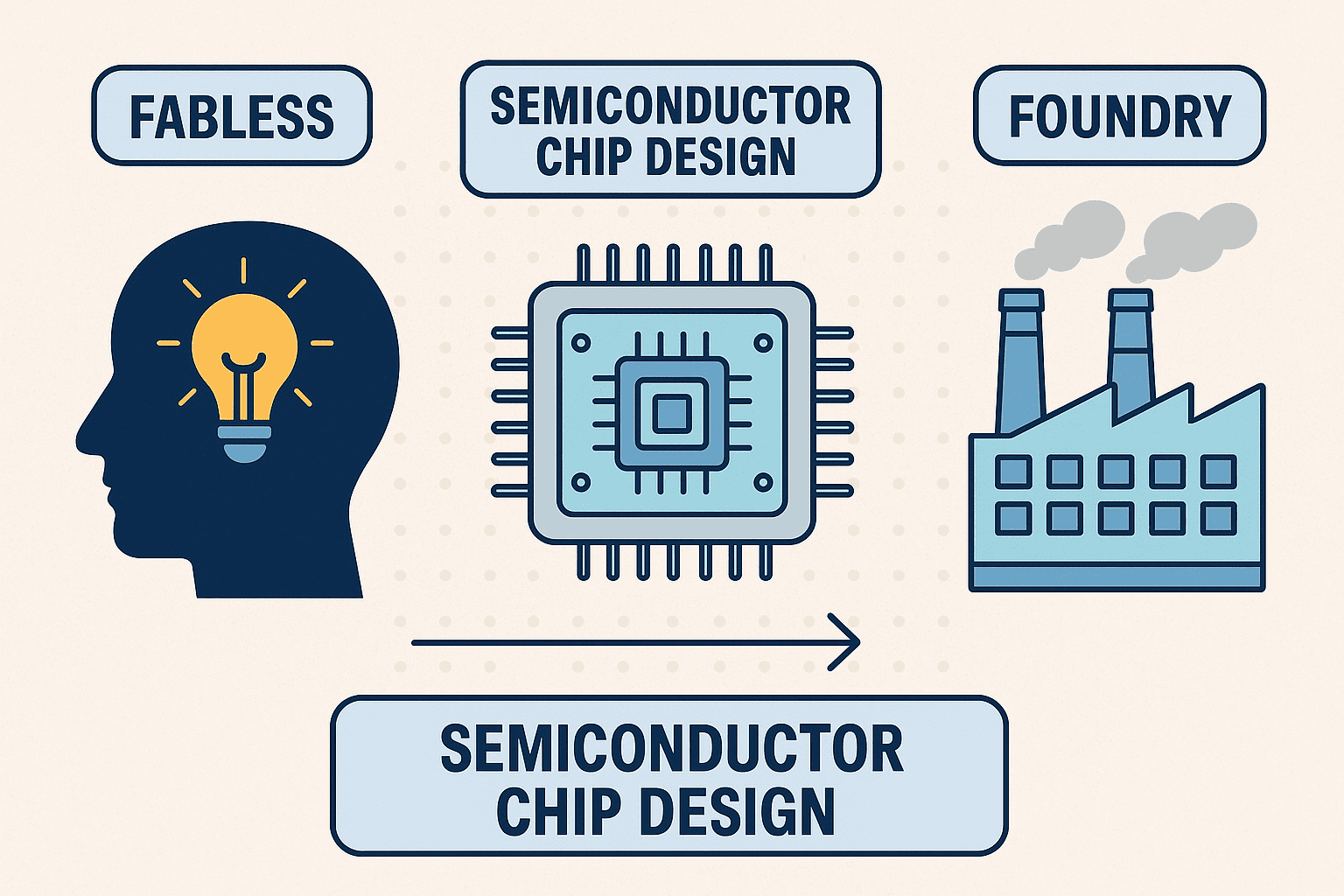
IIT Madras is now a national model: a micro-ecosystem where fabless semiconductor India startups design, test, and ship chips—long before India has its own fab.

How did IIT Madras become the launchpad for fabless semiconductor India?
The story began in 2010 when IIT Madras established the Research Park—a 1.2 million sq ft campus connecting academic labs with private R&D. By 2017, it had launched the Incubation Cell for hardware and deep-tech ventures.
When the government announced the India Semiconductor Mission in 2021, IIT Madras was ready: it already hosted design labs, cleanrooms, and EDA access.
Today, the campus houses:
- Reconfigurable Computing Lab (RCL) – focus on RISC-V and FPGA research.
- Centre for Microprocessor Design – architectural design for secure IoT devices.
- IITM Incubation Cell (IITMIC) – mentor, fund, and scale tech startups.
Mindgrove’s Secure IoT chip—the first commercial SoC designed in India—was born here under IIT Madras Incubation. Read the main feature → India Chip Startup Mindgrove Redefines Chip Design in India
Which semiconductor startups came out of IIT Madras Deep-Tech Ecosystem?

1. Mindgrove Technologies
Mindgrove’s SoC innovation links academic design excellence with India’s wider fabless semiconductor movement. (See how India’s chip startup ecosystem is scaling innovation in Fabless Semiconductor India and Chip Startup Mindgrove.)
- Focus: IoT SoC India design, fabless semiconductor India model.
- Backed by: IIT Madras Incubation Cell & MeitY’s DLI Scheme.
- Product: 28-nm The RISC-V microcontroller is now entering pilot production.
2. InCore Semiconductors
- Focus: Open-source RISC-V cores, system-on-chip IP design.
- Founded by: Prof. Kamakoti Veezhinathan’s research group.
- Provides IP and EDA support to Indian defence and automotive clients.
3. Agnisumukh Semiconductors and DeepSight Labs
- Emerging teams working on AI accelerator chips and edge processors.
Together, they demonstrate how a university can function like a micro-semiconductor hub, providing research, incubation, and policy synergy under one roof.
How does IIT Madras Deep-Tech connect academia, government, and industry?
IIT Madras serves as the operational partner for several national semiconductor initiatives:
- Design Linked Incentive Scheme (DLI): offers grants and tool access to startups through C-DAC.
- Chip to Startup (C2S): trains students and facilitates prototype projects.
- Semicon India Partnerships: coordinates industry collaborations with TSMC, Synopsys, and Cadence for EDA licences.
This three-way linkage lets IIT Madras act as both an academic institution and a semiconductor incubator.
The institute’s work under the DLI Scheme ties directly to India’s policy-driven localisation strategy, detailed in India’s Semiconductor Design Ecosystem and Localisation Policy.
Faculty labs handle architecture research; students prototype chips; startups commercialise them.
That loop has now become India’s most successful model for hardware localisation India-wide.
Why does academia matter in India’s fabless semiconductor journey?
Unlike software, hardware innovation needs capital, lab time, and specialised equipment. Universities absorb those costs early, making it viable for small founders to launch.
- IIT Madras provides EDA licences worth crores for free.
- Access to cleanrooms and testing cuts R&D cost by 40 %.
- Faculty expertise bridges academic rigour and industrial pragmatism.
By lowering entry barriers, the IIT Madras Deep-Tech ecosystem enables a wave of India chip startups that might never have survived outside campus support. It’s how Mindgrove moved from a student project to a funded startup taping out its first chip within 24 months.
How does IIT Madras link to India’s localisation and digital sovereignty goals?
Every chip designed at IIT Madras is a small step toward the hardware sovereignty India needs.
- Local design ensures IP ownership stays in India.
- Collaboration with Indian testing firms like Kaynes and CG Power pushes hardware localisation India forward.
- National defence and IoT projects gain secure, homegrown hardware.
This academic-to-industry model is why MeitY and the Semiconductor Mission treat IIT Madras as India’s central R&D node for semiconductor design.
What lessons can other institutions learn from IIT Madras?
- Dedicated Infrastructure: Create cleanroom and EDA access pools for startups.
- Policy Integration: Align academic research grants with DLI and C2S programmes.
- Incubation Networks: Build industry tie-ups for testing and fabrication support.
- Long-term Vision: Treat semiconductors as national R&D assets, not short-term projects.
If IIT Delhi, IISc, and IIT Hyderabad replicate IIT Madras Deep-Tech model, India can have a distributed chip design grid that rivals Taiwan’s research-industry synergy.
Why IIT Madras will remain central to India’s chip future
The campus is expanding its semiconductor facilities by 2026 with the National Chip Design Center and a Semiconductor Research Park at the Taramani campus.
This hub will host over 30 fabless startups, training labs, and testing units.
As India waits for its first fab to go live, IIT Madras is already doing what matters most—turning research into commercial chips and teaching a generation to design for India and the world.
End Note
IIT Madras proves that India’s semiconductor rise won’t begin with a factory, it will start with a lab.
Mindgrove and InCore show how research can become industry. If other universities follow, India can transform its academic capital into hardware capital for a sovereign digital future.
To understand how IIT Madras fits into India’s larger fabless innovation map, explore Fabless Semiconductor India and Chip Startup Mindgrove and its policy foundation in India’s Semiconductor Design Ecosystem and Localisation Policy.
Related Reads
- China’s Molten Salt Reactor (MSR) 2025 Breakthrough: 5 Reasons Thorium Reactors Are Key to Energy Independence
- Future of IT Jobs in India 2025: Anthropic AI Index Reveals 3 Alarming Automation Trends | Geoinflux
References
- IIT Madras – Research Park Overview
- IIT Madras Incubation Cell – Deep-Tech Startups
- MeitY – Design Linked Incentive Scheme
- InCore Semiconductors – Official Site
- Moneycontrol – Mindgrove Feature
- India Semiconductor Mission Portal


