
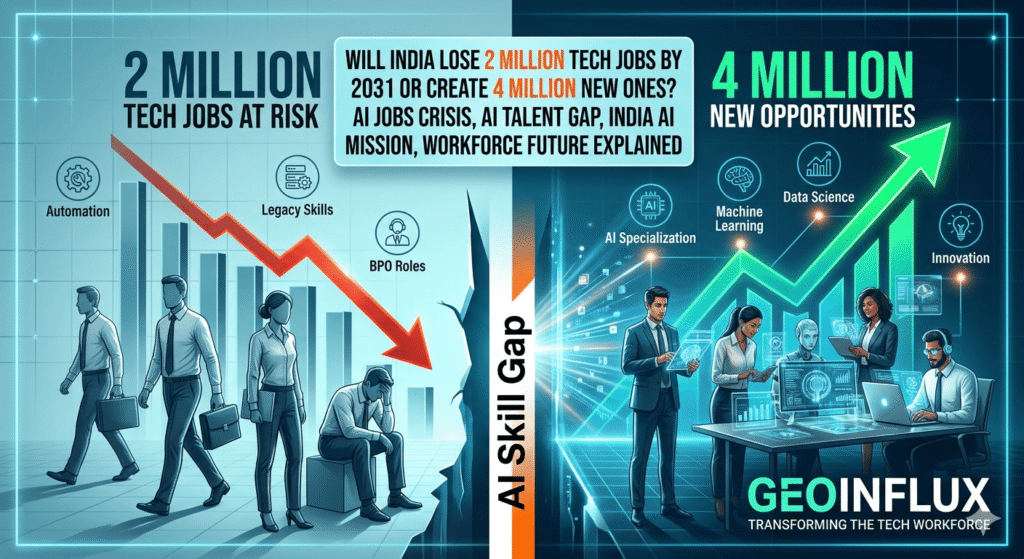

India AI Mission: The Indian government has recently released a report by NITI Aayog, along with NASSCOM and BCG. This report reveals the AI jobs crisis, talent gap, and India AI Mission shaping the future workforce.
The CEO of NITI Aayog stated that India’s tech sector could lose up to 2 million jobs by 2031. But the same report says 4 million new jobs will be created.
Both are happening at the same time, but how? Let’s have a look
India AI Mission: The Great Tech Transition
India’s tech sector is entering a major transition. A joint report by NITI Aayog, NASSCOM, and BCG warns that up to 2 million tech jobs could disappear by 2031 due to AI automation. At the same time, 4 million new roles are expected to emerge, driven by enterprise AI adoption, Global Capability Centers (GCCs), and the India AI Mission.
The real issue is not a lack of roles, but the widening AI talent gap, where demand is drastically outpacing skilled workers. Currently, India faces a ratio of only one qualified candidate for every two AI job openings. Emerging technologies like real-time accent neutralization are also shifting global service roles toward India, turning historical disadvantages into competitive edges.
The outcome, whether the workforce shrinks to 6 million or expands to 12 million, depends entirely on the speed of adaptation by individuals and policymakers.
AI Talent Gap: Transformation, Not Just Crisis
India is not just facing an AI job crisis and tech jobs; it is entering a profound job transformation phase. While headlines focus on the 2 million roles at risk of disappearing by 2031, they often overlook the 4 million new opportunities on the horizon.
The disruption is real, but the narrative is shifting from “replacement” to “evolution”. The fundamental question for the Indian techie is no longer “Will I have a job?” but “Will I be the one ready for the jobs being created?”
Why Could India Lose 2 Million Tech Jobs by 2031?
The threat to 2 million roles stems from the efficiency of Generative AI.
- Automation of Routine: Tasks in software development, such as boilerplate coding and basic unit testing, are now handled by AI agents in seconds.
- Productivity Gains: As AI tools allow a single developer to do the work of three, companies are seeing massive productivity gains, which naturally leads to smaller team sizes for the same output.
- Silent Layoffs: We are seeing “hiring freezes” rather than mass visible layoffs. Companies are simply not replacing the 20-30% of staff that leave through natural attrition, opting instead for AI-driven workflows.
Which Tech Jobs Are Most at Risk from AI in India?
Certain sectors are on the “front lines” of this automation wave:
- QA Testing: Manual and basic automated testing roles are being rapidly replaced by AI that can predict bugs and write test scripts.
- Customer Support & Help Desks: Level 1 support is almost entirely migratable to advanced AI chatbots that handle intent and emotion.
- Entry-Level Coding: Basic HTML/CSS and repetitive backend tasks are now low-hanging fruit for Large Language Models (LLMs).
- BPO Workflows: Data entry and simple transcription are becoming obsolete as AI achieves near-perfect accuracy in these domains.
How Is AI Increasing Productivity and Reducing Hiring Needs?
The numbers tell a compelling story of efficiency. Industry data suggests an overall productivity boost of 10–20% across the board. However, in simpler workflows like documentation or basic bug fixing, that boost jumps to 50–60%. This means projects that once required a six-month cycle are being completed in three, allowing firms to scale without increasing their headcount.
What Is the Hidden Opportunity in the AI Jobs Crisis in India?
The “India Advantage” is evolving. Technologies like real-time accent neutralization are a game-changer. Previously, certain high-end global consulting or sales roles stayed in the West due to linguistic nuances. Now, AI can neutralize accents in real-time, allowing Indian professionals to compete for any global role. We are witnessing the rise of Outsourcing 2.0, where India’s “weaknesses” in global communication are being solved by software.
Why Is There an AI Talent Gap in India Despite High Demand?
Despite being a “coding superpower,” India has a massive skill mismatch:
- The 1:2 Ratio: There is only one qualified worker for every two AI jobs posted.
- Education Lag: India produces fewer than 500 AI-specific PhDs annually, a drop in the bucket compared to global competitors.
- Academic Mismatch: Traditional engineering curriculums are often 2–3 years behind the current pace of GenAI development.
What Challenges Could Slow Down India’s AI Growth?
- Brain Drain: Approximately 44% of top-tier AI researchers from India currently work abroad.
- Infrastructure Gaps: High-quality AI requires massive GPU clusters, which India is only now starting to build at scale.
- Policy Speed: While the “India AI Mission” is ambitious, the execution speed of regional digital policies often lags behind private sector innovation.
How Is India Positioning Itself in the Global AI Race?
India is becoming the “Back Office of the AI World” through Global Capability Centers (GCCs). Over 1,600 GCCs now operate in India, with 70% prioritizing AI hiring in 2026. The upcoming AI Impact Summit 2026 is expected to showcase India’s move from using foreign models to building “Sovereign AI” tailored to Indian languages and datasets.
What Are the New Job Categories Created by AI in India?
The 4 million new jobs will likely fall into three buckets:
- Enterprise AI Roles: Professionals who implement and manage AI within traditional businesses.
- Frontier AI Roles: Advanced roles focusing on AI integration with hardware, IoT, and edge computing.
- AI for AI: Researchers and engineers building the actual models, focusing on data labeling, RLHF (Reinforcement Learning from Human Feedback), and model fine-tuning.
Why Are Freshers Better Positioned Than Experienced Professionals?
In the AI era, “unlearning” is harder than “learning.” Fresh graduates often have a faster learning curve and zero “legacy bias.” They treat AI tools as standard equipment rather than a threat. While an experienced professional might resist a new AI workflow that replaces their 10-year-old process, a fresher adopts it in hours, making them highly cost-effective and adaptable.
What Does the India AI Mission Plan to Do?
The government-backed India AI Mission aims to:
- Mainstream AI education in Tier 2 and Tier 3 cities.
- Establish a National AI Computing Grid with thousands of GPUs.
- Provide funding for AI startups that solve “India-scale” problems (agriculture, healthcare, vernacular languages).
What Are the Two Possible Futures for India’s Tech Workforce?
- Scenario 1 (Stagnation): If reskilling fails, the workforce could shrink to 6 million as automation eats the base-level jobs.
- Scenario 2 (Evolution): If India masters the AI talent gap, the workforce could swell to 10–12 million, making India the indispensable engine of the global AI economy.
How Much of India’s Economy Is Actually at Risk from AI?
It is important to keep perspective. The tech sector accounts for roughly 12% of India’s GDP. While this is a massive chunk, 88% of the economy—including construction, traditional agriculture, and localized services is far less susceptible to immediate AI disruption. This provides a built-in economic safety net.
What Should You Do Right Now to Stay Relevant?
- Daily Integration: Use at least one AI tool (like ChatGPT, Claude, or GitHub Copilot) in your daily tasks today.
- The 2-Hour Rule: Dedicate 2 hours every week strictly to learning a new AI workflow.
- Build Publicly: Don’t just learn; build a small AI-driven project and share it on LinkedIn or GitHub.
Strategic Insight: Is This an AI Job Crisis or a Skill Crisis?
Jobs are not disappearing; outdated skills are. The speed of adaptation is the only differentiator that matters in 2026. India’s demographic dividend is only an advantage if those millions of people are skilled. Without reskilling, a large population becomes a liability; with it, it becomes the world’s greatest asset.
The Future of Tech Jobs in India
| Factor | Risk | Opportunity |
| Automation | 2M roles at risk in QA/Support | 50%+ productivity boost for creators |
| AI Adoption | Massive 1:2 talent gap | 4M new roles in Enterprise & Frontier AI |
| Global Shift | High competition from AI-first nations | Outsourcing 2.0 via accent/language tech |
| Policy | Potential for slow execution | India AI Mission providing GPU/funding |
Frequently Asked Questions (FAQs)
-
What is the India AI Mission?
It is a government initiative designed to build sovereign AI infrastructure, provide GPU access to startups, and catalyze AI education across the country.
-
Will AI replace jobs in India by 2031?
AI will automate specific tasks, leading to the displacement of roughly 2 million roles, but it is expected to create 4 million new roles that require AI-collaboration skills.
-
Which tech jobs are safe from AI?
Roles requiring high-level strategic thinking, complex human empathy, and “Frontier AI” development (building the AI itself) are currently the safest.
Related Articles
- Why Digital Sovereignty Is a National Security Issue in 2026
- How AI Infrastructure Is Reshaping Global Power
- India and the Global AI Race
End Note: India is not losing jobs. It is redefining them. The real divide will not be between industries, but between people who adapt and those who wait.
Author: Kushan Kislay
Published: April 5, 2026
Source: NITI Aayog, NASSCOM, BCG Industry Report 2026
 2
2
 20
20
 20
20