























































Blog

  • Can You Get a High-Paying Tech Job in the AI Era of Mass Layoffs with Free MIT Courses? (2026 Guide)

    Can You Get a High-Paying Tech Job in the AI Era of Mass Layoffs with Free MIT Courses? (2026 Guide)

    Tech layoffs are rising in 2026, but AI is also creating new roles. Learn how to use free MIT courses to become “unreplaceable” and land a high-paying job.

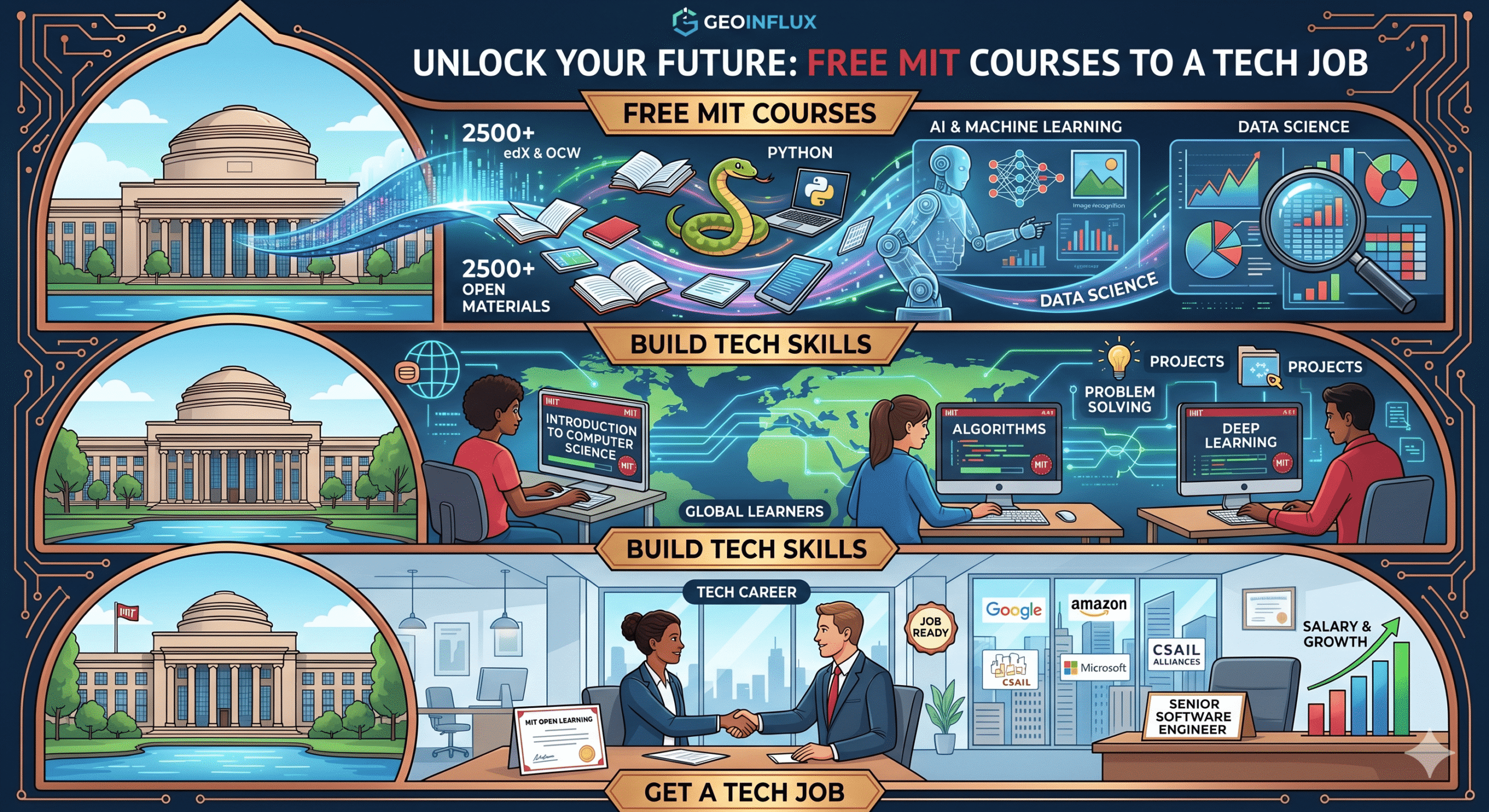
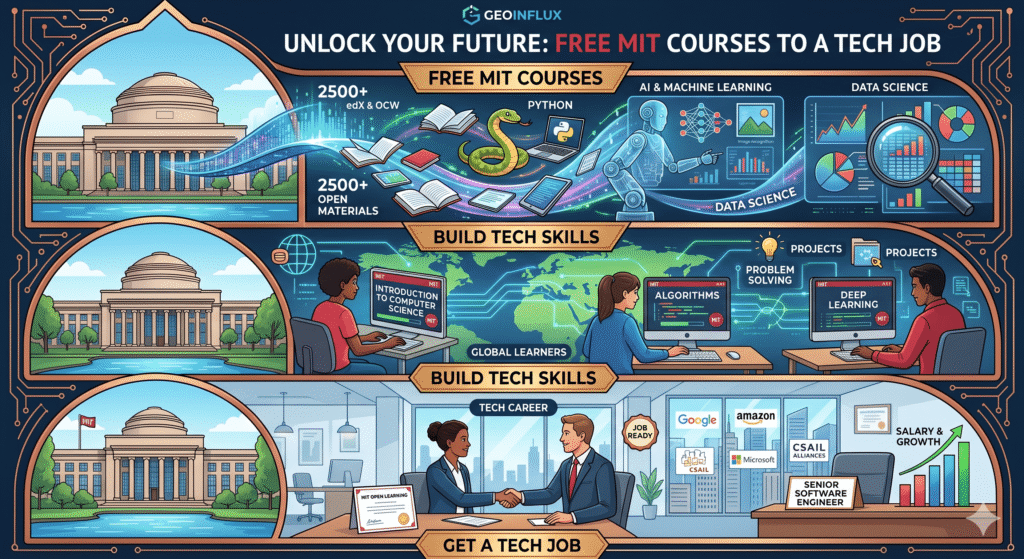
    The Reality Check: Yes, you can absolutely get a tech job using free MIT courses, even during mass layoffs. While many “basic” roles are being cut, companies are desperately hiring people who understand the deep logic of AI. These courses give you the elite skills that standard “bootcamps” miss.

    The 2026 Layoff Truth: Why “Junior” is a Dangerous Title

    In 2026, many companies are using AI to do the “grunt work” that junior developers used to do. This is why we see layoffs. If your only skill is “writing basic code,” an AI agent can do that faster.

    To survive, you need to move from being a “Coder” to being a “System Architect.” MIT courses don’t just teach you how to write code; they teach you how systems work under the hood.

    How MIT Courses Make You “Layoff-Proof”

    1. The “Logic Bridge”: Humans vs. AI

    AI is excellent at following patterns, but it struggles to invent new solutions. By taking courses like Design and Analysis of Algorithms, you learn how to create logic from scratch. When an AI gets stuck, you are the human expert who understands the core math to fix it, making you unreplaceable in any tech job.

    When an AI gets “hallucinations” or gets stuck on a complex bug, you are the human expert who understands the core math to fix it, making you the most valuable person on the team. If you want to stay updated on how these AI shifts are changing the industry every week, check out our AI Latest News category for the newest breakthroughs.

    2. The AI Foundation (Where the Jobs Are)

    Most people in 2026 are just “prompting” AI, but the high-paying jobs are in building and fine-tuning the models themselves. The Matrix Calculus for Machine Learning course gives you the deep mathematical “superpowers” that simple prompt engineers lack. Understanding how data moves through a neural network allows you to work on the actual architecture of AI, which is where the $130K+ salaries are currently hidden.

    This intersection of high-level math and global technology is a major part of Geotech, where we analyze how technical shifts like these impact global power.

    Updated Course Strategy for the Layoff Era

    Group A: The “Survival” Skills (Foundations)

    1. Operating Systems: This course teaches you exactly how hardware talks to software, which is a skill AI agents cannot easily replicate in the physical world. Companies in 2026 are desperate for people who can manage the “bare metal” and cloud infrastructure that keeps their AI running. By mastering the “soul” of the computer, you become essential for keeping the lights on during tough economic times.
    2. Database Management Systems: Data is the “fuel” that drives every AI model in existence, and knowing how to store, clean, and protect that data is a massive career shield. While AI can write simple queries, it can’t design a secure, massive-scale data architecture for a global corporation. If you know how to manage the “memory” of a company, you become a foundational employee that they simply cannot afford to lay off.

    For more step-by-step guides on mastering these foundational tools, browse our Programming and AI Resources section.

    Group B: The “High-Growth” Skills (AI & ML)

    • Machine Learning: Instead of just using AI tools as a consumer, this course teaches you how to be the creator who trains the machines to recognize patterns. You will learn the statistical logic that allows a computer to “learn” from its own mistakes without a human holding its hand. In a competitive market, being the person who can improve a company’s AI performance is the ultimate job security.
    • Deep Learning: This is the specific technology behind modern marvels like ChatGPT and AI image generators. By understanding neural networks, you can help businesses customize these “general” AI tools for their own specific, private needs. This “customization” is a huge trend in 2026, and it requires deep knowledge that goes far beyond just knowing how to type a prompt.

    The Hiring Manager’s Secret: “T-Shaped” Skills

    In a layoff era, companies have stopped looking for “generalists” and started looking for “T-Shaped” professionals. This means you have a broad, basic understanding of all tech (the top of the T), but you are a deep master in one specific, hard-to-replace skill (the stem of the T).

    1. Use the MIT Name: Even if you didn’t go to the campus, listing “MIT Coursework” on your resume signals to recruiters that you have the mental toughness to finish the hardest curriculum on Earth. It proves you aren’t just looking for “easy” shortcuts, which is a quality hiring managers value deeply when budgets are tight.
    2. Focus on “Impact” Roles: Use your new MIT knowledge to apply for roles that directly “generate revenue” or “save costs,” such as AI Optimization or efficient Backend Engineering. During layoffs, the teams that are “making the company money” are the last ones to be cut, while experimental or “fluff” roles are the first to go.

    FAQs

    1. Is it worth starting a tech career in 2026 with all these layoffs?

      Absolutely, but you have to be smarter about it than people were five years ago. The “boring” or “easy” coding jobs are going away, but the “smart” jobs that require deep logic are actually growing. Using free MIT resources allows you to gain these “elite” skills without the crushing weight of a $100,000 student loan.

    2. Will AI eventually replace the people who took these MIT courses?

      The courses don’t just teach you how to type; they teach you advanced problem-solving. AI is a tool for solving problems, but it still needs a “human-in-the-loop” to decide which problems are worth solving and to verify that the AI’s answer is safe. Think of AI as the hammer—it’s powerful, but it still needs a carpenter to build the house.

    References & Citations

  • India’s Rotating Detonation Engines Breakthrough: Is This the End of Jet Engines?

    India’s Rotating Detonation Engines Breakthrough: Is This the End of Jet Engines?

    Rotating Detonation Engines Breakthrough: Discover how Deipro Pulse Aerospace is building India’s first Rotating Detonation Engine (RDE), a supersonic propulsion breakthrough for defense.

    Quick Take

    India is currently witnessing a paradigm shift in its aerospace and defense sector. While the nation has long relied on global players for high-end propulsion technology, a domestic startup is now engineering a solution that could put India at the forefront of the next generation of flight.

    Deipro Pulse Aerospace, led by veteran defense analyst Saurav Jha, is developing India’s first Rotating Detonation Engine (RDE), a technology that moves beyond traditional combustion to harness the power of supersonic shockwaves.

    The Architect of Innovation: From Journalist to Engineer

    The story of Deipro Pulse is as much about human capital as it is about hardware. The startup was co-founded by Saurav Jha, a name synonymous with strategic depth in the Indian defense community. As the founder of the Delhi Defence Review, Jha spent years documenting the critical gaps in India’s military-industrial complex.

    However, in a rare move for a civilian analyst, Jha transitioned from writing about aerospace to building it. Having advised the Government of India and major strategic firms, his expertise is now focused on a “deep-tech” mission. The startup recently secured ₹25 crore in funding from Alpha Fund, signalling strong investor confidence in India’s ability to produce high-stakes sovereign technology.

    Understanding the Breakthrough: What is a Rotating Detonation Engine?

    To appreciate why the Rotating Detonation Engine is a revolutionary leap, we must compare it to the “deflagration” process used in standard jet engines.

    1. The Conventional Method: Deflagration

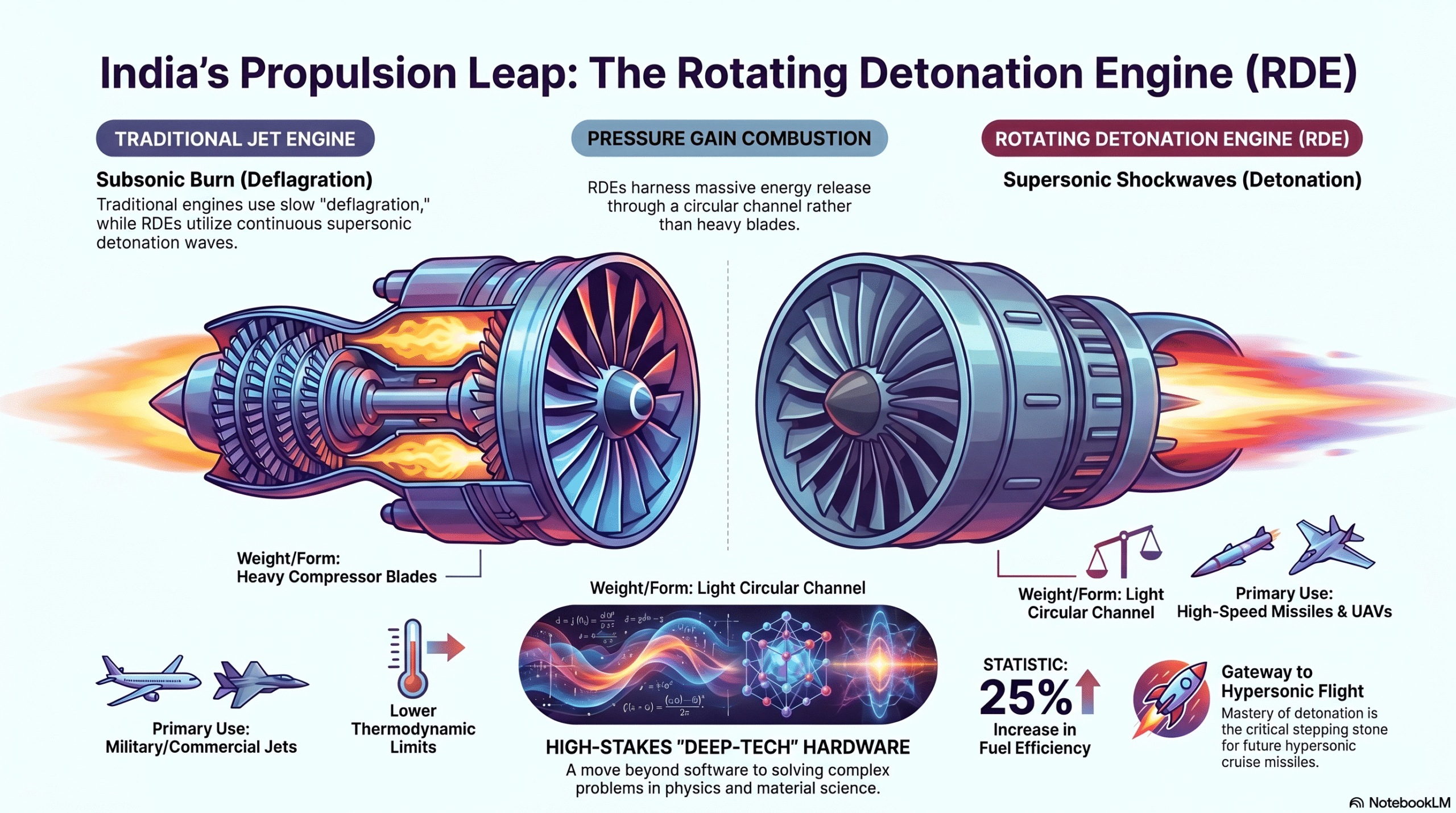
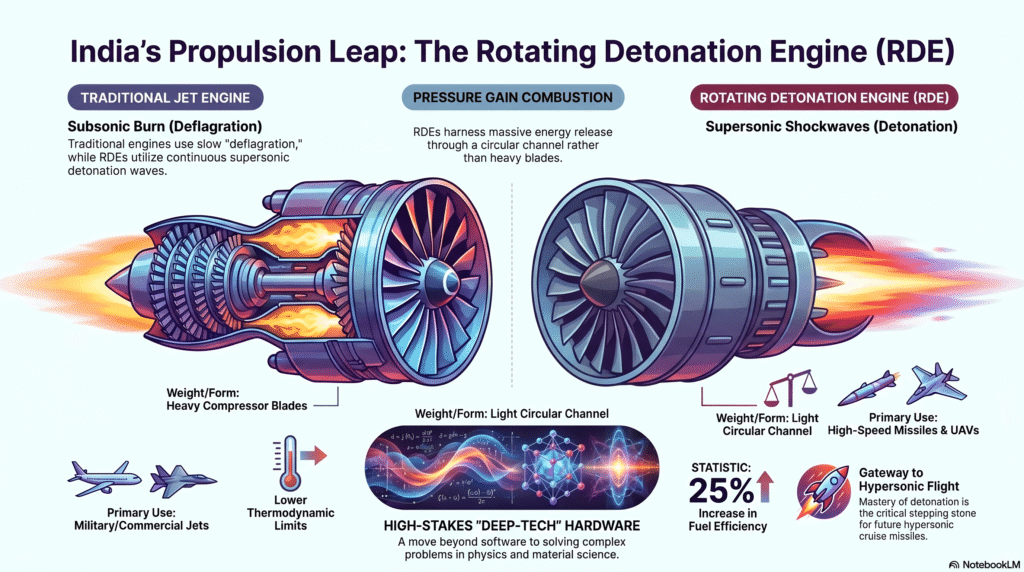
    In a standard jet engine, air is sucked in, compressed by heavy spinning blades, and mixed with fuel. The resulting burn is a relatively slow, controlled process called deflagration. It is constant and steady, much like a candle flame. While reliable, this method has reached its thermodynamic efficiency limits.

    2. The RDE Method: Detonation

    An RDE operates on an entirely different physical principle: detonation. Instead of a slow burn, it uses a supersonic shockwave that travels around a circular channel.

    • Supersonic Combustion: The shockwave slams into the fuel-air mixture, igniting it almost instantly.
    • Instant Energy Release: This process happens faster than the speed of sound, releasing massive amounts of energy with significantly more pressure and force than a standard engine.

    Strategic Impact: Why RDE is the Future of Indian Defense

    The development of a functional Rotating Detonation Engine by Deipro Pulse Aerospace has significant implications for India’s strategic autonomy and the Integrated Defence Staff (IDS) requirements.

    • Enhanced Fuel Efficiency: RDEs are theoretically 25% more efficient than traditional gas turbines, allowing for longer-range missions for missiles and drones.
    • Compact Power: Because they don’t require the massive, heavy compressor blades found in traditional jets, these engines can be smaller, lighter, and faster.
    • Hypersonic Potential: Mastery of detonation-based propulsion is a critical stepping stone toward reliable hypersonic cruise missiles and high-speed interceptors.

    Future Outlook: A New Era for Indian Startups

    The success of Deipro Pulse reflects a broader trend in the Indian Startup Ecosystem: the move toward “Deep Tech.” No longer content with just software or services, Indian entrepreneurs are now tackling the hardest problems in physics and material science. By moving from deflagration to detonation, India isn’t just catching up; it is attempting to leapfrog existing global standards.

    Key Takeaways & Summary

    FeatureTraditional Jet EngineRotating Detonation Engine (RDE)
    Combustion TypeDeflagration (Subsonic Burn)Detonation (Supersonic Burn)
    Key ComponentHeavy Compressor BladesCircular Detonation Channel
    EfficiencyLower (Thermodynamic Limits)Higher (Pressure Gain Combustion)
    Primary UseCommercial & Military JetsHigh-Speed Missiles & Future UAVs

    Frequently Asked Questions

    What is a Rotating Detonation Engine (RDE)?

    An RDE is a next-generation engine that uses a continuous supersonic detonation wave to burn fuel. This is much more powerful and efficient than the slow combustion process used in today’s aircraft.

    Who is building India’s first RDE?

    Deipro Pulse Aerospace, a startup co-founded by defense expert Saurav Jha, is currently leading the development of this technology in India.

    How is RDE different from a normal jet engine?

    A normal engine burns fuel slowly (deflagration), while an RDE uses a shockwave to explode the fuel-air mixture at supersonic speeds (detonation), creating more thrust with less fuel.

    Why is this important for India?

    It reduces dependence on foreign engine technology and provides the Indian military with more advanced, efficient, and faster propulsion systems for defense hardware.

    Related Articles

    Verified Industry References

  • Trump NATO Exit Strategy: The Secret Prelude to an Israel-Turkey War in 2026?

    Trump NATO Exit Strategy: The Secret Prelude to an Israel-Turkey War in 2026?

    Is the US leaving NATO to side with Israel against Turkey? Explore Trump’s NATO Exit Strategy, Joe Kent’s viral prediction, Trump’s “paper tiger” narrative, and the 2026 Syria flashpoint.

    Quick Take: The “Paper Tiger” and the New World Order

    The 2026 geopolitical landscape has been permanently altered by the US-led strikes on Iran. However, the most significant shift isn’t a new war, but the potential collapse of an old alliance. President Donald Trump’s recent description of NATO as a “paper tiger” following the Iran conflict has signalled a looming Trump NATO exit strategy.

    While many view this as mere isolationism, insiders suggest a deeper, more calculated agenda: removing the legal hurdles of the North Atlantic Treaty to prepare for an inevitable Israel-Turkey war in 2026.

    The Joe Kent Turkey Prediction: Why 105 Million People Listened

    The catalyst for this global conversation was the high-profile resignation of Joe Kent, the Trump-appointed Director of the National Counterterrorism Center (NCTC). Kent’s exit wasn’t just a policy disagreement; it was a whistleblower moment regarding the future of US-Turkey relations.

    The “Arsonist and Firefighter” Analogy

    In a viral statement seen by over 105 million people, Kent warned that the US is increasingly playing both arsonist and firefighter in the Middle East, igniting regional conflicts only to intervene as the “stabilizer.”

    • The Syria Flashpoint: Kent explicitly stated, “We’ll be leaving NATO so we can side with Israel when Turkey and Israel eventually clash in Syria.” * The Iran Catalyst: Having resigned over the “unnecessary” Iran war, Kent argues that the logic used to attack Tehran is now being repurposed for Ankara.

    Article 5 vs. Reality: Why Turkey is Being Isolated

    The core of the Trump NATO exit strategy lies in Article 5. Under current NATO rules, the US is legally bound to defend Turkey. However, as Turkey consolidates power in Northern Syria, it is increasingly coming into direct conflict with Israeli security objectives.

    “Turkey is the New Iran” Narrative

    On April 13, 2026, Turkish Foreign Minister Hakan Fidan warned that Israel is systematically attempting to “declare Turkey the new enemy” now that the Iranian threat has been diminished. This is no longer a fringe theory; it is becoming a state strategy.

    By withdrawing from NATO, the Trump administration would effectively strip Turkey of its Western security umbrella, allowing for a US-Israel joint axis to operate against Turkish interests in Syria without triggering a wider European conflict.

    Economic Fallout: Geopolitics and Your Portfolio

    The geopolitical impact on LPG prices in India and global stock markets has already been felt following the Iran strikes. A conflict involving Turkey, a vital energy and trade corridor, would be catastrophic for global stability.

    Economic SectorPredicted Impact of Turkey Conflict
    Energy MarketsMassive surge in LPG and Brent Crude prices.
    Indian StocksHigh volatility in logistics and manufacturing sectors.
    European DefenseShift toward an “EU-only” defense structure, excluding Turkey.

    Strategic Insights: The Road to 2027

    The Trump vs. Joe Kent controversy is more than a personal feud. Trump’s vitriolic response, mocking Kent’s personal life and labeling him a “sleazebag”, suggests that Kent’s insights into the US withdrawal from NATO and Syria have hit a sensitive nerve.

    We are moving toward a period where historical alliances are being traded for tactical partnerships. If the US exits NATO, Turkey will find itself isolated between a retreating Europe and an aggressive US-Israel alliance.

    Frequently Asked Questions

    What is the Trump NATO exit strategy?

    The strategy involves the US withdrawing from NATO to remove the legal obligation (Article 5) to defend Turkey, thereby allowing the US to support Israeli military objectives in the Middle East more freely.

    Why did Joe Kent resign from the NCTC?

    Joe Kent resigned in March 2026, stating he could not support the “unnecessary” war with Iran, which he claimed was driven by external pressure rather than an imminent threat to the US.

    Is an Israel-Turkey war in 2026 actually possible?

    According to Turkish Foreign Minister Hakan Fidan, Israel is actively framing Turkey as its next primary adversary. Analysts point to Syria as the most likely location for a confrontation.

    How does the US withdrawal from NATO affect India?

    A US exit would destabilize global security, leading to market volatility and a significant impact on LPG prices in India, as Turkey is a major hub for regional energy transit.

    Related Reads

  • BLA Naval Attack Jiwani 2026: The Saudi-Pakistan SMDA Activation and UAE Debt Crisis Explained

    BLA Naval Attack Jiwani 2026: The Saudi-Pakistan SMDA Activation and UAE Debt Crisis Explained

    “Discover why the BLA’s first maritime strike in Jiwani and the 13,000-troop Saudi-Pakistan SMDA deployment are pushing Pakistan to a breaking point in April 2026.

    Key Highlights

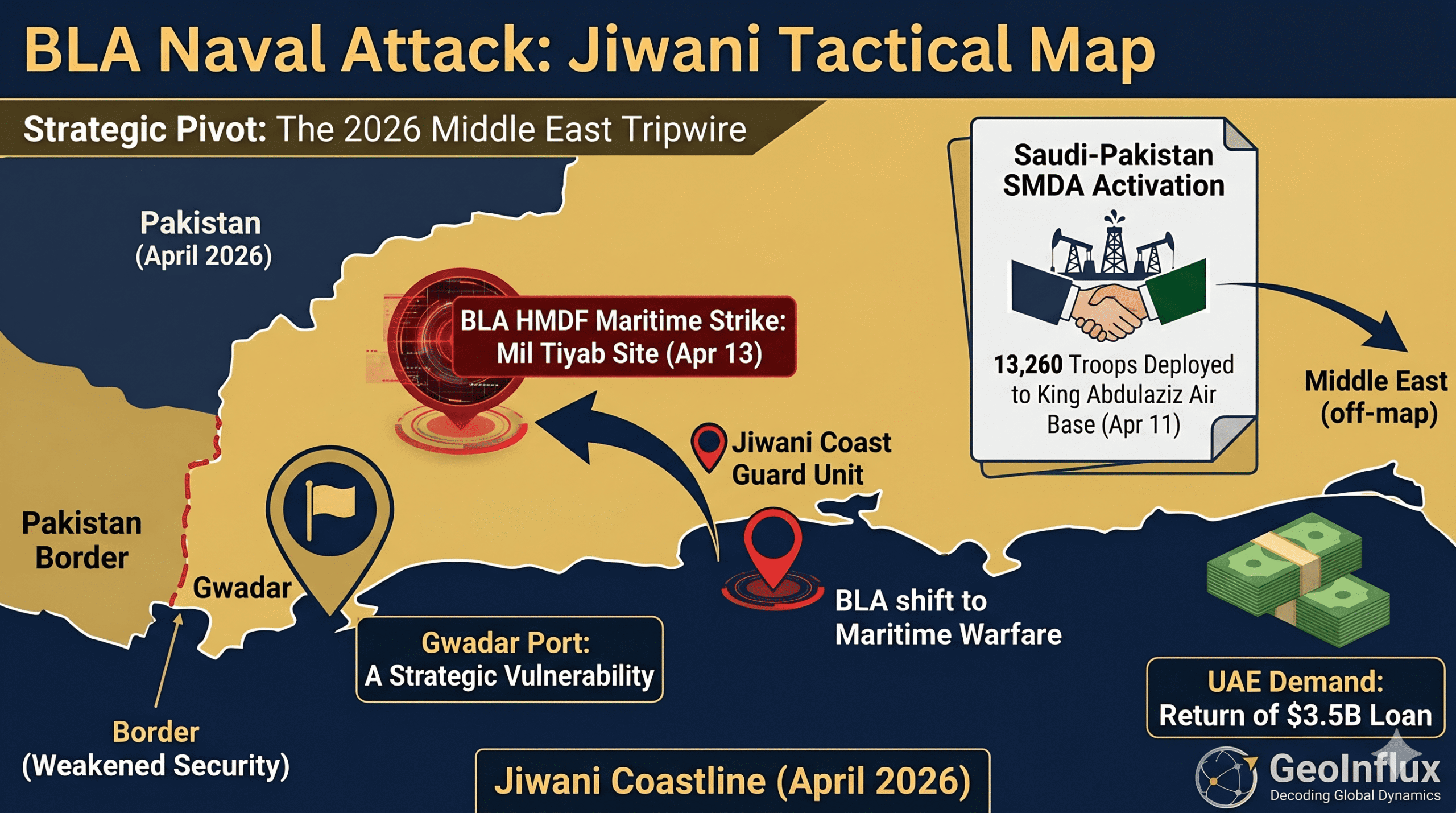
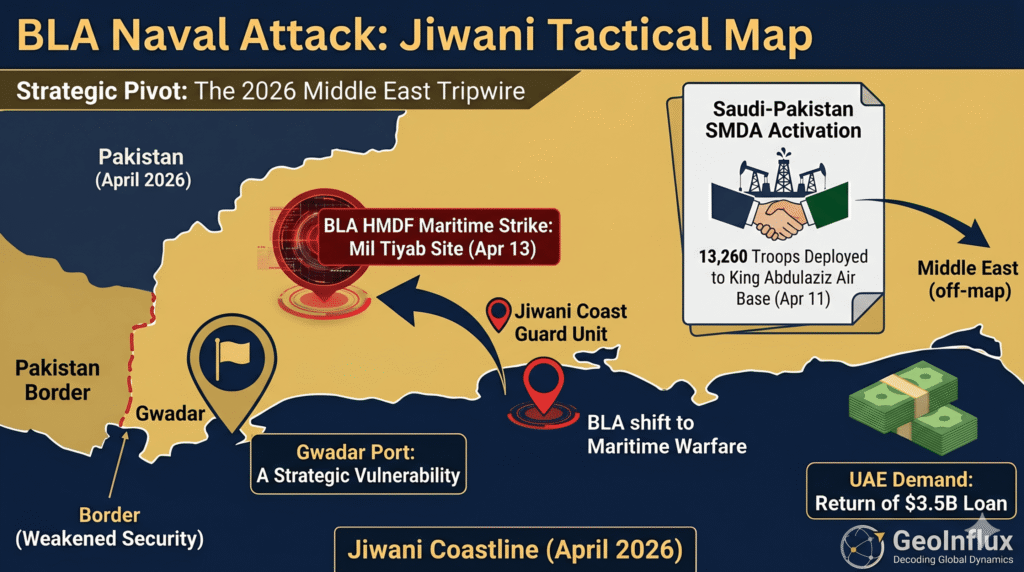
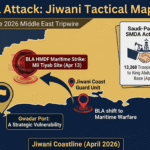
    The regional security architecture of South Asia shifted dramatically on April 13, 2026. While the world’s attention was fixed on the failing U.S.-Iran talks in Islamabad, the Baloch Liberation Army (BLA) executed its first-ever successful naval operation at the “Mil Tiyab” site near the Jiwani coast. This isn’t just a local skirmish; it is a signal that Pakistan’s internal stability is collapsing at the exact moment its external military commitments are expanding to the Gulf.

    BLA’s First Naval Attack: The HMDF Factor

    On April 14, the BLA’s media wing, Hakkal, officially announced the creation of the Hammal Maritime Defence Force (HMDF).

    • The Operation: At 10:00 AM on April 13, BLA commandos targeted a Pakistan Coast Guard patrol boat near the Iran-Pakistan maritime boundary, killing three personnel.
    • The Shift: Historically, Baloch insurgents focused on land-based ambushes. By moving to Maritime Hybrid Warfare, the BLA is now targeting the “Blue Economy” and the maritime security of the CPEC corridor.
    • Strategic Impact: This forces the Pakistan Navy to divert critical assets from the Indian border to patrol the fragile Jiwani-Gwadar coastline.

    Saudi-Pakistan SMDA: The Largest Deployment in 35 Years

    A major development we are tracking at GeoInflux is the activation of the Strategic Mutual Defence Agreement (SMDA).

    • The Deployment: On April 11, 2026, Pakistan deployed 13,260 ground troops and a squadron of JF-17 Thunder Block III fighters to King Abdulaziz Air Base in Saudi Arabia.
    • The Tripwire: This is the largest Pakistani deployment since the 1991 Gulf War. Stationed just 40km from the Iran-targeted Ras Tanura oil terminal, these troops now act as a “tripwire.” Any Iranian strike on the base would legally trigger a full-scale Pakistani military response.

    New Posts

    India’s Rotating Detonation Engines Breakthrough: Is This the End of Jet Engines?

    Rotating Detonation Engines Breakthrough: Discover how Deipro Pulse Aerospace is building India’s first Rotating Detonation Engine (RDE), a supersonic propulsion …

    Financial Geopolitics: The UAE’s $3.5 Billion “Pressure Play”

    Economic sovereignty in Islamabad is currently under siege from the Gulf.

    • UAE’s Demand: In a surprising move, the UAE has demanded the immediate return of $3.5 billion in loans by April 23, 2026.
    • The Strategic Game: While the UAE creates the “pressure,” Saudi Arabia and Qatar have stepped in with a $5 billion support package.
    • GeoInflux Analysis: This appears to be a coordinated “Pay-to-Play” strategy. The Gulf states are providing financial lifelines in exchange for Pakistan’s military presence under the SMDA.

    The “Islamabad Impasse”: Why Diplomacy Failed

    The 21-hour marathon talks in Islamabad between U.S. Vice President JD Vance and Iran’s Mohammad Bagher Ghalibaf collapsed on April 12, 2026.

    • The Sticking Point: The U.S. demanded a rollback of Iran’s nuclear program and control over 440kg of enriched Uranium. Iran demanded sovereignty (Digital Sovereignty and National Security in 2026.) over the Strait of Hormuz tolls and the unfreezing of $120 billion in assets.
    • The Security Failure: Despite the “Blue Book Protocol” (Pakistan’s high-level VIP security manual), delegates reported a deep “trust deficit.” The atmosphere was further chilled when President Trump threatened a full blockade of the Strait of Hormuz immediately following the collapse.

    Strategic Summary Table: Pakistan’s April 2026 Crisis

    FrontKey EventStrategic Consequence
    InternalBLA Maritime Strike (Jiwani)Threat to CPEC & Gwadar’s “Safe Port” status
    ExternalSMDA Activation (13,260 Troops)Risk of direct war with Iran to protect Saudi oil
    Economic$3.5B UAE Debt RepaymentTotal loss of financial autonomy to Riyadh
    DiplomaticIslamabad Talks CollapseFailure of Pakistan’s role as a regional mediator

    Conclusion: A Year of Convergence

    The year 2026 is a historical convergence point. Pakistan is facing a “Triple Threat”: a new maritime insurgency, a liquidity trap set by the UAE, and a military commitment that could force it into a conflict with its neighbour, Iran.

    For India, this chaos signifies a shift in the IMEC corridor vs. CPEC rivalry. As Pakistan struggles with coastal security, the reliability of Gwadar is being eclipsed by the stability of alternate routes.

    Stay tuned to GeoInflux as we continue to decode these global dynamics.

    Related Reads

    References

    Latest post

  • The Global AI Race 2026: WhyAI Sovereignty is the New Oil

    The Global AI Race 2026: WhyAI Sovereignty is the New Oil

    The Global AI Race 2026: In today’s era of Artificial Intelligence, where the world is battling for AI Sovereignty to win the Global AI Race, the US and China battle for GPU dominance, while India’s “Third Way” strategy is redefining the Global AI Race. Explore why AI Sovereignty is the definitive resource of 2026.

    Quick Take: The Shift to Algorithmic Autonomy

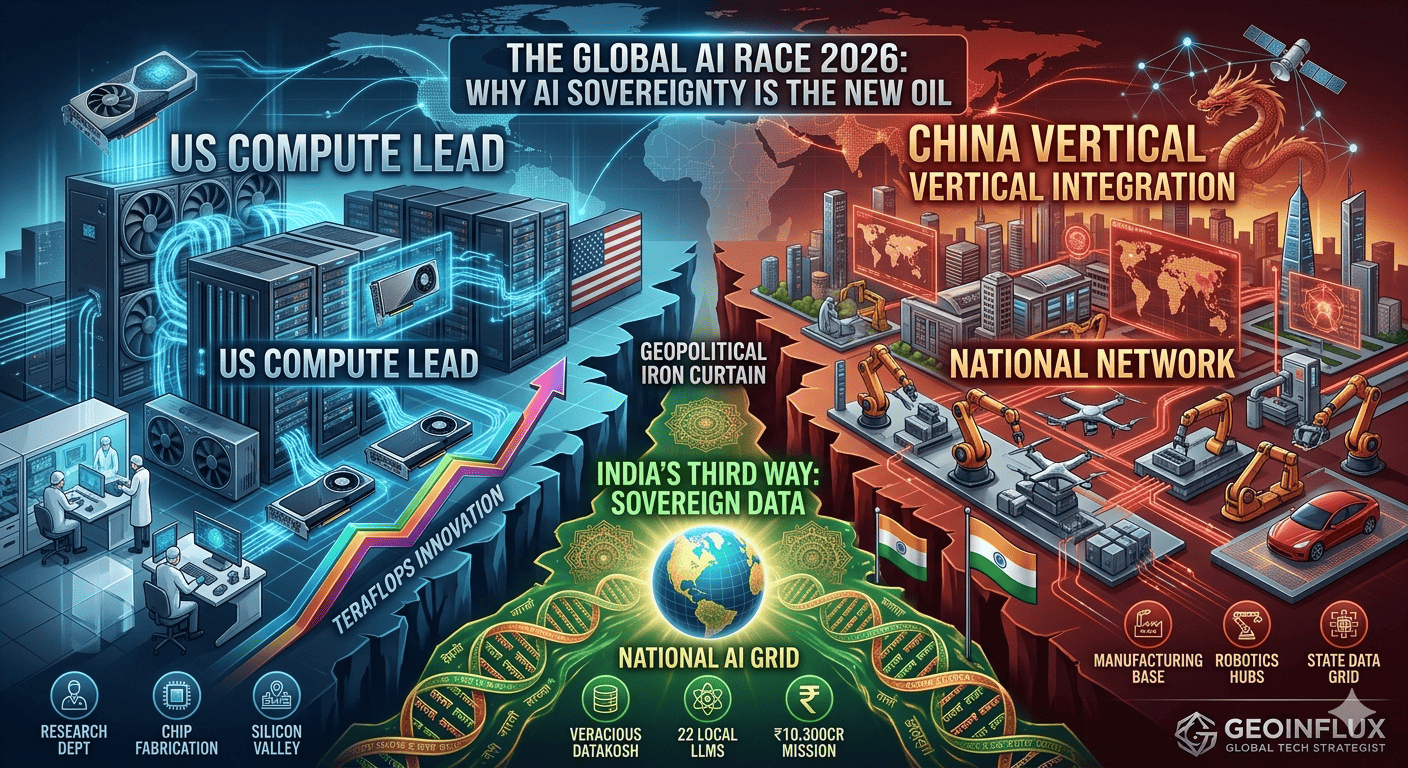
    The Global AI Race has shifted from a corporate competition into a high-stakes geopolitical arms race. In 2026, “AI Sovereignty” is the primary goal for world powers. Nations are no longer content with using foreign-hosted models; they are racing to build sovereign Large Language Models (LLMs) trained on local data and powered by domestic GPU clusters.

    Also Read: AI Geopolitics: Is AI Reshaping Global Power in 2025? 5 Shocking Global AI Power Shift That Changed Everything

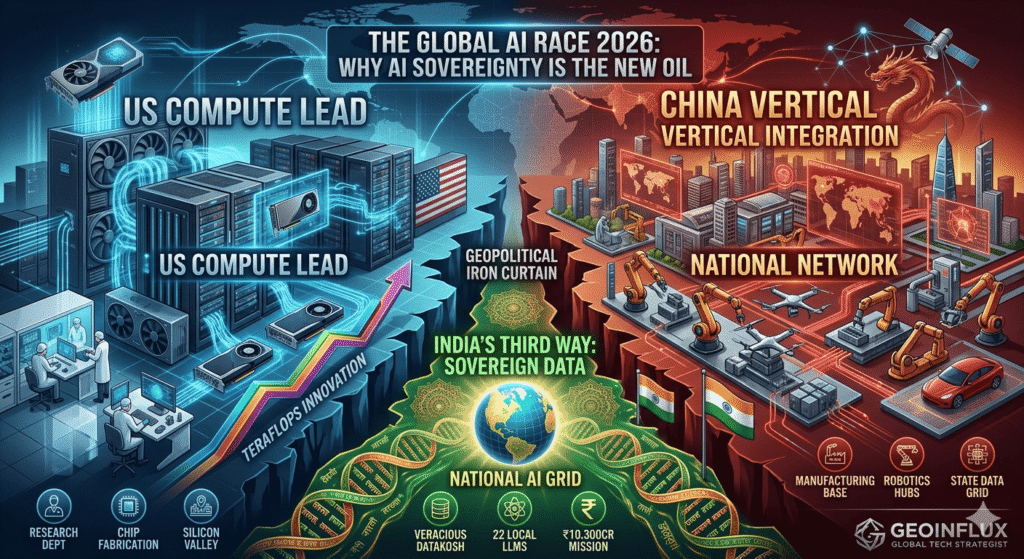
    While the US maintains a lead in raw compute power through Silicon Valley, China’s vertical integration and India’s “Data Dividend”, fueled by the India AI Mission, are rapidly closing the gap. This isn’t just about economic growth; it’s about who controls the algorithms that govern national defence, global finance, and digital identity.

    Countries without their own AI stack risk becoming “digital colonies” in an era where data is the fuel and compute is the refinery.

    The Three Pillars of the 2026 AI Race

    To understand the current power balance, we must examine the three pillars of modern national strength:

    • Compute Sovereignty: The hunt for H100S and next-gen Blackwell chips. In 2026, national power is measured in Exaflops.
    • Data Protectionism: Nations are “fencing off” their citizens’ data. This prevents foreign AI from training on unique cultural and behavioural datasets, ensuring that domestic models remain the most accurate for local use.
    • Algorithmic Diplomacy: This is the use of AI exports and “Model-as-a-Service” as a tool for international influence. Much like oil in the 20th century, AI is now the primary lever for securing trade deals and military alliances.

    US vs. China: The Compute Iron Curtain

    The divide between Western and Eastern AI ecosystems is now a permanent fixture of 2026.

    • The Silicon Shield: Strict export controls on high-end chips have forced China to pivot entirely to domestic silicon, with Huawei and Baidu leading the way. This has created a “bifurcated internet” where Western and Chinese models rarely interact.
    • The Innovation Lead: While the US dominates the “frontier” of general AI research, China is winning in vertical integration, embedding AI into the physical world through robotics, smart cities, and a fully automated manufacturing supply chain.

    India’s Role: From Service Hub to Sovereign Power

    India is no longer just the world’s back office; it has become a Sovereign AI Power.

    • The India AI Mission: With a budget of over ₹10,300 crore, the mission has successfully onboarded over 38,000 GPUs available at a subsidized rate of just ₹65 per hour. This has democratized access for startups that were previously priced out of the race.
    • Vernacular AI Mastery: While Western models struggle with cultural nuance, India is building Sovereign LLMs in 22 regional languages. These models are trained on AIKosh, a national dataset platform with over 5,500 datasets across 20 sectors.
    • India AI Impact Summit 2026: Held in New Delhi, this summit saw 91 countries sign the New Delhi Declaration, shifting the global conversation from AI “risk” to AI “impact” and developmental priorities for the Global South.

    The Rise of “Sovereign Clouds”

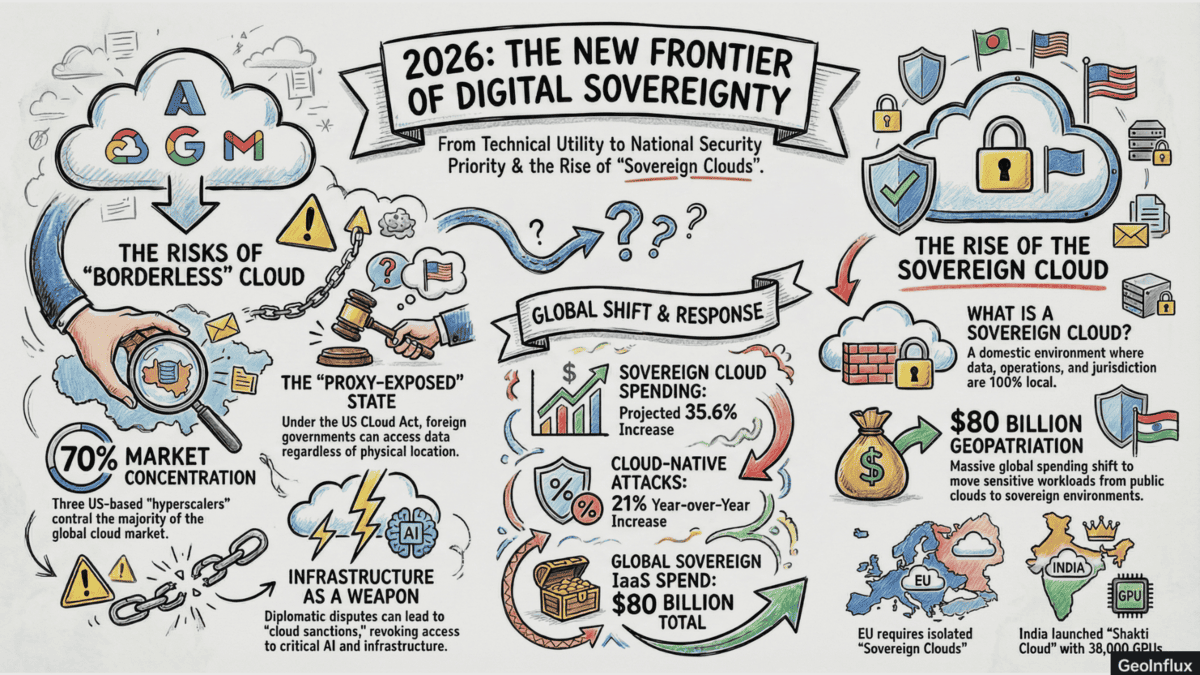
    In 2026, the public cloud will no longer be enough. The “Year of Truth for AI” has pushed organizations toward Cloud 3.0, a mix of hybrid and sovereign cloud architectures.

    • Why it matters: Sensitive government and healthcare data can no longer reside on servers controlled by foreign entities.
    • Impact: Companies like Google and Microsoft are now building specialized “Sovereign Hubs” (like Google’s new $15 billion AI hub in Visakhapatnam) to comply with local data residency laws while still providing world-class compute.

    Strategic Insight: The “Digital Colony” Risk

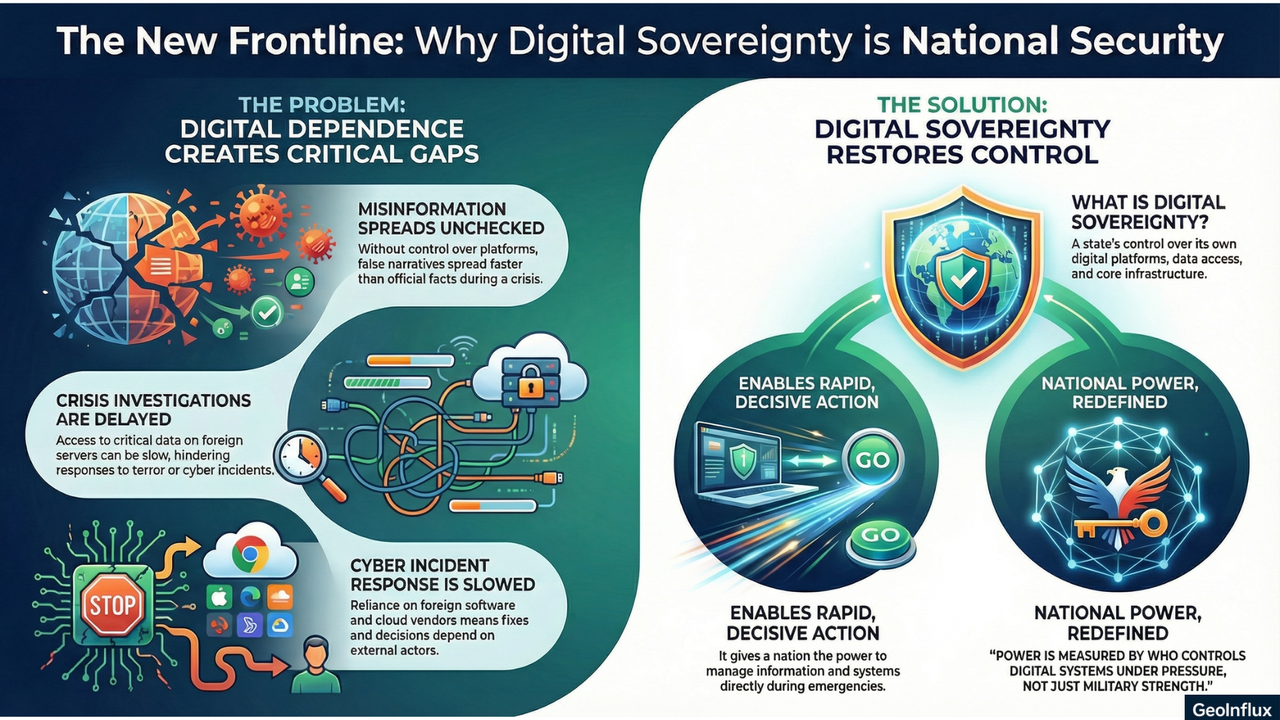
    The strategic implication of 2026 is clear: Resilient Interdependence. No country can be entirely self-sufficient in AI, but those who do not own their core “stack”, the hardware, the data, and the model, will become digital colonies. They will be forced to rent intelligence from foreign powers, leading to a loss of strategic autonomy in everything from economic forecasting to cybersecurity.

    The Global AI Power Balance 2026

    Nation/RegionCore StrengthKey Challenge2026 Strategy
    USAFrontier Research & HardwareHigh Energy Costs / RegulationMaintaining the “Compute Lead”
    ChinaVertical Integration / RoboticsChip Sanctions / Data AccessOpen-Source Influence & Domestic Silicon
    IndiaData Dividend & Talent PoolInfrastructure ScalabilityIndia AI Mission / Vernacular Models
    EUPrivacy & RegulationLack of Frontier Tech Hubs“The Brussels Effect” / AI Defense

    What This Means for Businesses and Leaders

    1. Prioritize Local Context: If you are operating in India, a model trained on Silicon Valley data will not understand the nuances of the “Bharat” consumer.
    2. Audit Your Stack: Know where your AI models are hosted. If your critical business logic is on a foreign-owned sovereign cloud, you are exposed to geopolitical risk.
    3. Invest in “AI for Social Good”: As highlighted in the India AI Impact Summit, the most successful AI applications in 2026 are those solving real-world problems in agriculture, healthcare, and education.

    FAQs

    Who is winning the Global AI Race in 2026?

    The US leads in raw hardware and research, but India is emerging as the leader of the Global South’s AI movement, focusing on democratic and inclusive access to compute.

    What is AI Sovereignty?

    It is a nation’s ability to build, host, and govern its own AI models and infrastructure without being dependent on foreign technology for critical operations.

    How does the India AI Mission help startups?

    It provides high-end GPUs at subsidized rates (₹65/hour), offers access to the AIKosh dataset platform, and provides financial support through the IndiaAI Startup Financing pillar.

    What is the “New Delhi Declaration”?

    A 2026 agreement signed by over 90 countries that emphasizes human-centric AI, trust, and developmental impact over pure risk-based regulation.

    Related Articles

    Featured Sources & Citations:

    End Note: In 2026, the race is no longer about who has the fastest AI, but who owns the AI they use. Stay ahead with GeoInflux.

    Author: Kushan Kislay Published: April 5, 2026

    Thanks Note: Stay informed, stay ahead.

  • India AI Mission: Will India Lose 2 Million Tech Jobs or Create 4 Million New Ones by 2031? AI Tech Workforce Future Explained

    India AI Mission: Will India Lose 2 Million Tech Jobs or Create 4 Million New Ones by 2031? AI Tech Workforce Future Explained

    India AI Mission: The Indian government has recently released a report by NITI Aayog, along with NASSCOM and BCG. This report reveals the AI jobs crisis, talent gap, and India AI Mission shaping the future workforce.

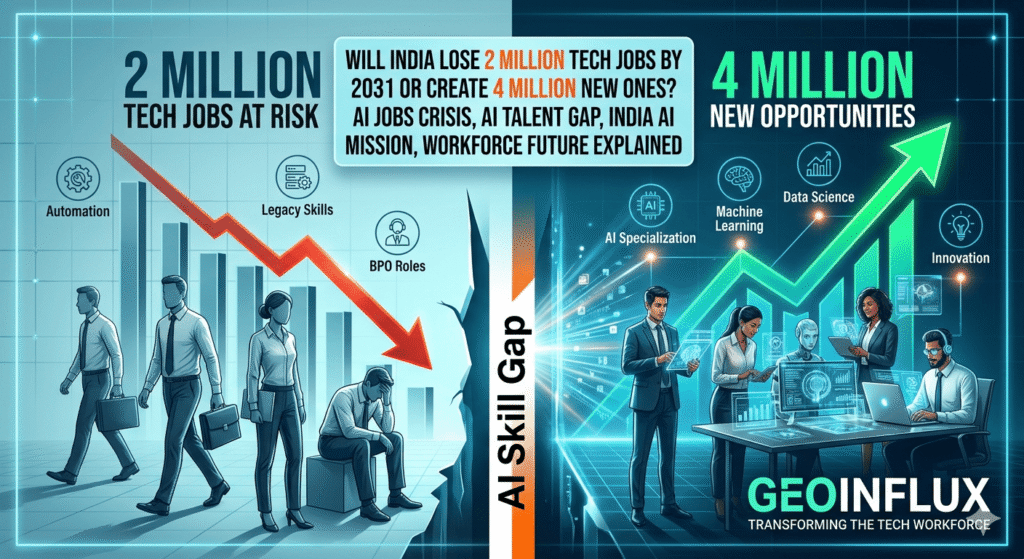
    The CEO of NITI Aayog stated that India’s tech sector could lose up to 2 million jobs by 2031. But the same report says 4 million new jobs will be created.

    Both are happening at the same time, but how? Let’s have a look

    India AI Mission: The Great Tech Transition

    India’s tech sector is entering a major transition. A joint report by NITI Aayog, NASSCOM, and BCG warns that up to 2 million tech jobs could disappear by 2031 due to AI automation. At the same time, 4 million new roles are expected to emerge, driven by enterprise AI adoption, Global Capability Centers (GCCs), and the India AI Mission.

    The real issue is not a lack of roles, but the widening AI talent gap, where demand is drastically outpacing skilled workers. Currently, India faces a ratio of only one qualified candidate for every two AI job openings. Emerging technologies like real-time accent neutralization are also shifting global service roles toward India, turning historical disadvantages into competitive edges.

    The outcome, whether the workforce shrinks to 6 million or expands to 12 million, depends entirely on the speed of adaptation by individuals and policymakers.

    AI Talent Gap: Transformation, Not Just Crisis

    India is not just facing an AI job crisis and tech jobs; it is entering a profound job transformation phase. While headlines focus on the 2 million roles at risk of disappearing by 2031, they often overlook the 4 million new opportunities on the horizon.

    The disruption is real, but the narrative is shifting from “replacement” to “evolution”. The fundamental question for the Indian techie is no longer “Will I have a job?” but “Will I be the one ready for the jobs being created?”

    Why Could India Lose 2 Million Tech Jobs by 2031?

    The threat to 2 million roles stems from the efficiency of Generative AI.

    • Automation of Routine: Tasks in software development, such as boilerplate coding and basic unit testing, are now handled by AI agents in seconds.
    • Productivity Gains: As AI tools allow a single developer to do the work of three, companies are seeing massive productivity gains, which naturally leads to smaller team sizes for the same output.
    • Silent Layoffs: We are seeing “hiring freezes” rather than mass visible layoffs. Companies are simply not replacing the 20-30% of staff that leave through natural attrition, opting instead for AI-driven workflows.

    Which Tech Jobs Are Most at Risk from AI in India?

    Certain sectors are on the “front lines” of this automation wave:

    • QA Testing: Manual and basic automated testing roles are being rapidly replaced by AI that can predict bugs and write test scripts.
    • Customer Support & Help Desks: Level 1 support is almost entirely migratable to advanced AI chatbots that handle intent and emotion.
    • Entry-Level Coding: Basic HTML/CSS and repetitive backend tasks are now low-hanging fruit for Large Language Models (LLMs).
    • BPO Workflows: Data entry and simple transcription are becoming obsolete as AI achieves near-perfect accuracy in these domains.

    How Is AI Increasing Productivity and Reducing Hiring Needs?

    The numbers tell a compelling story of efficiency. Industry data suggests an overall productivity boost of 10–20% across the board. However, in simpler workflows like documentation or basic bug fixing, that boost jumps to 50–60%. This means projects that once required a six-month cycle are being completed in three, allowing firms to scale without increasing their headcount.

    What Is the Hidden Opportunity in the AI Jobs Crisis in India?

    The “India Advantage” is evolving. Technologies like real-time accent neutralization are a game-changer. Previously, certain high-end global consulting or sales roles stayed in the West due to linguistic nuances. Now, AI can neutralize accents in real-time, allowing Indian professionals to compete for any global role. We are witnessing the rise of Outsourcing 2.0, where India’s “weaknesses” in global communication are being solved by software.

    Why Is There an AI Talent Gap in India Despite High Demand?

    Despite being a “coding superpower,” India has a massive skill mismatch:

    • The 1:2 Ratio: There is only one qualified worker for every two AI jobs posted.
    • Education Lag: India produces fewer than 500 AI-specific PhDs annually, a drop in the bucket compared to global competitors.
    • Academic Mismatch: Traditional engineering curriculums are often 2–3 years behind the current pace of GenAI development.

    What Challenges Could Slow Down India’s AI Growth?

    • Brain Drain: Approximately 44% of top-tier AI researchers from India currently work abroad.
    • Infrastructure Gaps: High-quality AI requires massive GPU clusters, which India is only now starting to build at scale.
    • Policy Speed: While the “India AI Mission” is ambitious, the execution speed of regional digital policies often lags behind private sector innovation.

    How Is India Positioning Itself in the Global AI Race?

    India is becoming the “Back Office of the AI World” through Global Capability Centers (GCCs). Over 1,600 GCCs now operate in India, with 70% prioritizing AI hiring in 2026. The upcoming AI Impact Summit 2026 is expected to showcase India’s move from using foreign models to building “Sovereign AI” tailored to Indian languages and datasets.

    What Are the New Job Categories Created by AI in India?

    The 4 million new jobs will likely fall into three buckets:

    1. Enterprise AI Roles: Professionals who implement and manage AI within traditional businesses.
    2. Frontier AI Roles: Advanced roles focusing on AI integration with hardware, IoT, and edge computing.
    3. AI for AI: Researchers and engineers building the actual models, focusing on data labeling, RLHF (Reinforcement Learning from Human Feedback), and model fine-tuning.

    Why Are Freshers Better Positioned Than Experienced Professionals?

    In the AI era, “unlearning” is harder than “learning.” Fresh graduates often have a faster learning curve and zero “legacy bias.” They treat AI tools as standard equipment rather than a threat. While an experienced professional might resist a new AI workflow that replaces their 10-year-old process, a fresher adopts it in hours, making them highly cost-effective and adaptable.

    What Does the India AI Mission Plan to Do?

    The government-backed India AI Mission aims to:

    • Mainstream AI education in Tier 2 and Tier 3 cities.
    • Establish a National AI Computing Grid with thousands of GPUs.
    • Provide funding for AI startups that solve “India-scale” problems (agriculture, healthcare, vernacular languages).

    What Are the Two Possible Futures for India’s Tech Workforce?

    • Scenario 1 (Stagnation): If reskilling fails, the workforce could shrink to 6 million as automation eats the base-level jobs.
    • Scenario 2 (Evolution): If India masters the AI talent gap, the workforce could swell to 10–12 million, making India the indispensable engine of the global AI economy.

    How Much of India’s Economy Is Actually at Risk from AI?

    It is important to keep perspective. The tech sector accounts for roughly 12% of India’s GDP. While this is a massive chunk, 88% of the economy—including construction, traditional agriculture, and localized services is far less susceptible to immediate AI disruption. This provides a built-in economic safety net.

    What Should You Do Right Now to Stay Relevant?

    • Daily Integration: Use at least one AI tool (like ChatGPT, Claude, or GitHub Copilot) in your daily tasks today.
    • The 2-Hour Rule: Dedicate 2 hours every week strictly to learning a new AI workflow.
    • Build Publicly: Don’t just learn; build a small AI-driven project and share it on LinkedIn or GitHub.

    Strategic Insight: Is This an AI Job Crisis or a Skill Crisis?

    Jobs are not disappearing; outdated skills are. The speed of adaptation is the only differentiator that matters in 2026. India’s demographic dividend is only an advantage if those millions of people are skilled. Without reskilling, a large population becomes a liability; with it, it becomes the world’s greatest asset.

    The Future of Tech Jobs in India

    FactorRiskOpportunity
    Automation2M roles at risk in QA/Support50%+ productivity boost for creators
    AI AdoptionMassive 1:2 talent gap4M new roles in Enterprise & Frontier AI
    Global ShiftHigh competition from AI-first nationsOutsourcing 2.0 via accent/language tech
    PolicyPotential for slow executionIndia AI Mission providing GPU/funding

    Frequently Asked Questions (FAQs)

    1. What is the India AI Mission?

      It is a government initiative designed to build sovereign AI infrastructure, provide GPU access to startups, and catalyze AI education across the country.

    2. Will AI replace jobs in India by 2031?

      AI will automate specific tasks, leading to the displacement of roughly 2 million roles, but it is expected to create 4 million new roles that require AI-collaboration skills.

    3. Which tech jobs are safe from AI?

      Roles requiring high-level strategic thinking, complex human empathy, and “Frontier AI” development (building the AI itself) are currently the safest.

    Related Articles

    End Note: India is not losing jobs. It is redefining them. The real divide will not be between industries, but between people who adapt and those who wait.

    Author: Kushan Kislay

    Published: April 5, 2026

    Source: NITI Aayog, NASSCOM, BCG Industry Report 2026

  • AI Latest News April 2026: AI Infrastructure Race, Agentic AI Systems, AI Chip Competition Explained

    AI Latest News April 2026: AI Infrastructure Race, Agentic AI Systems, AI Chip Competition Explained

    AI Latest News April 2026: OpenAI kills Sora, Google redefines video AI, Mistral bets $830M on infrastructure, and the AI chip war explodes.

    Quick Take

    AI Latest News April 2026 shows a major shift in the industry. The focus is moving beyond models to the AI infrastructure race, AI chip competition, and the rise of agentic AI systems. Mistral AI is investing heavily in compute with a massive GPU supercluster powered by Nvidia.

    At the same time, Google is scaling AI video generation tools 2026 with Veo 3 on Vertex AI. OpenAI has shut down Sora to focus on agentic AI systems explained through GPT-5.4. Meanwhile, ScaleOps is solving cost challenges, and Rebellions is pushing new competition in AI chips.

    The message is simple. AI power now depends on compute, cost, and execution.

    What Happened in AI Today April 2026?

    • Mistral AI accelerates the AI infrastructure race with an $830M supercluster
      Mistral AI is building a Europe AI supercluster using Nvidia GB300 GPUs. This reduces reliance on US cloud providers and strengthens regional AI control. The AI infrastructure race is now tied directly to national strategy.
    • Google Veo 3 pushes AI video generation tools into production in 2026
      Google launched Veo 3 on Vertex AI, enabling real-time AI video creation with audio integration. This shifts content creation from manual workflows to automated pipelines powered by AI video generation.
    • OpenAI shifts to agentic AI systems, explained by shutting Sora
      OpenAI discontinued Sora to focus on GPT-5.4 and agent-based systems. This shows a transition from tools to systems that can act, decide, and execute tasks.
    • ScaleOps reduces AI cloud cost by 40% in the infrastructure race
      ScaleOps raised $130M to optimize GPU usage. Its platform improves efficiency and reduces waste, making large-scale AI deployments more sustainable.
    • Rebellions drives AI chip competition Nvidia vs startups narrative
      Rebellions reached a $2.3B valuation with inference chips built on 3nm architecture. This strengthens the AI chip competition Nvidia vs startups, dynamic.

    How Is Mistral AI Reshaping the AI Infrastructure Race 2026?

    Mistral AI
    Mistral AI Reshaping the AI Infrastructure Race 2026?

    Mistral AI is taking a major step in the AI infrastructure race 2026 by building one of the largest AI training clusters in Europe. With $830M in funding and thousands of GPUs from Nvidia, the company is focusing on raw compute power.

    This move reflects a deeper shift. AI development is no longer just about algorithms. It depends on access to large-scale infrastructure. Without compute, even the best models cannot compete. This is why companies and governments are investing heavily in data centers and GPU clusters.

    For Europe, this is about sovereignty. Relying on US hyperscalers creates dependency risks. By building its own infrastructure, Europe can control data, innovation, and economic outcomes. This aligns with the broader trend where AI infrastructure is treated as a strategic national asset.

    The AI infrastructure race is now global. Countries are competing to build the fastest, largest, and most efficient compute systems. This competition will define who leads in AI over the next decade.

    How Are AI Video Generation Tools 2026 Evolving with Google Veo 3?

    AI Video Generation Tools 2026
    Google Veo 3
    Google Veo 3 vs Midjourney

    Google is pushing AI video generation tools 2026 into real-world applications with Veo 3. Available through Vertex AI, this model allows developers to generate high-quality videos using simple prompts.

    The key shift is speed and accessibility. Traditional video production is slow and resource-heavy. AI video generation reduces this complexity. Users can create, edit, and refine content in real time. The addition of Lyria 3 audio makes outputs more realistic and usable.

    This has major implications for industries like marketing, education, and entertainment. Businesses can produce content at scale without large teams. Creators can experiment and iterate faster.

    From a strategic perspective, Google is positioning itself as a leader in creative AI. AI video generation is becoming a core capability, not a niche feature. This will likely disrupt traditional media workflows and redefine how content is produced.

    Why Are Agentic AI Systems Explained Through OpenAI’s Strategy Shift?

    Agentic AI Systems
    Agentic AI Systems Explained
    Manus AI Agent Task Execution Process

    OpenAI has made a clear pivot toward agentic AI systems explained through real-world applications. By shutting down Sora, the company is focusing on building systems that can act independently.

    Agentic AI systems are different from traditional tools. Instead of generating outputs, they can complete tasks. They can plan actions, execute workflows, and adapt based on results. This makes them more useful for businesses that need automation.

    GPT-5.4 is expected to combine reasoning, memory, and action into a single system. This will allow AI to handle complex tasks across domains. For example, an agent could research a topic, generate content, and publish it without human intervention.

    This shift reflects a broader industry trend. AI is moving from being reactive to proactive. Companies are building systems that deliver outcomes, not just responses. Agentic AI systems are likely to become the foundation of future AI platforms.

    How Is ScaleOps Solving Cost Challenges in the AI Infrastructure Race?

    ScaleOps
    5 Layers of AI cost optimisation
    ScaleOps Solving Cost Challenges in the AI Infrastructure Race?

    ScaleOps is addressing one of the biggest issues in the AI infrastructure race, cost. As companies invest in large GPU clusters, managing these resources efficiently becomes critical.

    ScaleOps provides tools to automate scaling and optimize GPU usage. This ensures that compute resources are not wasted. By improving efficiency, the platform can reduce cloud costs by up to 40%.

    This is important because AI is expensive. Training and running large models requires significant resources. Without optimization, costs can quickly become unsustainable. Solutions like ScaleOps make AI more accessible and scalable.

    The strategic takeaway is clear. The AI infrastructure race is not just about building bigger systems. It is about using them efficiently. Cost optimization is becoming a key factor in determining which companies succeed.

    How Is AI Chip Competition Nvidia vs Startups Evolving with Rebellions?

    AI Chip Competition Nvidia vs Startups
    AI Chip Competition Nvidia vs Startups Evolving with Rebellions
    AI Chip Competition deep learning

    Rebellions is intensifying the AI chip competition Nvidia vs startups narrative. With a valuation of $2.3B and strong funding, the company is focusing on inference chips.

    Inference is where models are used in real-world applications. This requires efficiency and scalability. While Nvidia dominates training, startups like Rebellions are targeting deployment.

    The use of 3nm architecture improves performance and reduces power consumption. This is critical for data centers that need to handle large workloads efficiently.

    The AI chip competition is becoming more specialized. Instead of one dominant player, we are seeing multiple companies focusing on different parts of the AI stack. This diversification will shape the future of AI hardware.

    What Trends Define AI Latest News April 2026?

    • AI infrastructure race is becoming the core battleground
      Countries and companies are investing heavily in compute. Control over GPUs and data centers is becoming a strategic advantage in global AI competition.
    • Agentic AI systems are replacing standalone tools
      AI is shifting toward systems that can act independently. This changes how businesses use AI, focusing on outcomes rather than outputs.
    • AI video generation tools 2026 are entering production scale
      Tools like Veo 3 are making video creation faster and cheaper. This is transforming content creation across industries.
    • AI chip competition Nvidia vs startups is intensifying
      New players are entering the market with specialized chips. This is breaking the dominance of a single provider and increasing innovation.
    • Cost optimization is becoming critical in the AI infrastructure race
      Efficient use of resources is now as important as having access to them. Companies that manage costs better will have a competitive edge.

    Quick Summary Table

    TopicUpdateImpact
    Mistral AI$830M superclusterAI infrastructure race
    Google Veo 3Global rolloutAI video generation
    OpenAI SoraShutdownAgentic AI systems
    ScaleOps$130M fundingCost optimization
    Rebellions$2.3B valuationAI chip competition

    FAQs

    What is the biggest trend in AI Latest News April 2026?

    The biggest trend is the AI infrastructure race. Companies are focusing on building and controlling compute resources like GPUs and data centers. This shift shows that infrastructure is becoming more important than models.

    What are agentic AI systems explained simply?

    Agentic AI systems are AI systems that can act independently. They can plan tasks, make decisions, and execute actions without constant human input, making them more useful for automation.

    Why are AI video generation tools 2026 growing fast?

    AI video generation tools are improving in quality and speed. They allow users to create high-quality content quickly, reducing costs and increasing accessibility.

    What is driving AI chip competition Nvidia vs startups?

    Different AI workloads require different types of chips. This is creating opportunities for new players to compete with established companies like Nvidia.

    Why is the AI infrastructure race important?

    The AI infrastructure race determines who controls the future of AI. Companies and countries with better infrastructure will have a significant advantage in innovation and economic growth.

    Related Reads

    Featured Sources & Citations

    Official Updates

    Infrastructure & Chips

    Industry Coverage

    End Note

    AI Latest News April 2026 highlights a turning point. The focus is shifting from models to infrastructure, chips, and intelligent systems. The next phase of AI will be defined by who controls these layers.

    Thanks for reading GeoInflux. Stay ahead where tech meets geopolitics.

    Kushan Kislay
    GeoInflux | Tech Geopolitics
    April 1, 2026

  • US-Europe Rift 2026: The Airspace Standoff Between Trump and France That is Paralysing Operation Epic Fury

    US-Europe Rift 2026: The Airspace Standoff Between Trump and France That is Paralysing Operation Epic Fury

    Is the US-Europe Rift 2026 reaching a point of no return? Discover why France refused US airspace for Iran-bound supplies and how Trump’s Operation Epic Fury is breaking NATO.

    Quick Take

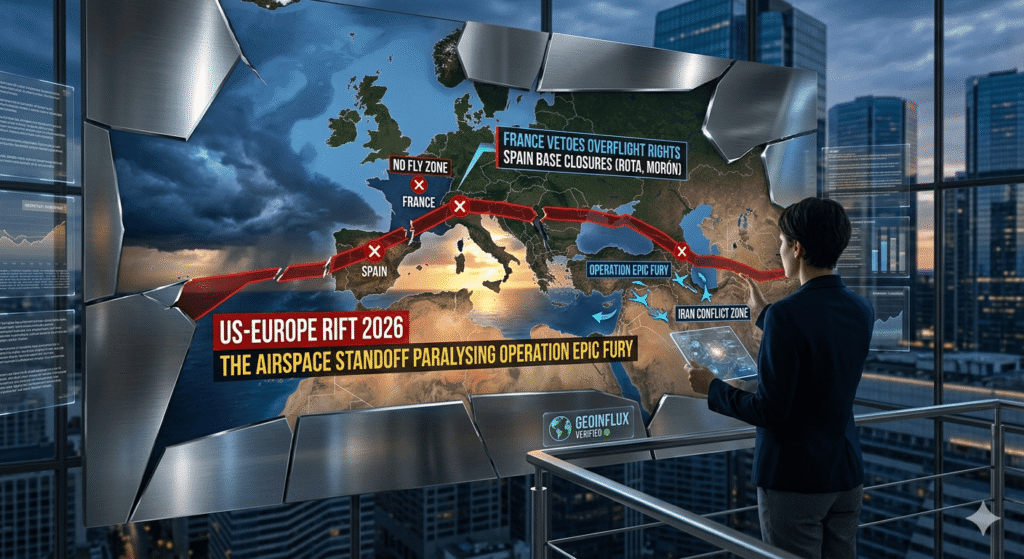
    The Transatlantic alliance has hit a historic breaking point. In late March 2026, President Trump publicly condemned France as “very unhelpful,” claiming Paris blocked military supply planes headed for Israel and the Iranian theater.

    Also Read: Is Pakistan Mediation Israel-Iran War Fake Exposed? Fact Check March 2026 | Geoinflux

    This France refused US its airspace for Iran controversy has exposed a deep US-Europe rift 2026, where European powers are no longer willing to be silent partners in American-led conflicts.

    As Operation Epic Fury continues to escalate monthly costs toward $50 billion, France’s refusal to serve as a “logistical colony” marks a fundamental shift in global power. The question is no longer whether NATO is under stress but whether NATO is collapsing under Trump.

    Fracturing the Shield: How Europe’s Airspace Denial is Dismantling the Transatlantic Alliance

    The US-Europe rift 2026 is no longer a diplomatic cold war; it is now an operational blockade. The Trump Iran war strategy 2026 has met a physical wall in Europe, specifically through France’s refusal to grant unconditional overflight rights for lethal aid bound for the Middle East. This standoff is the clearest evidence yet that the Western alliance is fracturing, as Europe prioritizes its own stability over Washington’s Op Epic Fury.

    The Airspace Standoff: Why France Refused US its Airspace for Iran Strikes

    Last week, a massive diplomatic firestorm erupted when France refused airspace for Iran-bound military logistics. President Trump took to Truth Social to warn that “The U.S.A. will remember” this refusal. While French sources claim they only restricted specific “lethal cargo” to protect their own neutrality, the impact on Op Epic Fury is undeniable. By forcing U.S. transport planes to take longer, more expensive routes, Paris has effectively placed a “tax” on the Trump Iran war strategy 2026, signaling that European soil will not be used to fuel a war it did not authorize.

    Operation Epic Fury Explained: A Mission Without Allies?

    When we look at Operation Epic Fury, it is a high-intensity campaign to dismantle the Iranian regime’s infrastructure. However, unlike previous Gulf Wars, the U.S. is going in largely alone. The US Europe rift 2026 has left the U.S. military scrambling for alternative basing and overflight rights. With Spain and Italy also showing hesitation, Op Epic Fury is becoming a case study in the limits of American power when its traditional allies decide to pursue Strategic Autonomy.

    The Existential Question: Is NATO Collapsing Under Trump?

    The current friction over Iran has brought the alliance to the edge. Is NATO collapsing under Trump? It certainly appears so in an operational sense. NATO was designed for collective defense in Europe, but the Trump Iran war strategy 2026 demands that NATO act as a global logistics hub for American interests. France’s defiance is a rejection of this “vassal” status. If the US Europe rift 2026 continues to widen, the functional unity of NATO may not survive the summer.

    Strategic Insights: The 1987 Connection and War Costs

    Trump’s skepticism of allies isn’t new; it’s the fulfilment of his 1987 “Open Letter” to the American people, where he argued allies were “taking advantage” of the U.S. This philosophy now drives his response to the US Europe rift 2026. However, with Op Epic Fury costing roughly $45 billion a month, the U.S. can ill-afford to lose the logistical efficiency provided by European partners. The high cost of war is meeting the high cost of a broken alliance.

    The Breakdown of the Transatlantic Shield (March 2026)

    EventStatusGeopolitical Impact
    French AirspaceFrance Refused Airspace for Iran cargo.Increased flight times and costs for Op Epic Fury.
    NATO UnityIs NATO Collapsing Under Trump?Article 5 remains, but operational trust is at 0%.
    Financial Cost$40–50B monthly expenditure.Severe domestic inflation and deficit risks in the U.S.
    DiplomacyUS Europe Rift 2026 peaking.Europe moving toward an independent defense identity.

    FAQs

    Why did France refuse US airspace for Iran-bound supplies?

    France’s refusal is a strategic move to distance itself from Op Epic Fury. Paris argues that the Trump Iran war strategy 2026 is destabilizing and that European territory should not be a staging ground for a conflict that lacks a UN mandate or NATO consensus.

    Is the US Europe rift 2026 permanent?

    While alliances can heal, the US Europe rift 2026 appears structural. The move by France to block military flights indicates that Europe is no longer willing to subordinate its regional security to U.S. Middle East policy.

    Operation Epic Fury explained: What is its main goal?

    Operation Epic Fury is the 2026 U.S. mission to “decapitate” the Iranian regime’s leadership and destroy its nuclear capabilities. However, without European overflight rights, the mission faces significant logistical delays.

    Is NATO collapsing under Trump?

    Many geopolitical analysts argue that while NATO exists on paper, its operational core is hollow. The current US Europe rift 2026 over Iran suggests that for “out-of-theatre” missions, NATO is essentially defunct.

    Featured Sources & Citations Box

    End Note

    The US Europe rift 2026 is the physical manifestation of the world’s shift toward multipolarity. When France refused US its airspace for Iran, they didn’t just block a plane; they signalled the end of the American Century’s unquestioned dominance over European policy.

    Thank you for following GeoInflux. We provide the data-driven clarity you need as the world order undergoes its most violent restructuring since 1945.

    Author: GeoInflux Editorial Team

    Date: April 1, 2026

  • Is Pakistan Mediation Israel-Iran War Fake Exposed? Fact Check March 2026 | Geoinflux

    Is Pakistan Mediation Israel-Iran War Fake Exposed? Fact Check March 2026 | Geoinflux

    Is Pakistan mediation in the Israel-Iran war real or fake? Discover the truth behind Iran’s rejection, India’s stance, and the 2026 media propaganda battle.

    Quick Take

    In late March 2026, the Pakistan mediation Israel-Iran war claim has become a flashpoint for global information warfare. While Islamabad has aggressively positioned itself as a regional peacemaker, hosting foreign ministers from Turkey and Saudi Arabia, the ground reality remains highly contested.

    On March 30, 2026, Iran’s Foreign Ministry officially distanced itself from the talks, stating, “Pakistan’s forums are their own; we didn’t participate.” Despite global media headlines suggesting a breakthrough, Tehran has dismissed the U.S.-led 15-point peace plan delivered via Islamabad as “unreasonable”. This contrast between Pakistan’s high-decibel PR and the direct rejection by key combatants highlights a massive gap between perception and reality.

    Meanwhile, the India vs Pakistan geopolitics 2026 divide grows, as New Delhi maintains a policy of “credible silence” backed by deep strategic ties, leaving many to wonder if Pakistan’s role is a genuine diplomatic feat or a sophisticated narrative play.

    Is Pakistan’s Mediation Claim in the Israel-Iran War Fake?

    Evidence suggests that the Pakistan mediation Israel-Iran war claim is largely exaggerated and lacks the official backing of the primary warring parties. While Pakistan has functioned as a diplomatic “courier” for U.S. proposals, both Iran and Israel have publicly signalled their lack of confidence in Islamabad as a formal mediator.

    On March 30, 2026, Tehran clarified that no direct negotiations are occurring through these forums, labelling the current “peace plan” as unacceptable.

    Background: Pakistan’s Claim Vs. Reality

    Why is Pakistan Claiming a Mediation Role in the Israel-Iran War?

    Pakistan is currently attempting a massive diplomatic pivot in March 2026 to boost its economic strategy and global standing. By acting as an intermediary, Islamabad hopes to:

    • Leverage U.S. Ties: Utilize its improved rapport with the Trump administration to act as a bridge to Tehran.
    • Domestic Image Building: Counter internal instability by projecting a “Global Peacemaker” image.
    • Control the Narrative: Use the Israel-Iran war March 2026 updates to position itself as more active than its regional rivals.

    However, the “Islamabad Dialogue” held on March 29, 2026, notably lacked representatives from the two countries actually at war: Israel and Iran.

    Israel-Iran war March 2026 updates

    Did Israel and Iran Reject Pakistan’s Mediation Role?

    The rejection has been swift and public. Iran rejects Pakistan mediation efforts as “ineffective” and “one-sided.” The Iranian Consulate in Mumbai and the Foreign Ministry in Tehran issued a stinging clarification on March 30, 2026, stating that while regional calls for peace are welcome, Iran was not part of the Pakistan-led plan. Tehran specifically noted that the 15-point U.S. “action list” delivered via Islamabad contained “excessive and unreasonable demands.”

    Israel has been equally dismissive. The Israeli Ambassador to India recently rejected the idea of Pakistan as a mediator, citing the lack of diplomatic relations and Pakistan’s historical stance. For Israel, a mediator without “skin in the game” or a sovereign AI-backed intelligence framework to ensure compliance is a non-starter.

    How Did Global Media Amplify the Pakistan Mediation Narrative?

    The Pakistan mediation story is a masterclass in digital propaganda. Western outlets, eager for a de-escalation narrative, initially amplified Islamabad’s press releases. This created a “feedback loop” where media reports were cited by Pakistani officials as “global recognition” of their role.

    In the realm of cloud geopolitics, whoever controls the initial “data burst” often controls the truth. Pakistan used its state-aligned media machinery to flood the 2026 news cycle with the “mediator” tag, even as the actual diplomatic substance remained hollow.

    Strategic Insights: India vs Pakistan Geopolitics 2026

    The India vs Pakistan geopolitics 2026 dynamic has shifted from border skirmishes to “influence warfare”.

    • India’s Stance: External Affairs Minister S. Jaishankar has reportedly dismissed the mediation claim, emphasizing India’s direct strategic links with Israel and the U.S. India’s focus remains on the IMEC corridor and securing its digital sovereignty cloud infrastructure.
    • The Broker vs. Partner Debate: While Pakistan acts as a “broker” (or messenger), India is viewed as a “strategic partner” by the West. India’s refusal to engage in loud PR indicates a belief that real power in 2026 is quiet, tech-driven, and results-oriented.

    Recap / Summary Table

    Pakistan Mediation: Fact-Check 2026

    FeatureThe ClaimThe Reality (March 31, 2026)
    Iran’s ParticipationActive NegotiatorIran denies being part of the plan.
    Israel’s StanceConsidering the RoleRejection based on lack of credibility.
    U.S. PositionUsing Pakistan as LeadUsing Pakistan merely as a courier.
    OutcomeImminent CeasefireConflict continues; proposals rejected.

    FAQs

    Is Pakistan really mediating between Israel and Iran?

    No, Pakistan is not a formal mediator. While it has conveyed messages between the U.S. and Iran in March 2026, both Iran and Israel have officially rejected Pakistan’s claim of leading a successful peace process.

    Why did Iran reject Pakistan’s mediation claim?

    Iran rejects the claim because it views the U.S. proposals delivered through Pakistan as “unreasonable.” Tehran officially stated on March 30, 2026, that it did not participate in Pakistan’s regional forums and has no direct talks with Washington.

    Is Pakistan’s mediation claim fake?

    The claim is widely considered a “narrative push” or media propaganda. While some diplomatic communication occurred, the label of “mediator” is seen as an exaggeration by the Pakistani government to improve its global image.

    How is India positioned in the Israel-Iran war?

    India maintains “strategic autonomy.” It has direct, high-level communication with the U.S., Israel, and Saudi Arabia. India prefers quiet diplomacy over the public mediation claims seen in Pakistan.

    What is information warfare in the Israel-Iran conflict?

    Information warfare in 2026 involves using state-sponsored media and social platforms to create a perception of diplomatic power. Pakistan’s mediation claim is an example of using narrative to gain geopolitical leverage without verified results.

    Related Articles

    Featured Sources & Citations Box

    End Note

    In the geopolitics of 2026, the truth is often buried under layers of digital propaganda. Pakistan’s attempt to claim the role of a peacemaker may have won them a few news cycles, but in the halls of power, credibility is built on action, not press releases.

    Thanks Note

    Thank you for trusting GeoInflux to decode the complex narratives of global power. We remain committed to analytical clarity in an age of information warfare.

    Author: GeoInflux Editorial Team

    Date: March 31, 2026

    Ref: Iran Rejects Pakistan’s Mediation Claims – NDTV Profit

  • Introduction to Problem Solving: Thinking Like a Programmer in 2026.

    Introduction to Problem Solving: Thinking Like a Programmer in 2026.

    Introduction to Problem Solving: To program a solution for a problem, you should think in a specific way. Learn the problem-solving cycle, algorithms, and flowcharts for Python and Java.

    What is Problem Solving in Programming? Problem solving is the systematic process of analyzing a problem and designing algorithms using tools like flowcharts and pseudocode to create an effective solution. It is the essential thinking phase that must occur before any code is written.

    The 4-Step Problem-Solving Cycle

    Programs are not quick creations. To develop efficient software, one must follow a disciplined methodology consisting of four major stages:

    • 1. Analysis: Understand the problem minutely and identify processing components and their relationships.
    • 2. Design: Find a solution and develop a step-by-step algorithm.
    • 3. Coding: Translate the designed algorithm into a specific programming language.
    • 4. Testing & Debugging: Find errors (testing) and rectify them (debugging) to ensure the program works correctly.

    Once these steps are complete, the program must be documented, implemented for real users, and maintained to remove undetected errors or add new features.

    Designing the Blueprint: Algorithms and Flowcharts

    Before writing code, developers use two primary tools to map out their logic: Algorithms and Flowcharts.

    1. The Algorithm

    An algorithm is a set of rules that define how a problem can be solved in a finite number of steps.

    Key Characteristics of a High-Quality Algorithm:

    • Precision: Every step must be clearly and precisely defined.
    • Finiteness: The algorithm must terminate after a limited number of steps.
    • Effectiveness: Each operation must be doable in a finite time using basic methods.
    • Definiteness: It must be clearly defined exactly what should be done at each stage.

    2. The Flowchart

    A flowchart is a pictorial representation of a step-by-step solution. It helps programmers visualize the sequence of operations. Standard symbols include:

    • Oval: Represents the Start or Stop of the process.
    • Parallelogram: Indicates Input or Output operations.
    • Rectangle: Used for Processing (like arithmetic calculations).
    • Diamond: Represents a Decision point (Conditional logic).

    The “Java Bridge”: From Python Logic to Java Syntax

    As you progress from Python to Java, you will notice that while the Problem Solving Cycle remains identical, the syntax becomes much stricter. In Python, you can often “figure it out as you go,” but Java requires a more rigid analysis phase.

    Click to Learn Java with Oracle’s Java Tutorials.

    Comparative Logic: Adding Two Numbers

    Consider the logic for adding two numbers: Input N1, N2 → $S = N1 + N2$ → Print S .

    FeaturePython ImplementationJava Implementation
    Variable Declarations = 0 (Dynamic)int s = 0; (Static/Explicit)
    Input Handlingn1 = input()Scanner.nextInt();
    Statement EndingNew lineSemicolon (;) is mandatory
    Type SafetyImplicitExplicit (must define int, float, etc.)

    The Lesson: Python’s simplicity makes it excellent for learning the Analysis and Design phases. However, Java’s strictness forces you to become a better Tester and Debugger because errors are often caught before the code even runs.

    Frequently Asked Questions

    What is Pseudocode? Pseudocode is an informal language used to describe program steps without strict syntax. It is easy to understand, like English, and helps explain logic without being bound to a specific programming language.

    What is the difference between Testing and Debugging? Testing is the process of finding errors in a program, while debugging is the process of correcting those found errors.

    How do we measure the efficiency of an algorithm? Efficiency is governed by two main factors: Time-wise efficiency (how fast it runs) and Space-wise efficiency (how much memory/RAM it consumes).

    What is a Dry Run? A Dry Run is the manual execution of code step-by-step on paper to track variable values and identify logical errors.

    Conclusion

    Mastering the Introduction to Problem Solving is the single most important step for any developer. Before touching code, you must decompose a complex problem into smaller, manageable parts.

    By following the structured problem-solving cycle, from analysis to maintenance, you ensure your programs are not just functional, but efficient and scalable.

    End Note

    This post is the first in our “GeoInflux Python-to-Java Journey.” We are documenting the transition from Python’s beginner-friendly syntax to Java’s robust, enterprise-grade architecture. Master the logic today, and the syntax will follow tomorrow.

    References and Citations

    • The Problem-Solving Cycle: Methodology involving Analysis, Design, Coding, and Testing.
    • Algorithm Constraints: Definiteness, effectiveness, and finiteness.
    • Flowchart Standards: Pictorial representation using standardized logic symbols.
    • Pseudocode Advantages: Informal, language-independent logic description.
    • Efficiency Metrics: Factors governing time and space resources.

    Get Latest AI Updates. Click Here