


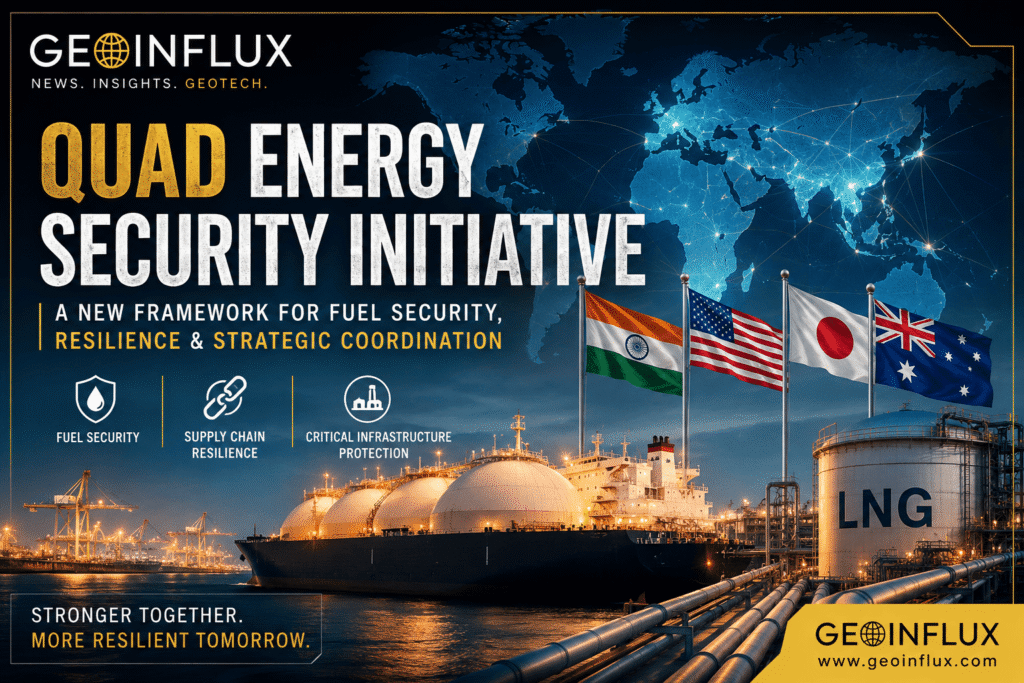
The QUAD’s latest Energy Security Initiative looks like a fuel security plan, but it may signal a much bigger shift in global strategic coordination. Here’s why.
Quick Take
The QUAD Energy Security Initiative is a new framework launched by India, the United States, Japan, and Australia to improve coordination during fuel disruptions and future energy crises. At its core is the newly announced Quad Fuel Security Forum, designed to strengthen preparedness, information sharing, and collective resilience. While the announcement focuses on fuel security, its strategic significance is broader. Energy disruptions today affect manufacturing, shipping, supply chains, digital infrastructure, and economic stability, making resilience planning an increasingly important part of strategic partnerships.
What Did QUAD Actually Announce?
India, the United States, Japan, and Australia have announced the QUAD Energy Security Initiative, a new cooperative framework focused on fuel resilience and crisis preparedness.
Its main operational mechanism is the Quad Fuel Security Forum, which is expected to support coordination during supply disruptions, improve emergency response planning, and strengthen information sharing around fuel-related risks.
The immediate objective is straightforward: reduce vulnerability to future energy shocks. This matters because recent disruptions have shown how quickly fuel instability can create wider economic stress. Energy crises no longer remain isolated market events. They spill into manufacturing, trade, logistics, and broader strategic planning, forcing governments to think beyond short-term crisis management. This is what makes the announcement more than a routine policy update.
Latest Posts
- QUAD Energy Security Initiative 2026 Explained: Why It Matters Beyond Fuel Security

- Why India-Bangladesh Border Tensions Are Rising Again in 2026?

- Can You Get a High-Paying Tech Job in the AI Era of Mass Layoffs with Free MIT Courses? (2026 Guide)


Why Did QUAD Launch the Energy Security Initiative Now?
The timing is not accidental. Over the past few years, governments have faced repeated reminders that global infrastructure systems are far more fragile than they appear. The Russia-Ukraine conflict disrupted oil and gas markets, pushing fuel prices sharply higher. Shipping instability in critical maritime routes created fresh uncertainty for trade flows. LNG market disruptions exposed the risks facing import-dependent economies.
Each crisis reinforced the same lesson: interconnected economies remain vulnerable when energy systems come under pressure. The problem is not limited to energy availability alone.
When fuel supply becomes uncertain, manufacturing slows because factories rely on uninterrupted power and predictable input costs. Logistics networks become more expensive as shipping absorbs higher fuel prices. Supply chains become harder to manage as delays spread across transport corridors.
That pressure eventually reaches financial markets, industrial planning, and government decision-making. Seen in this context, the QUAD Energy Security Initiative appears to be a proactive response to a changing risk environment. Instead of reacting after disruption occurs, member countries are moving toward structured coordination before the next crisis arrives.
What Is the Quad Fuel Security Forum and Why Does It Matter?
The Quad Fuel Security Forum is the most practical element of the new initiative. While full operational details are still emerging, its intended purpose appears clear: create a mechanism through which QUAD members can coordinate more effectively during fuel disruptions.
That likely includes emergency planning, information sharing, risk monitoring, and discussions around response coordination when supply shocks affect regional stability. This matters because strategic partnerships are increasingly judged not only by diplomatic statements, but by whether they can function effectively during crises.
An announcement alone does not improve resilience. What matters is whether countries can actually work together when disruptions hit. Faster information sharing, earlier risk assessment, and coordinated responses can make the difference between a manageable shock and wider economic damage.
If the Quad Fuel Security Forum evolves into a functioning resilience mechanism rather than remaining a symbolic announcement, it could become one of the more important institutional developments within the QUAD framework.
Why Does Energy Security Matter Beyond Fuel Markets?
Energy security today affects far more than fuel imports. Modern economies depend on tightly interconnected systems, and energy now underpins many of the infrastructure layers shaping Technology and Infrastructure Geopolitics.
Manufacturing depends on reliable electricity. Shipping networks rely on affordable fuel. Industrial production becomes vulnerable when supply disruptions persist.Large datacenters require continuous power to operate, especially as the global AI Infrastructure Race pushes countries to expand compute capacity..
That changes the strategic meaning of fuel disruption. A prolonged energy shock is no longer just an economic inconvenience. It can weaken production capacity, disrupt trade flows, increase inflationary pressure, and create broader uncertainty across critical sectors.
This explains why governments increasingly treat resilience as a strategic priority. The QUAD’s latest move reflects that broader shift. Fuel coordination is not simply about stabilizing markets. It is increasingly about protecting the infrastructure systems that keep economies functioning under stress.
Is QUAD Expanding Beyond Traditional Security?
The QUAD has traditionally been associated with maritime security and broader strategic coordination. This initiative suggests that role is evolving.
Strategic competition today does not always take the form of conventional confrontation. Economic disruption, infrastructure pressure, and supply chain instability can create strategic consequences without direct military escalation.
That changing environment is pushing alliances and partnerships to adapt. The QUAD Energy Security Initiative reflects this shift by moving beyond familiar defense-focused cooperation into practical resilience planning.
This does not mean the QUAD is abandoning its traditional security role. Instead, it suggests the grouping is expanding its definition of preparedness. Security is no longer only about deterrence. It is also about whether critical systems can keep functioning during disruption. This makes the current initiative strategically important beyond its immediate energy focus.
What Does This Mean for India?
For India, this initiative carries both practical and strategic significance. India remains closely connected to major maritime trade and energy routes, making fuel stability directly relevant to its economic interests. Any disruption affecting regional shipping or imported energy can quickly create pressure on domestic costs, industrial output, and broader economic planning.
At the same time, India’s ambitions in manufacturing, infrastructure expansion, and digital growth depend on resilient support systems. This gives New Delhi a strong reason to support structured crisis coordination.
There is also a strategic dimension, especially as India’s evolving regional strategy increasingly depends on resilient economic and infrastructure partnerships.. As global partnerships evolve beyond traditional security cooperation, countries that help shape operational resilience frameworks gain greater influence in setting future regional priorities.
This allows India to participate not only as a strategic partner, but also as a contributor to emerging infrastructure coordination models. India’s role could become increasingly valuable in a world where disruption is becoming a recurring strategic challenge.
Could This Become a Broader Model for Strategic Partnerships?
Although the initiative is shaped by current regional realities, its broader logic is not geographically limited. Many governments face similar risks. Energy disruptions, supply chain instability, shipping insecurity, and infrastructure vulnerabilities are now recurring global concerns rather than isolated regional problems.
That makes resilience-focused coordination increasingly relevant beyond the QUAD. If the Quad Fuel Security Forum proves operationally effective, other partnerships may study similar frameworks for crisis preparedness and infrastructure continuity.
Future strategic cooperation may increasingly combine traditional security coordination with mechanisms focused on resilience, emergency response, and systemic risk management. This possibility gives this initiative significance beyond its immediate announcement.
Key Takeaways
| Development | Why It Matters |
|---|---|
| QUAD launched the Energy Security Initiative | Expands cooperation beyond conventional strategic coordination |
| Quad Fuel Security Forum announced | Creates a practical crisis coordination mechanism |
| Focus on fuel resilience | Addresses vulnerabilities exposed by recent global disruptions |
| Energy linked to wider systems | Manufacturing, shipping, digital infrastructure, and supply chains depend on stability |
| Broader strategic significance | May influence future resilience-focused partnerships |
FAQs
Why did QUAD launch the Energy Security Initiative now?
The initiative reflects growing concern over repeated disruptions that exposed weaknesses in global energy and infrastructure systems. Recent geopolitical crises, shipping instability, and supply chain disruptions have shown how quickly energy stress can create wider economic pressure. The framework appears designed as a proactive response rather than a reactive measure.
What is the Quad Fuel Security Forum?
The Quad Fuel Security Forum is the operational component of the initiative. It is intended to improve coordination among QUAD members during fuel disruptions through preparedness planning, information sharing, and crisis-response discussions.
Is QUAD moving beyond military and maritime security?
The latest initiative suggests the grouping is broadening its role. While traditional strategic coordination remains central, the focus is increasingly expanding into infrastructure resilience, crisis preparedness, and operational continuity.
Why does energy security affect digital infrastructure?
Modern digital systems depend on uninterrupted power. Datacenters, cloud infrastructure, AI compute systems, and industrial digital operations require stable electricity. That makes energy reliability essential to both physical and digital economic systems.
Could other countries adopt similar models?
Potentially, yes. If the QUAD framework proves effective, similar resilience-focused coordination mechanisms may emerge in other strategic partnerships facing comparable infrastructure and supply chain risks.
Related Reads
- How Technology in Geopolitics Is Reshaping Global Power in 2026
- Why Cloud Infrastructure Is a National Security Risk in 2026: Cloud Geopolitics and Digital Sovereignty Explained
Featured Sources & Citations
- QUAD Official Joint Statement / Foreign Ministers Release
- International Energy Agency (IEA) – Energy Security Analysis
- International Maritime Organization (IMO) – Maritime Security & Shipping Context
- UNCTAD – Trade and Logistics Reports
- World Bank – Infrastructure Resilience Research
End Note
The QUAD Energy Security Initiative may appear to be a targeted response to fuel disruption, but its broader significance lies in what it says about the changing nature of strategic cooperation. Modern disruptions increasingly affect infrastructure, logistics, production, and economic stability at the same time.
That means resilience is no longer a secondary policy concern. It is becoming part of strategic preparedness itself. If this initiative develops into a functioning coordination mechanism, it may represent an early sign of how future partnerships prepare for systemic disruption.
Thanks Note
Thank you for reading GeoInflux. As global competition increasingly intersects with infrastructure, resilience, and economic security, developments like this deserve analysis beyond the headlines.
Stay with GeoInflux for deeper coverage of strategic infrastructure, emerging technology, and shifting global power dynamics.


