


Chennai’s Mindgrove Technologies has become the first Indian chip startup to design a commercial-grade SoC fully in India. Learn how this fabless semiconductor from IIT Madras is reshaping chip design in India, driving hardware localisation, and strengthening India’s digital sovereignty.
Quick Take
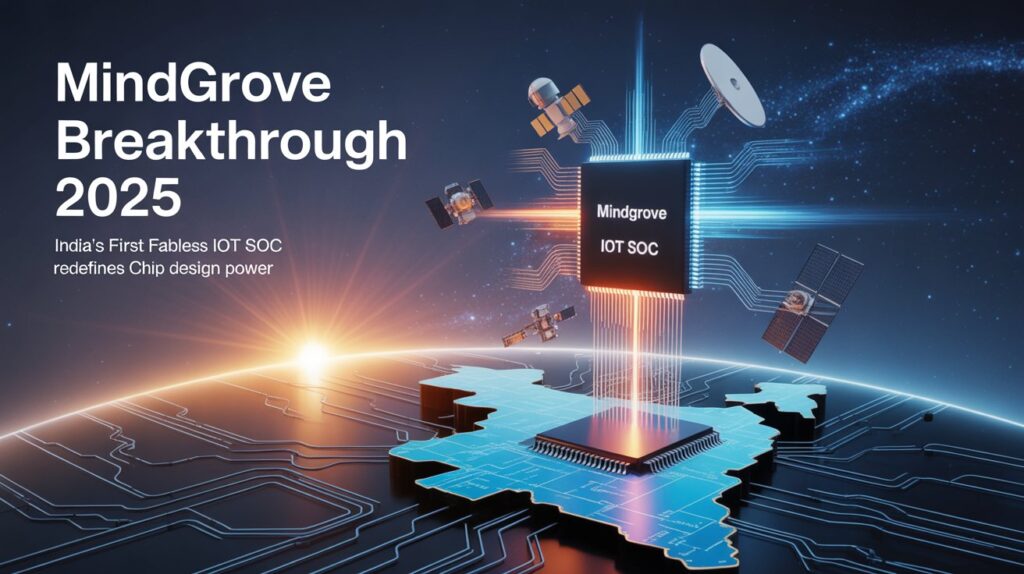
Indian chip startup Mindgrove Technologies has built India’s first commercial IoT SoC, marking a historic moment for local chip design. Backed by IIT Madras and powered by a fabless semiconductor model, the startup has proven that high-performance chip design in India is possible without owning a fabrication unit.
Mindgrove’s 28-nm SoC is built for IoT and embedded systems, showing how hardware localisation in India is becoming real. The milestone supports India’s semiconductor mission, boosts self-reliance, and signals a maturing silicon ecosystem driven by startups. It also raises the question of how fabless semiconductor India players can scale globally while managing capital, design IP, and foundry access.
What You Will Learn
- How Mindgrove became India’s first successful fabless semiconductor startup
- Why its IoT SoC marks a turning point for chip design in India
- How hardware localisation and digital sovereignty link to semiconductor strategy
- What role IIT Madras and India’s Design Linked Incentive (DLI) play in building deep-tech startups
- The biggest challenges for Indian chip startups in scaling globally
- Policy lessons for investors and government stakeholders supporting India’s semiconductor ecosystem
What did Mindgrove Technologies achieve in India’s chip design journey?
Mindgrove became the first Indian chip startup to design a commercial-grade IoT SoC in India. The chip was designed in Chennai under IIT Madras incubation, proving India’s design potential beyond software.
The company follows a fabless semiconductor India model—design in India, manufacture abroad—which is cost-efficient and IP-driven.
The milestone advances hardware localisation in India and strengthens digital sovereignty by ensuring India owns its critical tech stack.
To understand how India’s semiconductor policies made this breakthrough possible, read India’s Semiconductor Design 2025: How Design Linked Incentives Are Driving a Bold Localisation and Fabless Innovation Wave
How did Mindgrove’s journey from IIT Madras to chip design success begin?
Founded by engineers Shashwath T.R. and Sharan Srinivas J., Mindgrove began in 2021 as a spin-off from IIT Madras’ research ecosystem. It secured early grants from IIT Madras and later raised private investment to scale.

With deep-tech incubation, DLI scheme support, and academic backing, the startup achieved full SoC design and validation within two years.
Mindgrove’s growth shows how semiconductor startups in India can emerge from India’s university–industry ecosystem.
Learn more about IIT Madras’ pivotal role in nurturing semiconductor startups in Inside IIT Madras’ Deep-Tech Ecosystem: How Academia Is Fueling India’s Semiconductor Ambitions
What makes Mindgrove’s IoT SoC India design technically significant?
The “Secure IoT” chip is built on a 28-nm process, clocking ~700 MHz, using a RISC-V architecture. It’s designed for smart devices, wearables, and embedded applications. The chip reportedly costs 30 per cent less than foreign microcontrollers of similar performance.
The startup is developing a second chip, “Vision SoC”, focused on edge computing and automotive systems, another major step in India’s semiconductor mission.
For a deeper look at how India’s fabless chip startups like InCore and Saankhya Labs are driving IoT innovation, see The Rise of Fabless Startups and IoT SoC Innovation in India: Lessons from Mindgrove and Beyond
How does Mindgrove’s innovation support hardware localisation and digital sovereignty in India?
Local chip design means local IP control, reducing dependency on imported hardware. Mindgrove plans partnerships with Indian packaging and testing firms like Kaynes Technology and CG Power to localise more of the value chain.
This shift boosts domestic employment in electronics manufacturing clusters and advances India’s hardware sovereignty goals. Embedding Indian-designed chips into IoT and smart infrastructure devices brings localisation from lab to market.
Explore the broader strategic implications in Hardware Sovereignty and Supply-Chain Independence: Why India’s Semiconductor Story Is Geopolitical
What challenges does Mindgrove face as a fabless semiconductor India startup?
India still lacks commercial-scale foundries, so Mindgrove uses overseas partners like TSMC for fabrication.
Long lead times, high design costs, and dependence on external fabs are the biggest hurdles.
Intellectual-property protection and securing fabrication access remain ongoing concerns. Scaling from prototype to production requires major capital and strategic partnerships.
Why is chip design in India key for self-reliance and tech sovereignty?
India has 20 per cent of the world’s chip design talent but few homegrown commercial chips. Mindgrove changes that narrative; it shows chip design in India can deliver viable products, not just outsourced services.
Local IP strengthens India’s leverage in global tech geopolitics, insulating it from export bans and external supply-chain shocks. It’s a foundational step toward true digital and hardware sovereignty.
What lessons can policymakers and investors learn from Mindgrove’s model?
- Policy focus: Strengthen the Design Linked Incentive (DLI) and support local testing and packaging infrastructure.
- Investor focus: Fund deep-tech for long-term innovation, not quick exits.
- Industry focus: Link startups, academia, and manufacturers through shared infrastructure.
Mindgrove’s story proves India’s semiconductor ecosystem is maturing, and design-driven innovation is now possible from Chennai—not only from Silicon Valley.
For full coverage of India’s policy and semiconductor strategy, start with India’s Semiconductor Design Ecosystem and Localisation Policy and continue through the complete India’s Semiconductor Sovereignty Series.
FAQ
1. What is Mindgrove Technologies, and what chip did it design?
Mindgrove Technologies is a Chennai-based Indian chip startup incubated at IIT Madras. It designed “Secure IoT”, India’s first commercial-grade 28-nm SoC built on RISC-V architecture for smart devices.
2. How do fabless semiconductor India startups work?
They design chips locally but outsource fabrication to foreign foundries, focusing capital on IP and R&D. Mindgrove uses this model while localising packaging and testing through Indian partners.
3. Why is chip design in India vital for tech sovereignty?
Owning chip IP gives India control over critical hardware and reduces exposure to foreign restrictions. It ensures domestic supply resilience and safeguards data infrastructure.
4. What incentives support semiconductor startups in India?
The Design Linked Incentive (DLI) scheme provides funding and R&D support for chip design. Mindgrove secured approval under this scheme for its second chip project.
5. What’s next for IoT SoC India innovation?
India is seeing startups building vision SoCs, edge-AI processors, and industrial-grade chips. Local packaging, assembly, and foundry access will be key for scaling production.
6. Can Indian chip design firms compete globally?
Yes. If they leverage cost advantages, retain IP, and forge strategic partnerships for fabrication and testing, Indian chip startups like Mindgrove can capture niche markets worldwide.
End Note
Mindgrove Technologies’ chip breakthrough marks a turning point in India’s hardware story. From a university lab to a commercial SoC, it shows how domestic design talent and strategic policy can shape a new era of digital sovereignty. If replicated nationwide, this model could turn India from a semiconductor consumer into a design powerhouse.
Continue reading the full GeoInflux Pillar Series to explore every dimension—policy, innovation, academia, and geopolitics—in India’s Semiconductor Sovereignty: How Mindgrove and IIT Madras Sparked a Chip Design Revolution.
Related Reads
- China’s Molten Salt Reactor (MSR) 2025 Breakthrough: 5 Reasons Thorium Reactors Are Key to Energy Independence
- Future of IT Jobs in India 2025: Anthropic AI Index Reveals 3 Alarming Automation Trends | Geoinflux
- Apple’s iOS 26.1 Update: 9 iPhone New Features, Critical Security Fix, and a Global Digital Sovereignty Showdown | Geoinflux
- Chip Geopolitics Exposed: 5 Ways the Silicon Curtain Threatens Global AI Balance and Tests India’s Strategy | Geoinflux Tech
References
- Moneycontrol: “No One Thought India Could Build Its Own Chip Until Chennai Startup Mindgrove Did It”
- Moneycontrol: “IIT Madras-Backed Startup Launches India’s First Indigenously Designed Microcontroller Chip”
- Moneycontrol: “Semiconductor Startup Mindgrove Eyes Local Chip Packaging Deals with Kaynes, CG Power, Plans Tata Fab Tie-Up”
- India Today: “IIT Madras Startup Mindgrove Launches First India-Made Microcontroller Chip”
- IIT Madras Newsroom: “MeitY Approves Mindgrove’s Proposal under Design Linked Incentive Scheme”
- Mindgrove Technologies – Official Website (Media Page)
 2
2
 20
20
 20
20





Pingback: India’s Semiconductor Design 2025: How Design Linked Incentives Are Driving A Bold Localisation And Fabless Innovation Wave GeoInflux
Pingback: India Chip Startup 2025: How Fabless Semiconductor India And IoT SoC Innovation Are Powering A Bold New Chip Design And Localisation Era GeoInflux
Pingback: IIT Madras Deep-Tech 2025: How India Chip Startup Bold Innovation And Fabless Semiconductor Design Are Powering Hardware Localisation GeoInflux
Pingback: Indian YouTube Alternative 2025: What Are The 5 Bold Breakthroughs In Atmanirbhar Bharat Tech Architecture Driving Digital Sovereignty In India GeoInflux