
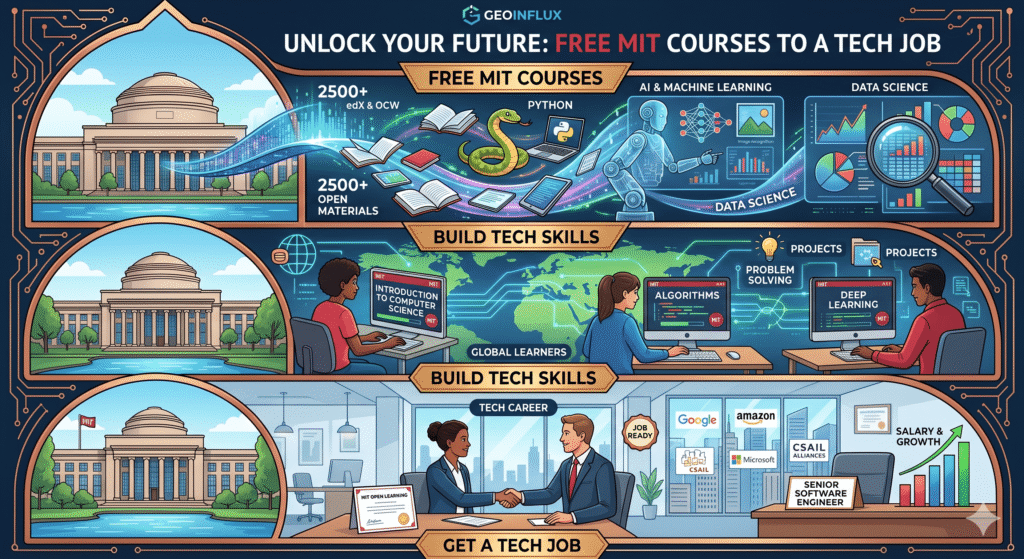

Tech layoffs are rising in 2026, but AI is also creating new roles. Learn how to use free MIT courses to become “unreplaceable” and land a high-paying job.
The Reality Check: Yes, you can absolutely get a tech job using free MIT courses, even during mass layoffs. While many “basic” roles are being cut, companies are desperately hiring people who understand the deep logic of AI. These courses give you the elite skills that standard “bootcamps” miss.
The 2026 Layoff Truth: Why “Junior” is a Dangerous Title
In 2026, many companies are using AI to do the “grunt work” that junior developers used to do. This is why we see layoffs. If your only skill is “writing basic code,” an AI agent can do that faster.
To survive, you need to move from being a “Coder” to being a “System Architect.” MIT courses don’t just teach you how to write code; they teach you how systems work under the hood.
How MIT Courses Make You “Layoff-Proof”
1. The “Logic Bridge”: Humans vs. AI
AI is excellent at following patterns, but it struggles to invent new solutions. By taking courses like Design and Analysis of Algorithms, you learn how to create logic from scratch. When an AI gets stuck, you are the human expert who understands the core math to fix it, making you unreplaceable in any tech job.
When an AI gets “hallucinations” or gets stuck on a complex bug, you are the human expert who understands the core math to fix it, making you the most valuable person on the team. If you want to stay updated on how these AI shifts are changing the industry every week, check out our AI Latest News category for the newest breakthroughs.
2. The AI Foundation (Where the Jobs Are)
Most people in 2026 are just “prompting” AI, but the high-paying jobs are in building and fine-tuning the models themselves. The Matrix Calculus for Machine Learning course gives you the deep mathematical “superpowers” that simple prompt engineers lack. Understanding how data moves through a neural network allows you to work on the actual architecture of AI, which is where the $130K+ salaries are currently hidden.
This intersection of high-level math and global technology is a major part of Geotech, where we analyze how technical shifts like these impact global power.
Updated Course Strategy for the Layoff Era
Group A: The “Survival” Skills (Foundations)
- Operating Systems: This course teaches you exactly how hardware talks to software, which is a skill AI agents cannot easily replicate in the physical world. Companies in 2026 are desperate for people who can manage the “bare metal” and cloud infrastructure that keeps their AI running. By mastering the “soul” of the computer, you become essential for keeping the lights on during tough economic times.
- Database Management Systems: Data is the “fuel” that drives every AI model in existence, and knowing how to store, clean, and protect that data is a massive career shield. While AI can write simple queries, it can’t design a secure, massive-scale data architecture for a global corporation. If you know how to manage the “memory” of a company, you become a foundational employee that they simply cannot afford to lay off.
For more step-by-step guides on mastering these foundational tools, browse our Programming and AI Resources section.
Group B: The “High-Growth” Skills (AI & ML)
- Machine Learning: Instead of just using AI tools as a consumer, this course teaches you how to be the creator who trains the machines to recognize patterns. You will learn the statistical logic that allows a computer to “learn” from its own mistakes without a human holding its hand. In a competitive market, being the person who can improve a company’s AI performance is the ultimate job security.
- Deep Learning: This is the specific technology behind modern marvels like ChatGPT and AI image generators. By understanding neural networks, you can help businesses customize these “general” AI tools for their own specific, private needs. This “customization” is a huge trend in 2026, and it requires deep knowledge that goes far beyond just knowing how to type a prompt.
The Hiring Manager’s Secret: “T-Shaped” Skills
In a layoff era, companies have stopped looking for “generalists” and started looking for “T-Shaped” professionals. This means you have a broad, basic understanding of all tech (the top of the T), but you are a deep master in one specific, hard-to-replace skill (the stem of the T).
- Use the MIT Name: Even if you didn’t go to the campus, listing “MIT Coursework” on your resume signals to recruiters that you have the mental toughness to finish the hardest curriculum on Earth. It proves you aren’t just looking for “easy” shortcuts, which is a quality hiring managers value deeply when budgets are tight.
- Focus on “Impact” Roles: Use your new MIT knowledge to apply for roles that directly “generate revenue” or “save costs,” such as AI Optimization or efficient Backend Engineering. During layoffs, the teams that are “making the company money” are the last ones to be cut, while experimental or “fluff” roles are the first to go.
FAQs
-
Is it worth starting a tech career in 2026 with all these layoffs?
Absolutely, but you have to be smarter about it than people were five years ago. The “boring” or “easy” coding jobs are going away, but the “smart” jobs that require deep logic are actually growing. Using free MIT resources allows you to gain these “elite” skills without the crushing weight of a $100,000 student loan.
-
Will AI eventually replace the people who took these MIT courses?
The courses don’t just teach you how to type; they teach you advanced problem-solving. AI is a tool for solving problems, but it still needs a “human-in-the-loop” to decide which problems are worth solving and to verify that the AI’s answer is safe. Think of AI as the hammer—it’s powerful, but it still needs a carpenter to build the house.
References & Citations
 2
2
 20
20
 20
20







Pingback: India AI Mission: Will India Lose 2 Million Tech Jobs Or Create 4 Million New Ones By 2031? AI Tech Workforce Future Explained GeoInflux