


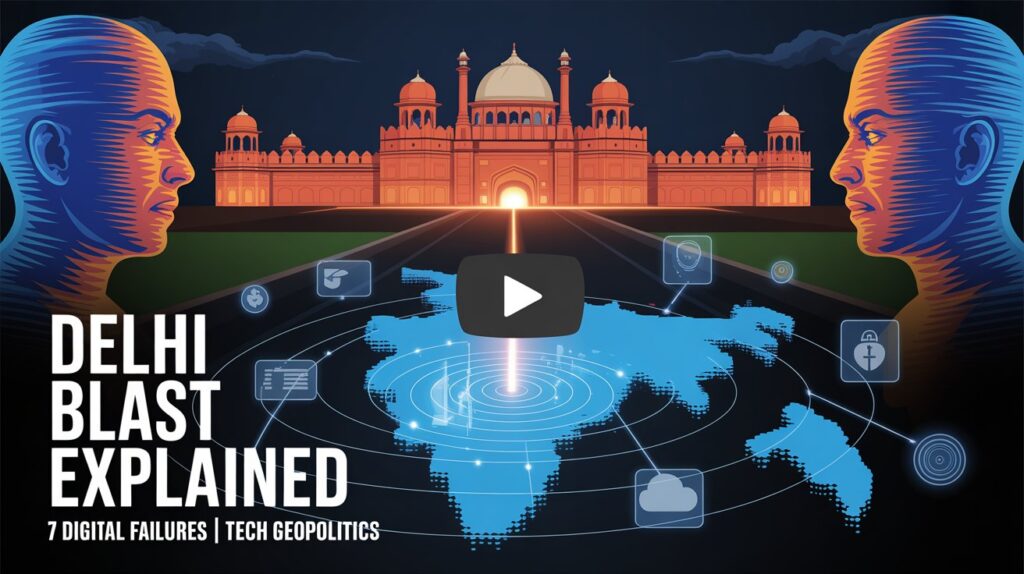
The November 10 Delhi blast exposed seven dangerous failures in India’s Tech Geopolitics posture. This analysis explains how Cross-Border Terrorism used encrypted apps, foreign servers, imported hardware, and Misinformation Warfare to exploit India’s weak Digital Sovereignty.
QUICK TAKE
The November 10, 2025 Delhi blast near Red Fort revealed a new breed of hybrid terror. The explosion itself was limited, but the digital turbulence began instantly. Foreign accounts circulated recycled conflict visuals and false claims before investigators reached the scene. These posts spread faster than verified updates and shaped the national mood.
Investigators needed chat logs, device metadata, cloud-stored files, and routing traces. But most of these datasets sat outside India, locked behind foreign platforms and foreign laws. This delay exposed how dependent India is on global digital infrastructure.
The attackers used encrypted apps, cross-border cloud backups, low-cost Chinese hardware, and crypto micro-payments to stay hidden. The Delhi blast showed how Cross-Border Terrorism now operates: physical violence supported by digital disruption.
This single incident exposed 7 deep failures in India’s Tech Geopolitics framework, proving that Digital Sovereignty is no longer optional. It is the backbone of National Security.
What Did the Delhi Blast Reveal About India’s Digital Weakness?
The Delhi blast revealed how Tech Geopolitics now shapes the execution, speed, and impact of Cross-Border Terrorism. The physical explosion lasted seconds, but the digital fallout spread across India’s information space within minutes.
Attackers relied on encrypted communication, foreign platforms, cloud-sync tools, and imported hardware, while misinformation networks hijacked the narrative. “Read the full breakdown of how tech tools strengthened the Delhi blast module.”
The attack exposed systemic vulnerabilities: slow foreign data access, jurisdictional delays, cloud dependency, crypto anonymity, and a broken crisis communication pipeline. These weaknesses showed that Digital Sovereignty, not just physical policing, now decides how fast India can respond to terror incidents.
This was not a traditional attack. It was a hybrid event where digital layers magnified the impact far beyond the physical blast.
BACKGROUND: Why Did the Delhi Blast Become a Hybrid Terror Event?
The November 10 explosion transformed instantly into a multi-layered crisis because digital ecosystems reacted faster than the state.
Three misleading narratives appeared within minutes
- Foreign accounts framed the explosion as a mechanical accident to dilute the terror angle. This was amplified across social media before police arrived.
- Old visuals from Lebanon and Gaza resurfaced as “Delhi CCTV footage,” confusing viewers unfamiliar with the original sources.
- Coordinated profiles claimed investigators were “hiding facts,” creating distrust in official updates.
This misinformation spread across languages
- Automated translation tools pushed the same false claims in Hindi, Bengali, Tamil, and English.
- This widened the reach and made the misinformation appear organic.
Digital evidence was stored outside India
- Encrypted chat logs sat in European data centers.
- Photos and route sketches synced to US-based cloud servers.
- Metadata and device logs were controlled by foreign support teams.
These jurisdictional boundaries slowed early investigation.
Procurement trails revealed imported hardware
- Low-cost Chinese sensors and GPS modules assisted reconnaissance.
- Communication boards were embedded into consumer gadgets to avoid suspicion.
- Cash-on-delivery purchases bypassed digital tracking.
This reduced the module’s visibility.
Crypto transactions funded logistics
- Micro-payments financed chemicals, VPNs, and safehouse rent.
- Privacy coins hid origins.
- Mixers broke transaction trails.
This blurred financial links to handlers.
The Delhi blast became a hybrid terror operation because attackers used digital tools to amplify confusion while weakening India’s investigative speed.
Must Read


The 7 System Failures the Delhi Blast Made Impossible to Ignore
The Delhi blast exposed seven major weaknesses in India’s security grid. Attackers exploited gaps in Digital Sovereignty, slow foreign data access, imported hardware, fragmented intelligence, and Misinformation Warfare.
The incident showed how Tech Geopolitics now shapes Cross-Border Terrorism, and why India needs faster digital access, stronger hardware control, and integrated cyber intelligence to prevent future hybrid attacks.
Failure 1: How Did Platform Dependency Undermine India’s Digital Sovereignty?
India depends on foreign platforms for communication, cloud storage, and metadata. During the Delhi blast, this dependency became a national security liability. “Detailed analysis of encrypted apps and digital workflows used in the attack.”
Foreign platforms controlled crucial evidence
- Investigators needed logs stored in multiple countries, slowing early leads.
Example: One messaging platform stored metadata across three regions, requiring separate legal processes. - Privacy policies limited how much data platforms could share during emergencies.
Crisis communication relies on systems that India does not govern
- False posts outranked official updates because engagement algorithms prioritised dramatic content.
Example: An old explosion clip from Beirut gained more visibility than the Delhi Police’s initial advisory. - This created confusion in the critical first hour.
India cannot claim Digital Sovereignty if foreign platforms control evidence and crisis narratives.
Failure 2: Why Did Slow Cross-Border Data Access Delay the Investigation?
Cross-Border Terrorism exploits jurisdiction gaps. Key evidence from the Delhi blast sat on foreign servers, forcing investigators to wait for overseas approvals. This delay gave handlers time to wipe logs and destroy early leads.
Evidence was hosted on multiple continents
- Recon photos sat on a US server.
- Location logs were in Europe.
- Device metadata routed through Southeast Asia.
Each region required different compliance procedures.
Investigators lacked real-time access
- Cloud-synced files couldn’t be retrieved immediately.
Example: A planning folder expired before access was granted. - Auto-delete messages erased crucial trails.
Timing gaps helped handlers escape
- The more India relied on foreign laws, the more time handlers had to wipe evidence.
Example: A 72-hour delay allowed remote deletion of device-linked cloud albums.
This failure showed that India’s investigation speed depends on the politics of global tech.
Failure 3: How Did Encrypted Apps Create Blind Spots That Terror Modules Exploited?
Encrypted platforms hide more than message content. They hide patterns, routing, and planning trails.
Auto-delete timers removed evidence before recovery
- Several planning messages vanished hours before the device seizure.
- Attachments left no local trace due to instant cloud-upload and deletion.
Burner accounts shielded identities
- Registered with foreign VoIP numbers, making verification impossible.
Example: An account used for route photos was linked to a VoIP number from Kenya.
VPN routing masked location trails
- IP logs showed activity from three continents in one day.
- This is confused geolocation tracking.
Encrypted apps gave the attackers near-perfect operational privacy.
Failure 4: How Did Imported Hardware Increase the Module’s Capabilities?
Imported hardware is a major vulnerability in Tech Geopolitics. Low-cost foreign chips and sensors gave the Delhi module better surveillance and coordination tools at very little cost. These devices are hard to track and often contain opaque firmware, which expands operational capability while weakening India’s control over the threat surface.
Cheap sensors improved surveillance
- Small infrared modules monitored alley movement near Red Fort.
Example: A 400-rupee sensor bought via COD provided real-time movement cues. - These devices blended into everyday objects.
Foreign GPS chips enabled precise planning
- Attackers mapped police patrol gaps using 200-rupee GPS boards.
- These chips exported location data to foreign analytics tools.
Communication modules hidden inside consumer electronics
- Modified routers acted as covert relay hubs.
Example: A home router from an online store was reconfigured for message relaying.
These vulnerabilities highlight India’s need for domestic chips and hardware localisation, as explained in the IIT Madras Deep-Tech 2025 analysis, local fabless ecosystems reduce foreign hardware risk.
Failure 5: How Did Crypto Funding Help the Module Avoid Detection?
Crypto removes the friction that traditional terror financing faces. Small, anonymous transfers paid for rent, chemicals and digital services without triggering banking alerts. Mixers and privacy coins hid transaction trails, making the module’s funding almost invisible during the Delhi blast timeline.
Micro-transactions stayed under the radar
- Transfers were below reporting thresholds.
Example: A sequence of 900 to 1,100 rupee payments funded safehouse rent without alerts.
Privacy coins hid origins
- Mixers made funds untraceable.
- Handlers avoided KYC by using throwaway email IDs.
Crypto paid for operational tools
- VPN subscriptions, cloud storage, and communication modules.
Example: An encrypted cloud service was paid via privacy coin to avoid identity trails.
Crypto funding gave attackers anonymity and speed.
Failure 6: How Did Misinformation Warfare Amplify the Attack?
Misinformation Warfare created more panic than the blast itself. False visuals, recycled conflict footage and coordinated foreign posts shaped perception before officials even reached the site. These narratives diluted the terror angle, confused the public and weakened early crisis communication
Old visuals became “breaking news”
- Videos from Gaza and Lebanon went viral as Delhi footage.
- These overshadowed police updates.
Foreign accounts coordinated narratives
- Claims of a “CNG malfunction” appeared in identical phrasing.
- Timed posts suggested a coordinated influence operation.
Automated translation boosted reach
- False content appeared across Indian languages, giving credibility.
- This widened confusion among local users.
Algorithms favoured dramatic falsehoods
- A misleading clip reached 1.2 lakh impressions in the first hour.
- Verified corrections arrived too late.
This showed how foreign narratives can hijack India’s crisis response from the outside.
Failure 7: Why Did Weak Digital Sovereignty Leave India Exposed?
Weak Digital Sovereignty made the Delhi blast harder to investigate. Critical data sat on foreign clouds, foreign apps controlled communication flows and foreign hardware shaped the threat surface. India couldn’t access key evidence fast enough, giving the module an advantage during the most important early hours.
India needs a sovereign cloud
- Storing evidence domestically prevents jurisdictional delays.
- Foreign servers slowed the entire investigation.
India must strengthen domestic platforms
As seen in India’s push for creator-led tech ecosystems, building local platforms reduces foreign dependency during crises.
Hardware localisation is essential
- Imported chips and modules expose India to unfamiliar risks.
- Domestic fabs reduce exposure and increase control.
India needs platform governance control
- Platforms should comply faster during national emergencies.
- Current delays give attackers time to erase evidence.
Weak digital control = weak national security.
How Do Other Countries Handle Tech-Driven Terrorism Better Than India?
The Delhi blast showed that India’s security architecture is still built for physical threats, not hybrid ones. Other nations have already adapted to digital-heavy terrorism, building systems India can learn from.
These models highlight the gaps in India’s Tech Geopolitics posture and why Digital Sovereignty is now a strategic requirement.
How Does the United States Respond to Tech-Enabled Terror?
The US has spent two decades building rapid digital-response systems after facing tech-driven terror threats.
Federal laws compel immediate platform cooperation
- Companies must share logs and metadata instantly when a national security threat is confirmed.
Example: Cloud companies in the US must preserve data the moment an emergency request is filed. - This ensures investigators receive critical data within hours, not days.
Critical infrastructure uses domestic cloud systems
- Sensitive datasets, security logs, and operational data remain inside US territory.
Example: US Cyber Command operates entirely on sovereign infrastructure. - This removes foreign legal delays entirely.
Digital evidence access is pre-built into the legal system
- The US doesn’t negotiate for evidence. It commands it.
- This is exactly what India lacked during the Delhi blast.
The US model shows that fast data access is not optional. It is the core of national defense.
How Does the European Union Treat Digital Infrastructure as National Security?
The EU sees digital ecosystems as part of its security perimeter.
The Digital Services Act enforces strict platform accountability
- Platforms must act quickly during emergencies.
Example: Slow action can trigger penalties under EU law. - This prevents misinformation from overwhelming crisis response.
Mandatory hardware verification protects critical sectors
- Device suppliers must reveal component origins and manufacturing chains.
Example: Unknown-chip imports face scrutiny before entering EU defense networks. - This prevents hidden vulnerabilities in imported electronics.
GDPR ensures jurisdictional control over sensitive data
- Investigative data cannot be stored in foreign countries without approval.
- This prevents the kind of foreign delays India faced during the Delhi incident.
The EU’s approach shows how strong regulation strengthens Digital Sovereignty.
How Does Israel Integrate Digital and Physical Intelligence?
Israel operates on the principle that hybrid threats must be tracked across both physical and digital layers simultaneously.
Real-time intelligence fusion
- Cyber signals, telecom logs, satellite data, and ground movement feeds merge into one system.
Example: A sudden spike in encrypted communication near a sensitive zone triggers an intelligence alert. - This reduces reaction time and prevents hybrid attacks from exploiting timing gaps.
Domestic platforms and local servers reduce dependency
- Encrypted apps used by agencies run entirely on Israeli servers.
- No foreign platform controls investigative timelines.
AI-driven early warning systems detect anomalies
- Abnormal routing, odd login times, or clustered online patterns trigger early review.
Example: Suspicious digital chatter around Jerusalem flagged a planned attack weeks in advance.
Israel’s framework proves why Cyber Intelligence Fusion is essential.
How Does China Use Full Digital Control to Prevent Hybrid Threats?
India will not follow China’s model, but it illustrates how full-stack control changes national security.
Every major platform operates under Chinese jurisdiction
- Cloud data cannot leave China without approval.
- Investigators face no foreign delays.
Encryption is regulated
- All major services provide state backdoor access.
- There are no metadata blind spots.
Hardware dependency is minimal
- China manufactures its own sensors, chips, modules, and routers.
Example: Huawei and SMIC support domestic defense hardware ecosystems.
China’s model is extreme, but its outcomes show why hardware dependence is a strategic vulnerability for India.
How Does Pakistan Exploit Tech Geopolitics Against India?
Pakistan-linked networks take advantage of India’s slow digital response systems.
Encrypted communication protects handlers across the border
- Direct control from Pakistan-based handlers remains untraceable.
Example: The Delhi module’s encrypted channels showed routing through multiple countries.
Cloud-based planning hides operational data
- Plans are distributed across foreign servers, which slows retrieval.
- Handlers rely on India’s jurisdictional weaknesses.
Cheap Chinese hardware supports reconnaissance
- Imported communication chips and sensors help with surveillance.
- These devices blend into consumer electronics.
Foreign misinformation networks distort narratives
- Coordinated accounts push narratives that downplay terrorism.
- The “CNG accident” line matched known foreign influence patterns.
Pakistan exploits every gap India has not yet secured.
What Did the Delhi Blast Reveal About Hybrid Warfare?
Hybrid warfare blends physical, digital, cognitive, and geopolitical layers to amplify impact. The Delhi blast used all four.
Hybrid Warfare Layer 1: Physical Layer
- Involves movement, reconnaissance, safehouses, and the explosive device.
Example: A Faridabad safehouse stored imported sensors, GPS boards, and components bought through cash-on-delivery. - Attackers stay within civilian patterns to avoid surveillance.
Hybrid Warfare Layer 2: Digital Layer
- Encrypted chats, cloud-sync, GPS trails, and online storage acted as the backbone of planning.
Example: Recon photos synced to a US cloud instantly, leaving no local copy. - Digital networks carried more operational weight than physical meetings.
Hybrid Warfare Layer 3: Cognitive Layer
- Misinformation reshaped public opinion before forensic teams arrived.
Example: Old Gaza and Lebanon clips circulated as “Delhi CCTV.” - Early confusion helps attackers hide behind narrative fog.
Hybrid Warfare Layer 4: Geopolitical Layer
- Evidence stored in foreign clouds delayed the investigation.
Example: One dataset took 18 hours due to European compliance review. - Platform dependency exposed India’s lack of Digital Sovereignty.
Hybrid warfare turns a small attack into a large national disruption.
India’s Needs Policy Roadmap: What Must India Build Now to Counter Tech-Driven Cross-Border Terrorism?
The Delhi blast exposed how Cross-Border Terrorism now operates through foreign servers, imported electronics, encrypted platforms, crypto funding, and Misinformation Warfare. India needs a new national security architecture that treats digital systems as critical infrastructure. This is the fully expanded roadmap that India must build now.
1. Build a Sovereign National Cloud for All UAPA-Class Evidence
India must stop relying on foreign cloud servers for critical data. A sovereign cloud gives instant access to logs, metadata, synced files, and device traces. It removes foreign privacy delays and prevents auto-delete losses.
2. Enforce Fixed-Time Compliance Windows for All Tech Platforms
Platforms must respond within strict time limits during terror cases. India needs mandatory log preservation, India-based emergency teams, and legal penalties for delays. National security cannot follow foreign office hours.
3. Create a National Hybrid Threat Command Center
Hybrid attacks need hybrid response. India must link MHA, IB, NIA, CERT-In, RAW, MEA, and state cyber cells into one real-time grid. This center tracks cloud activity, routing anomalies, crypto trails, and misinformation spikes.
4. Build an AI Grid for Early Detection of Digital Terror Patterns
AI must detect encrypted traffic surges, foreign IP clusters, cloud login oddities, bot activity, and crypto bursts. AI does not break encryption, it finds patterns humans miss.
5. Build Secure Domestic Alternatives to High-Risk Foreign Apps
India needs sovereign communication tools for government and agencies. These must use local servers, audited code, and India-controlled encryption. Foreign apps introduce jurisdictional and metadata risks.
6. Establish a National Digital Evidence Vault
A central, tamper-proof vault must store tower dumps, cloud snapshots, CCTV metadata, crypto flows, and reconstructed device logs. This shortens inter-agency delays from days to minutes.
7. Build an Integrated Supply Chain Security Index
India must rank all imported sensors, routers, chips, and communication modules by risk level. High-risk hardware must be banned from sensitive networks. This reduces exposure to hidden firmware threats.
8. Launch a National Hardware Localisation Mission
India needs domestic fabs, verified chip designs, secure firmware, and government-backed fabless startups. Hardware localisation is a national security requirement, not an economic slogan.
9. Create State-Level Cyber Terror Response Units
All major states need elite units trained in metadata forensics, cloud extraction, VoIP analysis, device fingerprinting, crypto tracing, and misinformation response. Local capability = faster on-ground results.
10. Build a Fast-Track Legal Pathway for Cloud Evidence Access
India needs emergency judicial pathways, automated compliance APIs, and standardised warrants for quick foreign cloud access. This prevents the long delays seen after the Delhi blast.
11. Deploy a National Counter-Misinformation Network
Misinformation must be treated as a threat vector. India needs multilingual verification teams, rapid-response fact-checking, visual forensics, and coordinated official channels to neutralise false narratives quickly.
12. Build a Nationwide Digital Literacy Grid
People must know how to verify images, spot bots, check timestamps, and identify recycled footage. A digitally aware public weakens foreign influence campaigns.
13. Strengthen India’s International Digital Cooperation
India must sign bilateral data-sharing agreements with the US, EU, Singapore, Japan, and Australia. These must cover cloud access, platform compliance, crypto tracing, and shared hybrid threat intelligence.
14. Boost Cyber Forensics Capacity Nationwide
Thousands of officers need advanced training in device reconstruction, cloud mapping, VoIP tracing, AI-led metadata sorting, and crypto laundering detection. Digital forensics is the backbone of hybrid-threat response.
15. Build Trusted Domestic Apps for Crisis Communication
Authorities need secure domestic platforms for internal alerts, cross-agency coordination, and encrypted emergency messaging. Reliance on foreign apps is a national security risk.
16. Create a National Hybrid Terror Playbook
India needs a unified template for the first one-hour response, misinformation suppression, platform triggers, crypto tracing, cloud workflows, and public communication. Every state must follow the same doctrine.
17. Make Tech Geopolitics a Core Pillar of National Security Strategy
The Delhi blast proved that without Digital Sovereignty, physical sovereignty collapses fast. India must treat data, chips, platforms, clouds, and AI as national security assets, not civilian utilities.
Key Takeaways From the Delhi Blast
These insights summarise how India must rethink its national security posture.
Digital systems shape crisis response
- Investigators faced delays because crucial logs were stored abroad.
- India must avoid being hostage to foreign compliance cycles.
Misinformation travels faster than verified information
- False visuals dominated public perception during the first hour.
- Crisis communication must be real time and coordinated.
Imported hardware increases exposure
- Cheap Chinese components supported surveillance and recon tasks.
- India needs deeper hardware localisation, as highlighted in the IIT Madras Deep-Tech analysis
Cyber intelligence must be fused and centralised
- Separate agencies tracked different digital trails, slowing the investigation.
- India needs a single intelligence fusion grid.
A sovereign cloud is essential to protect digital evidence
- Domestic storage cuts delays and prevents timed deletions.
- This gives India immediate control during crises.
Digital Sovereignty decides National Security
- India must control its data, platforms, hardware, and cloud systems.
- Without it, attackers exploit every gap across borders.
FAQ
1. How does the Delhi blast prove the link between Tech Geopolitics and Cross-Border Terrorism?
The Delhi blast showed that Tech Geopolitics decides how fast India can react to Cross-Border Terrorism. Attackers used encrypted apps, VPN masking, foreign cloud storage, and imported electronics. Because this infrastructure was controlled by companies outside India, investigators had to wait for foreign legal reviews before accessing crucial evidence.
During this wait, handlers deleted logs, shifted communication patterns, and wiped cloud albums. The delay wasn’t accidental. It was strategic. Terror modules know India does not control the digital platforms that carry their planning trails.
Misinformation Warfare further weaponised this geopolitical gap. Foreign accounts used global platforms to shape early narratives, downplay the blast, and confuse the public. These accounts exploited India’s inability to enforce immediate platform compliance.
The Delhi blast proved that national security now depends on how much control India has over its digital environment. Tech Geopolitics is now a counterterror battlefield.
2. Why did misinformation spread faster than verified updates during the Delhi incident?
Misinformation spreads faster because platforms reward engagement. Dramatic visuals gain more interaction than official statements. During the Delhi blast, foreign accounts posted sensational clips within minutes, using outdated footage from Lebanon and Gaza to portray exaggerated damage.
These videos were:
- emotional
- dramatic
- easy to share
- translated instantly
- algorithmically boosted
Verified updates arrived later because authorities needed to confirm facts before releasing statements. That delay left a vacuum. False posts filled it.
One misleading clip reached more than a lakh impressions before Delhi Police issued clarity. This proved that misinformation isn’t accidental. It is a coordinated tactic designed to distort the first wave of perception.
3. How do encrypted messaging apps help terror modules escape detection?
Encrypted apps hide content, routing, and timing patterns. Attackers use:
- auto-delete timers
- foreign VoIP registrations
- multi-hop routing
- cloud-sync
- burner phones
- anonymised device fingerprints
During the Delhi blast investigation, many messages had already vanished. Others were stored abroad. IP logs showed jumps across multiple countries, confusing geolocation tracing. These apps are not inherently criminal, but their global structure gives terror modules operational privacy India cannot penetrate fast enough.
This is why Digital Sovereignty matters. If India cannot access critical digital trails immediately, attackers win time by default.
4. How do crypto payments help modern terror modules stay hidden?
Crypto payments allow funding without identity verification. Terror modules use:
- privacy coins
- mixers
- small micro-transactions
- throwaway wallets
- foreign exchanges
- no-KYC accounts
The Delhi module used micro-transfers below detection thresholds to pay for safehouse rent, chemicals, VPN subscriptions, and cloud storage. Privacy coins obscured the origin of funds. Mixers fragmented transaction trails.
Crypto makes financing faster, quieter, and harder to trace using traditional anti-money laundering frameworks.
5. Does the Delhi blast confirm a shift toward hybrid warfare in India?
Yes. The Delhi blast is a clear example of hybrid warfare. The physical blast was the smallest part of the operation. The real attack happened across digital, cognitive, and geopolitical layers. Misinformation created panic. Encrypted platforms hid planning. Foreign servers slowed investigation. Imported electronics enabled surveillance.
The attack worked because India does not control many of the systems attackers rely on. Hybrid warfare uses less explosive power and more digital disruption. The Delhi blast confirmed this shift beyond any doubt.
Related Reads
References
Official Documents & Government Sources
- Ministry of Home Affairs, India — Annual Report 2022–23
- Lok Sabha Parliamentary Questions on cross-border terrorism (2024–2025)
- CERT-In Cybersecurity Advisories
Digital Infrastructure, Cyber Policy & Platform Governance
- US CISA — Cyber Threat and Cloud Security Guidance
- European Union — Digital Services Act
- GDPR Official Portal
Hybrid Conflict, Misinformation & Global Threat Models
- ODNI / NCTC — Emerging Technologies and Terrorism
- NATO StratCom — Misinformation and Influence Operations
- EU DisinfoLab — Cross-Border Digital Manipulation

Thank you for reading this full GeoInflux analysis. Your support motivates us to keep producing sharp, evidence-backed coverage on how technology and geopolitics shape India’s national security environment.
 2
2
 20
20
 20
20





Pingback: Delhi Blast 2025: How Was Tech-Enabled Terrorism Linked To The Red Fort Blast? GeoInflux