
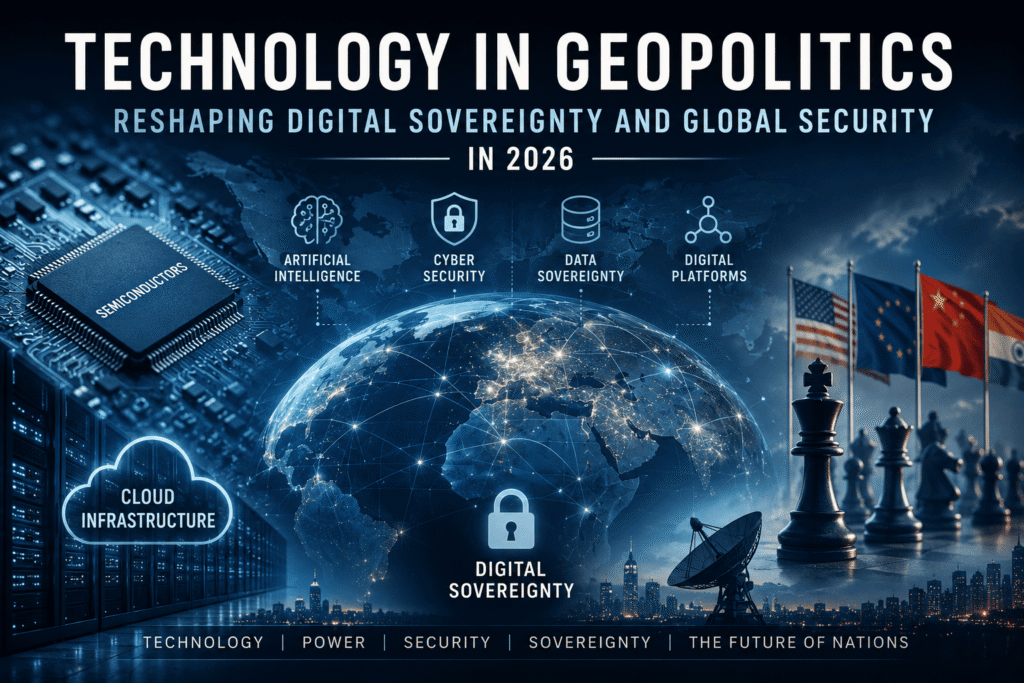

Technology is no longer separate from geopolitics. See how AI, chips, cloud infrastructure, and digital sovereignty are reshaping global security in 2026.
Quick Take
Technology has moved from the margins of geopolitics to its center. Today, control over artificial intelligence, semiconductors, cloud infrastructure, digital platforms, and strategic data increasingly shapes how states exercise power. Digital sovereignty is no longer a niche policy debate. It has become a national security priority.
A country may possess military capability and economic influence, yet remain strategically vulnerable if critical digital systems depend on foreign infrastructure or external technology ecosystems. This is why technology in geopolitics matters far beyond the tech sector.
This GeoTech pillar explains how digital power is reshaping state sovereignty, why AI and chip competition matter, how cloud dependence creates hidden risks, and why India is emerging as one of the most important strategic test cases in the global technology race.
How Technology in Geopolitics Is Redefining Digital Sovereignty and National Power
For decades, geopolitical power was measured through familiar indicators. Military strength, economic size, industrial capacity, geographic advantage, and diplomatic alliances defined how states projected influence. These foundations still matter, but they no longer tell the full story.
A new layer of power has emerged, and it is deeply technological.
Today, the systems that move information, power economies, coordinate public services, and shape public opinion are increasingly digital. This means control over technological infrastructure is no longer simply a development issue. It is a strategic issue.
A cyberattack can disrupt transportation, financial systems, or government services without a conventional military confrontation. A semiconductor export restriction can slow an AI ecosystem or weaken industrial ambitions. Dependence on foreign cloud infrastructure can create exposure during diplomatic friction. Social media platforms can influence how crises are perceived before official institutions even respond.
This is the strategic reality behind the growing importance of technology in geopolitics.
Technology no longer merely supports state power. It increasingly defines how power is exercised, constrained, or contested. Countries that control critical digital infrastructure gain leverage. Countries that remain structurally dependent often discover their vulnerabilities only when pressure rises.
Across GeoInflux’s GeoTech coverage, this shift has already appeared through multiple strategic developments. Our analysis of AI power competition explores how artificial intelligence is becoming a core instrument of geopolitical influence
Similarly, our work on cloud infrastructure and national security shows why digital dependency can create hidden strategic exposure
This pillar connects those themes into one broader strategic framework. At its core, the question is straightforward: when national interests are tested, who controls the technological systems your country depends on?
That question increasingly defines sovereignty itself.
Also Read
- Why India-Bangladesh Border Tensions Are Rising Again in 2026?

- Can You Get a High-Paying Tech Job in the AI Era of Mass Layoffs with Free MIT Courses? (2026 Guide)

- India’s Rotating Detonation Engines Breakthrough: Is This the End of Jet Engines?

- Trump NATO Exit Strategy: The Secret Prelude to an Israel-Turkey War in 2026?
- BLA Naval Attack Jiwani 2026: The Saudi-Pakistan SMDA Activation and UAE Debt Crisis Explained

- The Global AI Race 2026: WhyAI Sovereignty is the New Oil
What Is Technology in Geopolitics and Why Has It Become a Core National Security Issue?
Technology in geopolitics refers to the growing role of critical technologies in shaping international power, strategic competition, national resilience, and diplomatic leverage. It describes the intersection where technological capability becomes a geopolitical asset.
This is not limited to military technology. The modern geopolitical technology stack includes artificial intelligence, semiconductor manufacturing, cloud infrastructure, cyber capabilities, digital platforms, telecommunications systems, satellite networks, advanced computing, and data governance frameworks.
The reason this matters is simple. Modern states increasingly depend on these systems for governance, security, communication, economic productivity, and crisis management.
Artificial intelligence is becoming central to defense analysis, economic competitiveness, automation, intelligence processing, and decision support. Semiconductor control determines access to computing power, advanced manufacturing, and AI infrastructure. Cloud infrastructure increasingly hosts government operations, enterprise systems, and digital public services. Social media platforms shape information flows and public narratives on a massive scale.
In earlier geopolitical eras, states competed over land routes, energy corridors, ports, and industrial production. Today, strategic competition increasingly includes compute capacity, chip supply chains, digital infrastructure, and data access.
That is why governments around the world have begun treating technology policy as strategic policy.
The United States has used export controls to restrict access to advanced chips. China has prioritized domestic technological self-reliance. Europe has focused on regulatory sovereignty. India is expanding domestic semiconductor design, digital infrastructure, and AI capability as part of a broader strategic transition.
GeoInflux has tracked India’s semiconductor localization efforts as part of this wider sovereignty conversation. Our analysis of India’s semiconductor mission also highlights how chip capability is increasingly tied to strategic independence.
Technology has become geopolitical because dependence creates vulnerability, concentration creates leverage, and control creates strategic autonomy.
This shift is no longer theoretical. It is already shaping policy choices across major powers.
What Does Digital Sovereignty Actually Mean in the Age of Technology Power?
Digital sovereignty is often used as a political slogan, but in strategic terms, it has a much more practical meaning.
At its core, digital sovereignty refers to a state’s ability to exercise meaningful authority over the digital systems that support governance, security, economic activity, and crisis response. It is less about symbolic self-reliance and more about operational control.
A country may be highly digitized while remaining strategically dependent. That distinction is critical.
A nation can run digital payment systems, online governance platforms, AI services, cloud-based administration, and connected public infrastructure, yet still rely heavily on external providers for critical technology layers. If data storage, AI compute, semiconductors, cloud services, or platform enforcement depend on foreign actors, strategic autonomy becomes conditional.
That is where digital sovereignty becomes a national security concern. GeoInflux explored this issue in depth in our dedicated analysis on why digital sovereignty became a major security issue in 2026.
This broader pillar builds on that foundation. Digital sovereignty can be understood through several practical dimensions.
- Data sovereignty concerns who controls access to strategic information, citizen records, institutional datasets, and national digital assets.
- Infrastructure sovereignty concerns ownership or control over cloud systems, connectivity networks, data centers, and digital backbone infrastructure.
- Compute sovereignty addresses access to advanced processing capacity, particularly for AI development.
- Platform sovereignty asks whether governments can effectively enforce domestic law on influential digital intermediaries.
- Supply chain sovereignty focuses on resilience against technological chokepoints.
No country achieves absolute independence across every layer. Even major powers remain interconnected. The strategic issue is not complete self-sufficiency. It is excessive dependence in critical areas.
If a crisis disrupts access to key technologies, slows data access, or constrains digital response capacity, sovereignty becomes weaker in practice, regardless of formal legal authority.
Digital sovereignty is therefore not about isolationism. It is about ensuring that digital dependence does not translate into geopolitical vulnerability.
How Did Platforms Become Quasi-Sovereign Power Centers?
One of the most important changes in modern geopolitics is the rise of private technology platforms as strategic power centers.
Historically, governments and public institutions played a dominant role in shaping information environments during national crises. Today, that landscape has changed dramatically.
Social media platforms, search ecosystems, messaging services, and algorithm-driven distribution networks increasingly shape what citizens see, discuss, and react to before governments can establish official narratives.
This influence does not make platforms sovereign in the formal sense. They do not govern territory or possess constitutional authority. Yet their ability to shape visibility, public discourse, and information flows gives them influence that often resembles quasi-sovereign power.
That influence becomes especially significant during moments of instability.
During elections, protests, terror incidents, diplomatic escalations, or misinformation campaigns, digital platforms often become the first arena of public reaction. Platform design choices can influence what spreads rapidly, what remains suppressed, and how emotional escalation unfolds.
GeoInflux’s analysis of the Delhi terror incident examined how digitally connected environments can shape crisis dynamics:
The broader strategic lesson is clear. Modern crises increasingly begin in digital space before they fully unfold in physical space. This creates a governance challenge for states.
Governments are expected to maintain order, counter misinformation, enforce the law, and protect public confidence. Yet the communication ecosystems through which those battles unfold are often privately controlled. This raises difficult national security questions.
Can governments secure rapid compliance during emergencies? Can harmful narratives be contained fast enough? What happens when platform moderation policies conflict with domestic crisis priorities? How much enforcement power do states truly possess over transnational digital intermediaries?
These questions are no longer niche regulatory concerns. They are part of the new geopolitics of digital power.
Why Has Data Become the New Strategic Resource in Technology in Geopolitics?
In earlier geopolitical eras, strategic resources were tangible. Oil, shipping routes, industrial metals, and manufacturing capacity often determined national strength. In the digital era, data has joined that list.
Data is not simply an economic asset. It is increasingly a strategic asset.
Governments rely on data for governance, intelligence assessment, public service delivery, law enforcement, economic planning, and national security operations. Private firms rely on it for AI training, predictive systems, targeted services, and platform optimization. Militaries increasingly depend on data-intensive decision environments.
This is why data governance has moved beyond privacy debates. In geopolitical terms, the central issue is control. Who stores strategic data? Under which jurisdiction does it fall? Who can access it during emergencies? How quickly can lawful requests be enforced? What happens if data access becomes entangled in cross-border legal or diplomatic friction?
These are no longer abstract questions.
A digitally dependent state may have legal claims over information generated within its borders, yet practical access can still be delayed if infrastructure, cloud hosting, or service providers are externally controlled. That creates a sovereignty gap between legal authority and operational reality.
Data also creates leverage because AI systems depend on it. Countries that combine data access with computing power and algorithmic capability gain structural advantages in economic competition, surveillance capacity, and digital governance.
This is why digital sovereignty cannot be separated from data sovereignty.
Control over data increasingly influences intelligence capability, technological competitiveness, and crisis response effectiveness. In the age of technology in geopolitics, information control has become a strategic power multiplier.
Why Do Semiconductors and AI Compute Define the New Global Power Hierarchy?
If data is the strategic resource of the digital era, semiconductors are the infrastructure that makes that resource useful. Without chips, digital sovereignty remains incomplete.
Semiconductors power smartphones, servers, telecommunications networks, satellites, defense systems, industrial automation, cloud infrastructure, and artificial intelligence ecosystems. Advanced AI systems, in particular, depend heavily on high-performance compute capacity, which makes chip access a strategic issue rather than merely an industrial one.
This is why semiconductor geopolitics has become one of the most consequential arenas of modern strategic competition.
The concentration of advanced semiconductor manufacturing in a small number of geographies creates structural vulnerability for much of the world. States that rely heavily on imported chips remain exposed to supply disruptions, export restrictions, diplomatic friction, or broader geopolitical escalation.
The United States has already demonstrated how export controls can be used as strategic instruments. China has responded by accelerating domestic semiconductor development. Other countries, including India, increasingly recognize that chip capability is tied directly to technological sovereignty.
GeoInflux has tracked this shift extensively. Our analysis of chip geopolitics and AI power explores how semiconductor control increasingly shapes geopolitical leverage.
India’s semiconductor design localization effort reflects the broader strategic need to reduce dependency in critical technology ecosystems. The Vikram-32 and semiconductor mission story also signals how domestic capability building is becoming part of India’s longer-term sovereignty strategy.
GeoInflux’s coverage of the Dhruv64 microprocessor similarly highlights why indigenous computing architecture matters in sovereignty conversations.
The semiconductor issue goes beyond manufacturing. Modern AI power depends on compute access. Compute access depends on advanced chips. Advanced chips depend on highly concentrated supply chains, specialized manufacturing, design ecosystems, and geopolitical relationships.
That means AI competition is inseparable from semiconductor geopolitics. Countries without reliable compute access risk falling behind not only economically, but strategically.
This is why chip sovereignty is increasingly discussed alongside digital sovereignty.
How Does Cloud Infrastructure Create Hidden Strategic Dependence?
Cloud infrastructure is often treated as a technical efficiency story. In geopolitical terms, it is much more than that.
Modern governments, enterprises, digital platforms, and increasingly AI ecosystems depend on cloud infrastructure for storage, computation, resilience, and service delivery. Public services, analytics systems, enterprise workloads, communications infrastructure, and sensitive digital functions often run on cloud environments that most users never directly see.
This creates a hidden but powerful dependency layer. If critical infrastructure relies heavily on external providers, strategic autonomy becomes more complicated than it appears.
GeoInflux explored this directly in its cloud infrastructure and national security analysis. The central issue is not that foreign cloud infrastructure is inherently unsafe. The issue is concentration and dependence.
If a country’s critical systems depend disproportionately on a small number of foreign-controlled providers, several strategic questions emerge.
- How resilient are those systems during geopolitical tension?
- How quickly can domestic authorities secure emergency cooperation?
- What happens if legal jurisdiction becomes contested?
- How much control exists over data portability, continuity planning, or crisis override mechanisms?
Cloud concentration also affects AI sovereignty. Modern AI systems require scalable compute environments, model training infrastructure, storage ecosystems, and specialized hardware access. That means cloud infrastructure increasingly overlaps with AI power.
GeoInflux’s coverage of Google’s AI infrastructure push in India reflects this transition. Infrastructure partnerships can accelerate capability building, but they also raise long-term strategic dependency questions.
A digitally ambitious state must therefore distinguish between digital modernization and strategic autonomy. The two are related, but not identical.
Cloud dependence becomes particularly important because it is often invisible until pressure emerges. That makes it one of the most underestimated layers in technology geopolitics.
Why Do Modern National Crises Begin in Digital Space Before Physical Escalation?
One of the clearest shifts in technology in geopolitics is the changing character of crisis escalation.
Traditional crises often unfolded through visible physical events first. Military mobilization, border incidents, infrastructure attacks, or public unrest created immediate physical signals.
Today, many crises begin in digital environments. Information spreads before verification, Narratives harden before institutions respond, Misinformation amplifies uncertainty.
Coordination happens through connected networks. Public sentiment shifts in real time. This matters because perception increasingly shapes crisis outcomes.
A terror incident, cyberattack, diplomatic confrontation, or internal security event now unfolds simultaneously in physical and digital domains. Governments are no longer responding only to events themselves. They are also responding to rapidly evolving information ecosystems. We have examined this in Delhi terror analysis. The lesson extends far beyond a single incident.
Digital systems now influence how quickly panic spreads, how narratives are framed, how false claims circulate, and how institutional credibility is tested. Social platforms, encrypted communication networks, digital media ecosystems, and cyber vulnerabilities all shape the pace of escalation.
This creates a new strategic reality. National resilience now depends not only on physical preparedness, but also on digital preparedness. States must think about:
- information control capacity
- cyber resilience
- emergency digital coordination
- platform engagement mechanisms
- rapid response communication systems
- infrastructure continuity under stress
This is why digital sovereignty is not simply about economic modernization. It is about operational control during moments of instability. Technology in geopolitics has changed the battlespace.
Crises increasingly begin in code, networks, and information ecosystems long before conventional institutions fully react.
Who Controls the Global Digital Power Stack Today?
Understanding technology in geopolitics requires looking beyond individual headlines and examining the deeper architecture of digital power. Modern geopolitical influence increasingly depends on control across what can be described as the global digital power stack.
This stack is not controlled by a single country. Instead, power is distributed unevenly across multiple layers, with different states dominating different parts of the ecosystem.
The first layer is data. This includes the collection, storage, movement, and accessibility of strategic digital information. Data shapes governance, intelligence analysis, AI development, and economic decision-making.
The second layer is platforms. Social media networks, search engines, messaging systems, and digital intermediaries influence public narratives, information flows, and communication behavior at global scale.
The third layer is infrastructure. This includes cloud computing environments, data centers, connectivity systems, undersea cables, digital backbone architecture, and the increasingly strategic compute ecosystems that support AI.
The fourth layer is compute and semiconductor capability. Advanced AI systems, industrial automation, high-performance computing, and modern digital infrastructure depend heavily on semiconductor access and processing power.
The fifth layer is standards and governance. Technical standards often shape long-term power because the systems that define interoperability frequently determine who sets the rules others follow.
Different powers dominate different layers.
- The United States maintains strong influence across platforms, cloud infrastructure, advanced AI ecosystems, and semiconductor design leadership.
- China has built significant domestic platform power, large-scale digital governance capability, and growing technological self-reliance, though advanced chip dependence remains a challenge.
- Europe exercises influence primarily through regulatory frameworks rather than ownership dominance.
- India is rapidly expanding digital scale but remains in a transition phase across several strategic layers.
No state controls everything. But dominance across even two or three critical layers can generate enormous geopolitical leverage. This is why technology competition increasingly resembles strategic power competition rather than ordinary market rivalry.
How Are Major Powers Building Digital Sovereignty Strategies?
Different countries have reached the same broad conclusion: digital dependence creates strategic risk. Their responses, however, differ sharply.
How Does the United States Approach Technology Power?
The United States benefits from one of the strongest positions in the modern digital power ecosystem. Its influence spans major cloud infrastructure providers, AI ecosystems, semiconductor design leadership, digital platforms, and advanced research networks.
American strategy often combines public policy with private technological strength. This model allows strategic influence without requiring direct state ownership across every layer. Export controls, industrial incentives, strategic partnerships, and standards influence become tools of geopolitical competition.
The semiconductor export control strategy is a clear example. Access restrictions can alter the technological trajectory of competitors without traditional military confrontation. This reflects a model where corporate technological leadership aligns, directly or indirectly, with national strategic advantage.
Why Does China Focus on Technological Self-Reliance?
China’s approach is more state-directed. Its digital sovereignty strategy emphasizes domestic ecosystem control, local platform dominance, data governance authority, and reduced external dependency.
This approach emerged partly from vulnerability concerns. Dependence on foreign semiconductors, software ecosystems, and strategic technologies created structural risk.
China’s response has included domestic semiconductor investment, AI ecosystem development, tighter platform governance, and broader technological localization. The goal is not isolation. The goal is strategic resilience under geopolitical pressure.
Why Does Europe Prioritize Regulatory Sovereignty?
Europe’s model is distinct. Unlike the United States or China, Europe does not dominate global digital ownership at comparable scale. Its strength lies more in governance influence.
Regulatory frameworks around privacy, competition, digital governance, and platform accountability have become Europe’s strategic instruments. This gives Europe meaningful normative influence, though infrastructure ownership limitations create a different set of strategic constraints.
Europe demonstrates that governance power remains relevant, but ownership and capability still matter.
Why Is India Building a Hybrid Strategy?
India’s model is still evolving. Unlike the United States, India does not yet control dominant global platform ecosystems or advanced semiconductor manufacturing capacity.
Unlike China, it has not pursued a fully state-controlled digital architecture. Unlike Europe, it cannot rely primarily on regulation while remaining strategically dependent.
This creates a hybrid strategic path. India is simultaneously expanding digital public infrastructure, semiconductor capabilities, AI ambitions, sovereign technology initiatives, and digital governance frameworks.
The challenge is scale versus sovereignty. India’s digital growth has been extraordinary. But strategic autonomy requires deeper control over the infrastructure layers that support that growth. That is why India has become one of the most important strategic case studies in technology in geopolitics.
Why Is India the Most Important GeoTech Test Case?
Few countries illustrate the tensions between digital expansion and strategic dependence as clearly as India.
India is one of the world’s largest digital societies. Its payment infrastructure, identity systems, digital public services, startup ecosystem, connectivity expansion, and technology adoption have transformed governance and economic participation at remarkable scale.
Yet scale alone does not guarantee sovereignty. This is the strategic paradox. A country can be digitally advanced while remaining structurally dependent in critical technology layers. India’s ambitions increasingly reflect awareness of this gap.
Semiconductor localization efforts, indigenous processor development, AI ecosystem expansion, and strategic infrastructure investments all point toward a longer-term sovereignty agenda. Our semiconductor and sovereignty coverage reflects this broader shift
India’s technology trajectory also includes infrastructure partnerships and AI ecosystem development, which create both opportunities and questions about dependency. The broader challenge is balancing openness with resilience.
India cannot realistically pursue technological isolation. Nor should it. Its strategic objective is better understood as selective autonomy in critical systems while remaining globally integrated.
That makes India one of the most compelling GeoTech test cases. The decisions India makes on chips, cloud infrastructure, AI governance, data sovereignty, and digital resilience will help shape the strategic future of emerging digital powers.
What Will Define the Next Phase of Technology in Geopolitics?
The next phase of technology geopolitics will likely be defined by control over increasingly strategic digital chokepoints.
Artificial intelligence will become even more central to economic competition, military capability, governance automation, and information influence. This means AI sovereignty debates will intensify.
Semiconductor competition will remain foundational because compute access determines who can scale advanced AI ecosystems.
Cloud sovereignty will become more politically sensitive as digital infrastructure concentration deepens.
Cyber resilience will increasingly overlap with national security planning rather than remaining a specialist technical issue.
Platform governance tensions will continue as governments seek greater crisis control while global digital intermediaries retain transnational influence.
Emerging technologies such as advanced propulsion, defense innovation, and strategic industrial technologies will also matter.
GeoInflux’s coverage of strategic innovation, including India’s rotating detonation engine breakthrough, reflects how sovereignty debates increasingly extend beyond software and digital systems into broader advanced technology ecosystems:
A larger geopolitical question will shape this transition. Will the world move toward fragmented sovereign technology blocs, or toward competitive but interoperable strategic ecosystems?
That question remains unresolved. What is already clear is this: technology will increasingly determine how geopolitical power is accumulated, defended, and contested.
What Does This GeoTech Pillar Establish?
This GeoTech pillar establishes a core strategic reality. Technology is no longer simply a sector of economic policy. It has become a foundational component of geopolitical power.
Digital sovereignty is not about symbolism or technological nationalism. It is about preserving strategic autonomy in systems that increasingly define governance, crisis response, economic resilience, and national security.
Semiconductors, AI compute, cloud infrastructure, digital platforms, and data governance are no longer technical side issues. They are instruments of state power.
Countries that control critical technology layers gain leverage. Countries that remain structurally dependent face growing strategic constraints. India’s trajectory makes it one of the most important countries to watch in this transformation. GeoTech exists to track exactly this shift.
Frequently Asked Questions
What does technology in geopolitics mean?
Technology in geopolitics refers to the role of critical technologies in shaping international power, national security, diplomacy, and economic competition. This includes artificial intelligence, semiconductors, cloud infrastructure, cyber capabilities, digital platforms, and strategic data systems. As countries increasingly depend on digital infrastructure, technology has become a direct instrument of geopolitical influence rather than just a supporting economic sector.
What is digital sovereignty in simple terms?
Digital sovereignty means a country’s ability to maintain practical control over the digital systems it depends on for governance, security, and economic activity. This includes control over data, cloud infrastructure, computing capability, and legal authority over digital platforms. It does not mean complete isolation from global technology, but reducing dangerous strategic dependence.
Why are semiconductors so important in geopolitics?
Semiconductors power modern economies, AI systems, telecommunications, defense technologies, and cloud infrastructure. Because advanced chip production is concentrated in a small number of countries and firms, access to semiconductors has become a major strategic issue. Countries without reliable chip access face economic and national security risks.
Why is cloud infrastructure considered a national security issue?
Cloud infrastructure increasingly hosts critical digital operations, including public services, enterprise systems, and AI environments. Heavy dependence on external providers can create strategic vulnerabilities during geopolitical crises, legal disputes, or infrastructure disruptions. That is why cloud control has become part of digital sovereignty discussions.
How does artificial intelligence affect geopolitics?
Artificial intelligence affects geopolitics by influencing economic productivity, military modernization, intelligence analysis, cyber defense, and strategic competition. Countries leading in AI development gain long-term technological and geopolitical advantages, especially when they also control compute infrastructure and semiconductor supply chains.
Why is India important in technology geopolitics?
India is important because it combines massive digital scale with growing ambitions in semiconductors, AI, and digital infrastructure. At the same time, it still faces dependency challenges in several critical technology layers. This makes India one of the most important test cases for how emerging powers pursue digital sovereignty without technological isolation.
End Note
Technology has become one of the defining instruments of modern geopolitical power. The most important strategic competition of the coming decade will not be shaped only by military strength or economic size, but by who controls the digital infrastructure, computing power, semiconductor ecosystems, AI capability, and governance frameworks that modern states increasingly depend on.
Digital sovereignty is no longer optional policy language. It is becoming a practical measure of strategic autonomy. For countries like India, the challenge is not choosing between global integration and sovereignty. The real challenge is building resilience, capability, and leverage while remaining deeply connected to the global technology ecosystem. That tension will define the next era of GeoTech.
Featured Sources and Strategic References
Official and Strategic Research
- Observer Research Foundation (Digital Sovereignty / Strategic Tech Analysis)
- Center for Strategic and International Studies (Technology Policy & National Security)
- OECD Digital Policy and Data Governance
- European Commission Digital Strategy
- RAND Emerging Technology Research
- World Economic Forum Digital Sovereignty Analysis
GeoInflux GeoTech Related Reads
AI and Strategic Competition
How AI Geopolitics Is Reshaping Global Power in 2025
Cloud Infrastructure and National Security
Why Cloud Infrastructure Has Become a National Security Issue in 2026
Digital Sovereignty and Governance
Why Digital Sovereignty Became a National Security Issue in 2026
Semiconductor Geopolitics
- Chip Geopolitics, AI Power, and India’s Strategic Future
- India’s Semiconductor Design Ecosystem and Localization ush
- India Semiconductor Mission 2025 and Vikram-32 Explained
Indigenous Technology Sovereignty
Dhruv64 and India’s Technology Sovereignty Ambitions
Crisis Technology and Security
Delhi Blast 2025 and the Rise of Tech-Enabled Terrorism
AI Infrastructure and Strategic Capacity
Google AI Hub in Visakhapatnam and India’s Digital Future
Strategic Innovation and Advanced Technology
India’s Rotating Detonation Engine Breakthrough Explained
 2
2
 20
20
 20
20







Pingback: Why Digital Sovereignty Is Now A National Security Issue In 2026? GeoInflux