
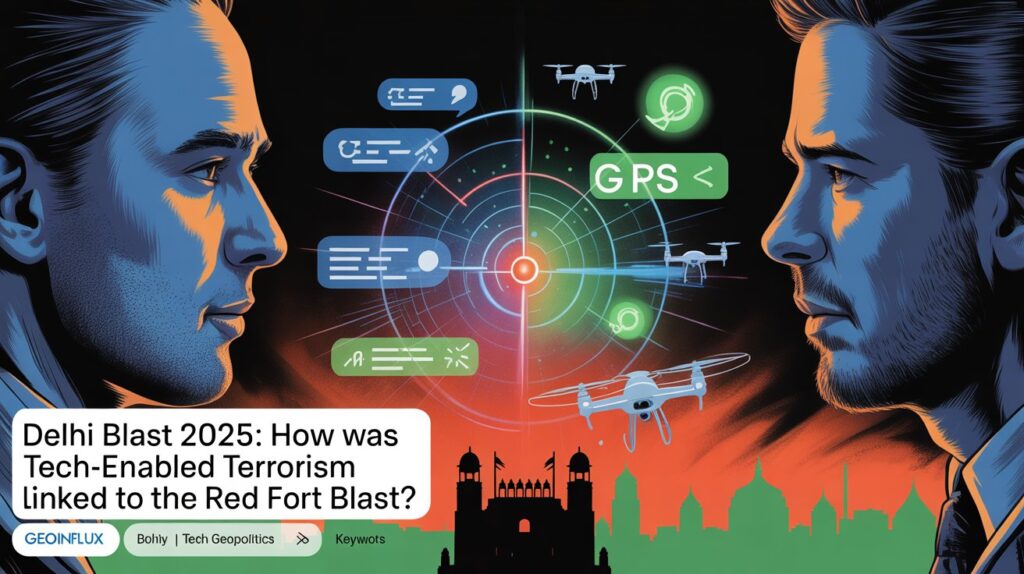

The Delhi Blast 2025 shows how tech-enabled terrorism works. Groups used encrypted apps, dark-web platforms, drones, GPS modules, and digital obfuscation to evade detection. This report explains how these tools shaped the attack and why agencies struggled.
Quick Take
Tech tools shaped how cross-border terror networks planned the Delhi blast 2025. Encrypted apps block metadata. Dark-web markets supplied detonators and SIM boxes. GPS timers and remote triggers made the device precise and hard to jam. Drones supported recon inside Delhi. Identity scrubbing tools hid the attackers across states.
These points link with the wider analysis in the Delhi Blast 2025: The Real Reason Behind the Red Fort Attack and the 7 Failures It Exposed report, which shows how these methods fit into hybrid warfare threats backed by state-supported networks. Digital radicalisation in India added another layer because online propaganda networks guide new operatives.
The case revealed security gaps. Agencies lacked real-time data sharing, modern forensics, and anti-drone systems. These digital tools helped the module operate inside the capital without early detection.

How Did Tech Tools Strengthen the Delhi Blast Module?
Terror networks now depend on cheap digital tools that lower risk and hide movement. The Delhi blast 2025 shows how these systems change the way urban modules operate. Each tool solved a specific problem for the attackers.
Encrypted communication hid the command chain. GPS modules handled timing without live signals. Drones mapped routes and patrol gaps. Dark-web marketplaces supplied hardware without physical contact. Identity scrubbing removed device links, telecom trails, and online footprints.
These tools helped the module avoid early detection. They also reduced the need for large teams or direct contact with handlers across the border. The entire workflow became decentralised, anonymous, and harder to trace. This gave the group the freedom to plan inside Delhi while keeping the coordination network outside India’s legal and operational reach.
This section explains how each tool worked and why India’s grid failed to stop the attack.
Background: Why Are Cross-Border Terror Networks Embracing Tech-Enabled Terrorism?
Cross-border handlers are shifting to tech-enabled terrorism because it lowers cost, reduces exposure, and removes the need for physical contact. Digital workflows let handlers guide operatives inside India without crossing borders or using large support networks. This makes the entire structure harder to detect. It also lets small teams carry out attacks that once required complex logistics.
Encrypted apps, anonymous payment channels, dark-web markets, and remote activation tools allow handlers to run modules from outside India. A single person abroad can manage communication, supply instructions, and supervise the attack cycle. These tools also help bypass traditional intelligence triggers like suspicious travel, money movement, or phone calls.
The Delhi blast 2025 fits this model. The module used encrypted chats, GPS timing, drones, and identity scrubbing to stay hidden. These methods mirror the shifts documented in the GeoInflux investigation “Delhi Blast 2025: The Real Reason Behind the Red Fort Attack and the 7 Failures It Exposed.” That analysis shows how cross-border networks now depend on small, digitised workflows instead of large training camps or physical meetings.
This new system gives handlers more control, reduces risk, and takes advantage of gaps in India’s surveillance and forensic infrastructure.
How Do Encrypted Apps Support Tech-Enabled Terrorism Linked to the Delhi Blast 2025?
Terror cells depend on encrypted apps to communicate. Signal, Telegram, Threema, and Briar block metadata and hide movement patterns. Messages vanish. Files auto-delete. Proxy chains erase trails.
This slowed the Delhi blast investigation. Device logs stayed locked. The command chain between handlers in Pakistan and operatives in India stayed hidden.
Short points with context:
- Encrypted apps block surveillance and make timelines unclear.
- Vanishing messages remove all evidence of coordination.
- Proxy chains hide location data.
- Device-level encryption delays forensic recovery.
How Do Dark-Web Platforms Help Cross-Border Terror Networks Plan Attacks?
Groups used dark-web markets to buy detonators, SIM boxes, remotes, and crypto wallets. TOR routes hide identity. Closed forums share manuals for IED building, GPS timing, and covert communication.
This matches procurement patterns seen in other cross-border operations examined in this post Delhi Blast 2025: The Real Reason Behind the Red Fort Attack and the 7 Failures It Exposed.
Short points with context:
- TOR hides the user’s identity.
- Hidden markets supply hardware.
- Forums post IED tutorials.
- No open logs exist for investigators.
How Did GPS and Remote Triggers Change the Execution of the Delhi Blast 2025?
GPS modules helped the attackers set exact timing. Remote triggers reduced human exposure. Older jammers did not stop the device because it used internal clocks and low-frequency activation.
Short points with context:
- GPS improves timing accuracy.
- Remote triggers let operatives leave early.
- City jammers fail against modern modules.
- More precision increases overall impact.
How Did Drones Help the Module Bypass India’s Security Grid?
Drones mapped routes, watched patrol movement, and helped plan the cleanest escape paths. Many Indian cities lack anti-drone coverage.
Punjab and J&K face similar cross-border drone drops, which links this attack to wider hybrid warfare activity.
Short points with context:
- Drones avoid ground patrols.
- They record real-time visuals.
- Cross-border drops strengthen supply chains.
- Small drones operate under radar detection.
How Did Digital Obfuscation Help the Module Avoid Detection?
Attackers used VPN chains, spoofed IMEIs, VoIP calls, and forged IDs. Public WiFi created another layer of anonymity.
Short points with context:
- VPN chains hide IP origins.
- Spoofed IMEI blocks device linking.
- Public WiFi hides the actual user.
- Fake IDs break SIM tracing.
Why Did Metadata Blind Spots Slow the Delhi Blast Investigation?
India’s agencies use separate databases. They lack real-time integration. Old analytic tools slow pattern detection. Encrypted device logs take time to unlock.
Short points with context:
- Fragmented databases delay matching.
- Outdated analytics reduce speed.
- Locked logs slow early-stage leads.
- Coordination gaps help handlers escape.
What Should India Upgrade to Counter Tech-Enabled Terrorism?
India needs unified metadata access, modern digital forensics, AI CCTV networks, and counter-drone systems. These upgrades must match the pace of modern hybrid warfare threats.
Short points with context:
- AI CCTV improves tracking.
- Anti-drone grids secure cities.
- Unified data systems help all agencies.
- Faster device access reduces delays.
- Better forensics improves early accuracy.
- Live threat mapping helps detect modules.
Strategic Insight: How Does This Fit the Larger Hybrid Warfare Threat Against India?
The Delhi blast shows how hybrid warfare has shifted toward small, low-cost, tech-driven operations. State-backed handlers no longer depend on large networks or physical training camps. They use encrypted apps, digital obfuscation, dark-web markets, drones, and GPS modules to guide operatives inside India with minimal contact. This reduces risk for the handlers and increases pressure on Indian agencies.
These attacks also test India’s ability to detect, trace, and respond quickly. Every delay exposes a structural weakness. Fragmented databases, slow log access, outdated surveillance grids, and weak anti-drone systems give cross-border networks room to operate. The attack model forces India to modernise or fall behind.
Hybrid warfare in South Asia now includes digital workflows, remote activation, covert financing, and psychological influence campaigns. Terror modules blend physical attacks with online propaganda, misinformation, and digital radicalisation. The goal is simple: create instability inside India without triggering direct conflict.
The Delhi blast fits this pattern. It used cheap hardware, remote handlers, and low visibility. It avoided traditional intelligence triggers. It created a security challenge without crossing the threshold of conventional war. This is the new template of hybrid pressure on India.
Recap: What Tech Tools Shaped the Delhi Blast 2025?
| Tool | Purpose | Impact |
|---|---|---|
| Encrypted apps | Coordination | Blocks metadata and slows tracing |
| Dark web | Procurement | Clean supply chain with no logs |
| GPS modules | Timing | High precision and low detection |
| Drones | Recon | Maps routes and patrol gaps |
| Obfuscation tools | Identity cover | Breaks device and IP matching |
FAQs
How Did Tech-Enabled Terrorism Change the Delhi Blast 2025 Investigation?
The Delhi blast investigation slowed because the module used encrypted communication, GPS timers, and dark-web tools. Encrypted apps removed metadata that investigators normally use for timelines. GPS timers avoided live network signals. Dark-web procurement left no open logs. These factors created a blank zone in the early hours. Digital obfuscation removed device links, and spoofed IDs blocked telecom trails. India’s fragmented databases worsened delays. Agencies could not match device logs, movement records, and forensic data in real time. This helps explain why cross-border terror networks prefer tech-enabled terrorism for urban targets.
Why Are Cross-Border Terror Networks Using GPS, Drones, and Dark-Web Tools?
Cross-border networks use these tools because they reduce exposure and increase precision. GPS modules allow exact timing without remote signals. Drones support recon and supply drops. Dark-web markets supply parts without creating physical trails. These tools fit hybrid warfare patterns seen across South Asia. The goal is simple: maximise impact, minimise risk, and bypass India’s older security infrastructure.
Why Did India’s Metadata Systems Fail to Detect the Delhi Blast Module?
India still uses separate metadata systems across agencies. These systems lack real-time integration. This delays matching patterns that link handlers to operatives. Forensics teams also lack fast access to encrypted device logs. Most detection tools are designed for older communication methods, not modern encrypted networks. These limitations slowed the Delhi blast case.
Related Reads
- How the Delhi Blast Exposed India’s Digital Security Gaps
- Why Pakistan’s Proxy Strategy Drives Hybrid Warfare in India
- How Drone Warfare Is Changing India’s Border Security
- How Digital Radicalisation Builds Sleeper Cells in India
End Note
Tech-enabled terrorism is now the default method for cross-border terror networks. The Delhi blast 2025 shows why India needs stronger digital forensics, modern surveillance, and unified data access. These tools are simple, cheap, and effective. The response must be faster and more integrated.

Thanks for reading this GeoInflux report. Your time and attention help us study how technology shapes national security and foreign policy. For feedback or suggestions, reach out anytime.
References
Official Reports
- Ministry of Home Affairs
https://www.mha.gov.in - National Investigation Agency
https://www.nia.gov.in - CERT-In
https://www.cert-in.org.in - UN Security Council
https://www.un.org/securitycouncil
Research Papers
- ORF
https://www.orfonline.org - Carnegie India
https://carnegieindia.org - IDSA
https://idsa.in - Journal of Strategic Security
https://scholarcommons.usf.edu/jss
Media
- The Hindu
https://www.thehindu.com - Indian Express
https://indianexpress.com - Times of India
https://timesofindia.indiatimes.com
 2
2
 20
20
 20
20







Pingback: Delhi Blast 2025: The Real Reason Behind The Red Fort Attack And The 7 Failures It Exposed | Geoinflux GeoInflux