
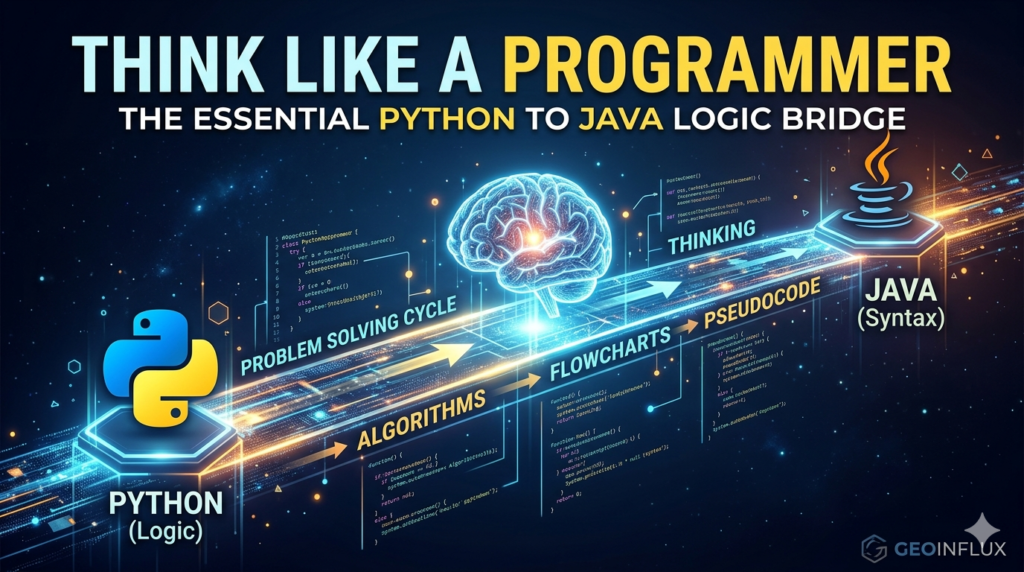

Introduction to Problem Solving: To program a solution for a problem, you should think in a specific way. Learn the problem-solving cycle, algorithms, and flowcharts for Python and Java.
What is Problem Solving in Programming? Problem solving is the systematic process of analyzing a problem and designing algorithms using tools like flowcharts and pseudocode to create an effective solution. It is the essential thinking phase that must occur before any code is written.
The 4-Step Problem-Solving Cycle
Programs are not quick creations. To develop efficient software, one must follow a disciplined methodology consisting of four major stages:
- 1. Analysis: Understand the problem minutely and identify processing components and their relationships.
- 2. Design: Find a solution and develop a step-by-step algorithm.
- 3. Coding: Translate the designed algorithm into a specific programming language.
- 4. Testing & Debugging: Find errors (testing) and rectify them (debugging) to ensure the program works correctly.
Once these steps are complete, the program must be documented, implemented for real users, and maintained to remove undetected errors or add new features.
Designing the Blueprint: Algorithms and Flowcharts
Before writing code, developers use two primary tools to map out their logic: Algorithms and Flowcharts.
1. The Algorithm
An algorithm is a set of rules that define how a problem can be solved in a finite number of steps.
Key Characteristics of a High-Quality Algorithm:
- Precision: Every step must be clearly and precisely defined.
- Finiteness: The algorithm must terminate after a limited number of steps.
- Effectiveness: Each operation must be doable in a finite time using basic methods.
- Definiteness: It must be clearly defined exactly what should be done at each stage.
2. The Flowchart
A flowchart is a pictorial representation of a step-by-step solution. It helps programmers visualize the sequence of operations. Standard symbols include:
- Oval: Represents the Start or Stop of the process.
- Parallelogram: Indicates Input or Output operations.
- Rectangle: Used for Processing (like arithmetic calculations).
- Diamond: Represents a Decision point (Conditional logic).
The “Java Bridge”: From Python Logic to Java Syntax
As you progress from Python to Java, you will notice that while the Problem Solving Cycle remains identical, the syntax becomes much stricter. In Python, you can often “figure it out as you go,” but Java requires a more rigid analysis phase.
Click to Learn Java with Oracle’s Java Tutorials.
Comparative Logic: Adding Two Numbers
Consider the logic for adding two numbers: Input N1, N2 → $S = N1 + N2$ → Print S .
| Feature | Python Implementation | Java Implementation |
| Variable Declaration | s = 0 (Dynamic) | int s = 0; (Static/Explicit) |
| Input Handling | n1 = input() | Scanner.nextInt(); |
| Statement Ending | New line | Semicolon (;) is mandatory |
| Type Safety | Implicit | Explicit (must define int, float, etc.) |
The Lesson: Python’s simplicity makes it excellent for learning the Analysis and Design phases. However, Java’s strictness forces you to become a better Tester and Debugger because errors are often caught before the code even runs.
Frequently Asked Questions
What is Pseudocode? Pseudocode is an informal language used to describe program steps without strict syntax. It is easy to understand, like English, and helps explain logic without being bound to a specific programming language.
What is the difference between Testing and Debugging? Testing is the process of finding errors in a program, while debugging is the process of correcting those found errors.
How do we measure the efficiency of an algorithm? Efficiency is governed by two main factors: Time-wise efficiency (how fast it runs) and Space-wise efficiency (how much memory/RAM it consumes).
What is a Dry Run? A Dry Run is the manual execution of code step-by-step on paper to track variable values and identify logical errors.
Conclusion
Mastering the Introduction to Problem Solving is the single most important step for any developer. Before touching code, you must decompose a complex problem into smaller, manageable parts.
By following the structured problem-solving cycle, from analysis to maintenance, you ensure your programs are not just functional, but efficient and scalable.
End Note
This post is the first in our “GeoInflux Python-to-Java Journey.” We are documenting the transition from Python’s beginner-friendly syntax to Java’s robust, enterprise-grade architecture. Master the logic today, and the syntax will follow tomorrow.
References and Citations
- The Problem-Solving Cycle: Methodology involving Analysis, Design, Coding, and Testing.
- Algorithm Constraints: Definiteness, effectiveness, and finiteness.
- Flowchart Standards: Pictorial representation using standardized logic symbols.
- Pseudocode Advantages: Informal, language-independent logic description.
- Efficiency Metrics: Factors governing time and space resources.
Get Latest AI Updates. Click Here
 2
2
 20
20
 20
20