


The Anthropic AI Usage Index 2025 reveals how AI adoption in India and coding automation are transforming the future of IT jobs in India amid automation vs augmentation. Learn how…
Quick Take: Future of IT Jobs in India
India’s AI engagement has hit a critical low point. The Anthropic AI Usage Index (AUI) puts India at 0.27, far below the 1.0 baseline expected for its massive workforce share. The issue isn’t low usage alone, but poor quality of engagement. Over half of India’s AI interactions focus on coding and software development, one of the easiest fields for full automation.
This narrow usage pattern means India is using AI to replace effort, not enhance ability. In contrast, countries like Singapore (AUI 4.57) and the US (3.62) use AI as a collaborative tool to boost problem-solving, learning, and creativity. As a result, they’re building smarter workers, while India risks training replaceable ones.
The future of IT jobs in India now depends on a clear pivot from AI automation vs augmentation. Workers must use AI to think, not delegate. Those who cultivate tacit knowledge, the unwritten organizational context that AI cannot learn, will survive the shift. Others may not.
Why Is India’s AUI a Warning Sign for the Future of IT Jobs in India?
India holds 18% of the global workforce but accounts for only 7.2% of premium AI usage. The Anthropic report’s AUI score of 0.27 exposes the gap between workforce size and AI adoption quality. It means India is operating at less than one-third of its expected rate.
Related Reads
- Apple’s iOS 26.1 Update: 9 iPhone New Features, Critical Security Fix, and a Global Digital Sovereignty Showdown | Geoinflux
- Apple iOS 26.1 Update 2025: Why India Still Lacks Support in New Apple Intelligence Languages and Digital Sovereignty Policy
- Stunning Apple iOS 26.1 Update 2025: The Truth Behind Liquid Glass Design, iPhone New Features, and Apple’s Bold Security Push
The data reveals a structural weakness. India is heavily focused on AI automation, not augmentation, using AI to replace tasks rather than enhance skills. This pattern points to a deeper issue: India’s top talent is training machines to replace them.
What Does the Anthropic AI Usage Index Measure?
The AUI tracks high-end usage of Anthropic’s Claude platform to gauge how professionals worldwide engage with AI tools. A score of 1.0 means a country’s usage matches its share of the global workforce. India’s 0.27 shows a serious imbalance.
Top performers like Singapore (4.57), the United States (3.62), and Canada (2.91) use AI far more intensively. The correlation is clear: AI adoption rises with national wealth, mirroring global GDP patterns.
Why Is India’s AI Usage Concentrated in Coding?
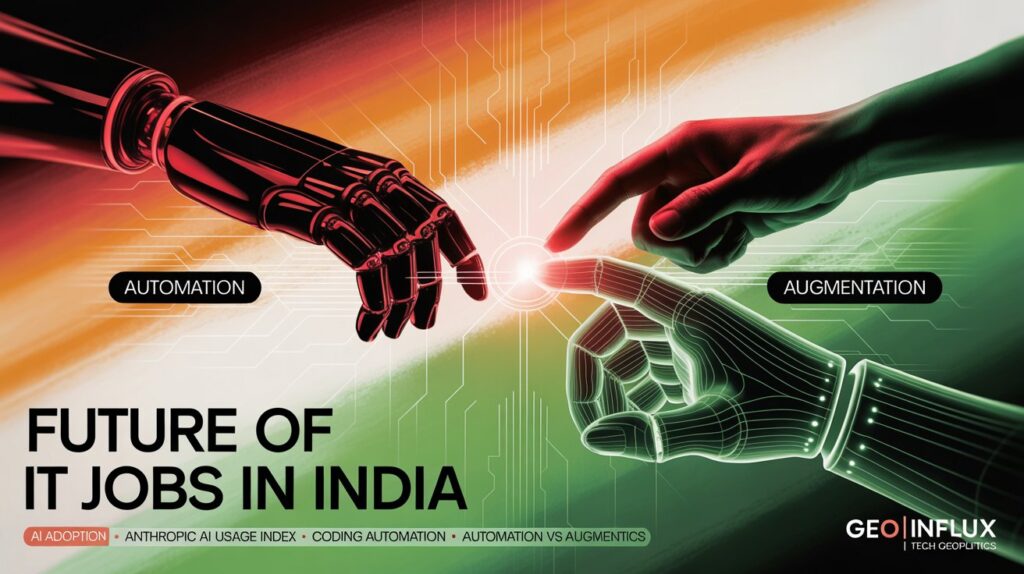
Over 50% of India’s AI usage is related to coding and software development, compared to one-third globally. Tasks like debugging, web app building, and code optimization dominate.
This is logical given India’s tech strengths, but it’s also dangerous. Coding is one of the easiest areas for AI to automate fully. By focusing AI on code execution, India is perfecting the job AI is built to replace.
How Is This Focus Creating a “Brutal Economic Reality”?
Coding tasks are logical, structured, and easily automated. As AI becomes better at understanding syntax and debugging, entry-level developer roles are disappearing. The “automation dividend” is replacing human efficiency with algorithmic speed.
India’s IT industry, one of its biggest employment engines, is already showing strain. Companies are reducing junior positions, a direct result of automation-driven efficiency.
What’s the Real Difference Between Automation and Augmentation?
- Automation replaces human effort. The worker delegates tasks to AI and learns nothing new.
- Augmentation expands human capability. The worker uses AI as a partner to test ideas, explore alternatives, and solve harder problems.
In automation, the AI learns and replaces. In augmentation, the human learns and evolves.
Why Is AI Automation Dangerous for India’s Workforce?
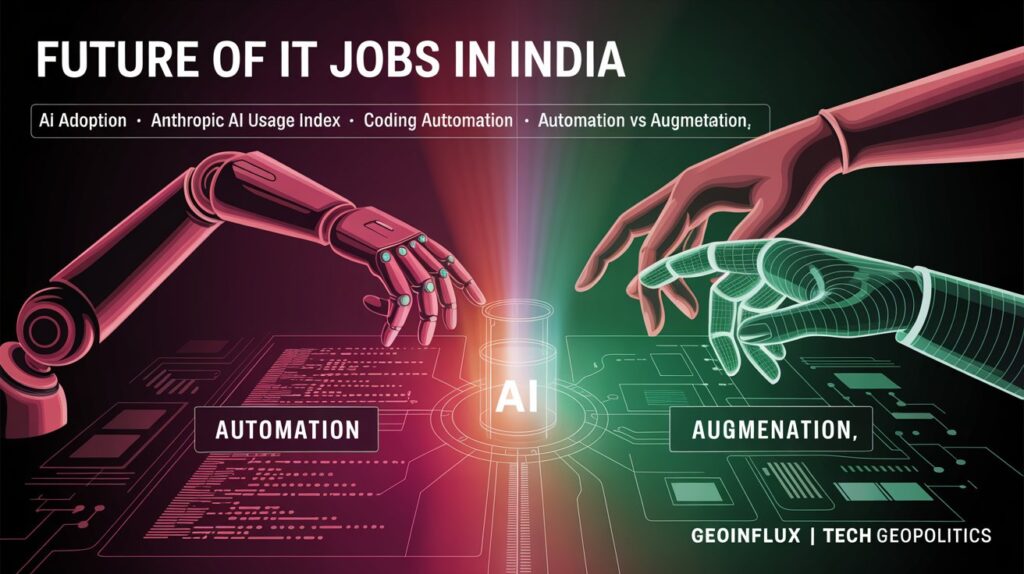
Because it strips away learning and creativity. When workers rely on AI to execute simple coding or documentation, they reinforce their own replaceability. Once tasks are automated, the human role vanishes.
The future of IT jobs in India depends on switching this mindset, AI must be used to augment knowledge, not outsource effort.
How Are High-Adoption Countries Using AI Differently?
Nations like Singapore and the US use AI to expand capability, not eliminate work. Their workers use tools like Claude and ChatGPT to explore complex scenarios, simulate strategies, and deepen understanding.
Their approach builds resilience. Instead of replacing workers, AI amplifies them. This is why AI-rich economies are widening the skill gap and securing their dominance.
Is India Already Losing Entry-Level IT Jobs?
Yes. Data shows 77% of enterprise AI usage globally replaces full tasks. Entry-level roles, routine coding, testing, or documentation are disappearing fastest.
- High Risk: Task-based jobs, clear inputs/outputs.
- Low Risk: Context-based roles, high problem-solving content.
Workers who handle ambiguity and context are harder to automate.
How Can Indian Workers Adapt to an Augmentation Model?
- Stop delegating. Use AI to analyze, not execute.
- Build tacit knowledge. Learn how your company thinks and operates.
- Engage with complexity. Work where AI struggles: context, synthesis, and human insight.
- Experiment and question. Use AI to challenge assumptions and build perspective.
This shift, from executor to synthesizer, is the only sustainable strategy.
Recap: Automation vs. Augmentation
| Feature | Automation (India’s Current Focus) | Augmentation (Global Leaders) |
|---|---|---|
| Goal | Replace human effort | Enhance human capability |
| Outcome | Faster results, no learning | Deeper learning, better thinking |
| Job Impact | Replaces entry-level roles | Creates context-rich expert roles |
| Task Type | Simple, structured (coding) | Complex, unstructured (strategy) |
FAQs
1. What’s the difference between AI automation and augmentation?
Automation means AI performs the task for you. Augmentation means AI helps you think better. The first removes effort; the second builds skill. High-AI nations are mastering augmentation to create smarter, more adaptive workers.
2. Why is India’s AI usage focused on coding?
India’s IT strength drives early adoption in software development. But over-reliance on coding tasks, which are easy for AI to automate, creates a long-term employment trap. To secure the future of IT jobs in India, AI must expand into strategy, business, and research tasks.
3. How does GDP per capita relate to AI adoption?
Wealthier countries have higher AUI scores. The global wealth map aligns with AI engagement, creating a feedback loop where rich nations get smarter, faster. For India, closing this AUI gap is essential to avoid a new “digital divide”.
4. How can workers protect their careers from AI automation?
Shift to high-context roles that rely on human judgement and tacit knowledge. Use AI as a tool to learn, not to offload. The more context you hold, the harder it is for AI to replace you.
5. What is tacit knowledge, and why does it matter?
Tacit knowledge is the unspoken, experiential understanding of how organizations really work, something AI can’t access. Workers who possess this insight become indispensable in the AI era.
6. Can India improve its low AUI score?
Yes, but only through deliberate change. India must pivot from automating code to augmenting intelligence, using AI to solve complex, cross-domain problems.
End Note
India’s AUI score of 0.27 is not destiny; it’s a warning. Professionals must decide whether to use AI to think or to disappear. The future of IT jobs in India will belong to those who learn to augment, not automate.
Thanks For Reading
Thank you for reading this GeoInflux analysis. We bring fact-driven insights on how technology and geopolitics are shaping the multipolar world.
References
- Anthropic – AI Usage Index 2025: Global Adoption and Workforce Trends
- Anthropic Research – September 2025 Economic Index Report
- Campus Technology – Anthropic Study Tracks AI Adoption Across Countries and Industries
- The Economic Times – India Tops Technical Claude Usage, Second-Largest Market for Anthropic
- World Economic Forum – Future of Jobs Report 2025
 2
2
 20
20
 20
20





Pingback: China’s Molten Salt Reactor (MSR) 2025 Breakthrough: 5 Reasons Thorium Reactors Are Key To Energy Independence GeoInflux
Pingback: Indian Chip Startup Mindgrove Redefines Chip Design In India: Inside India’s First Fabless Semiconductor And IoT SoC Breakthrough 2025 GeoInflux