
The India-EU Free Trade Agreement is the largest strategic trade pact India has signed. This pillar guide explains how it reshapes trade, technology rules, supply chains, and global power alignment
Quick Take
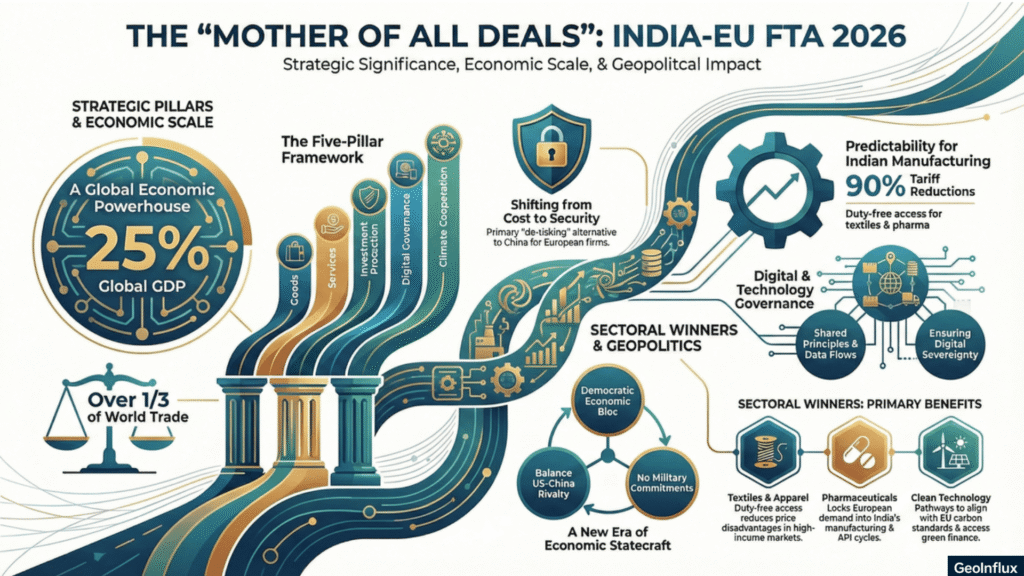
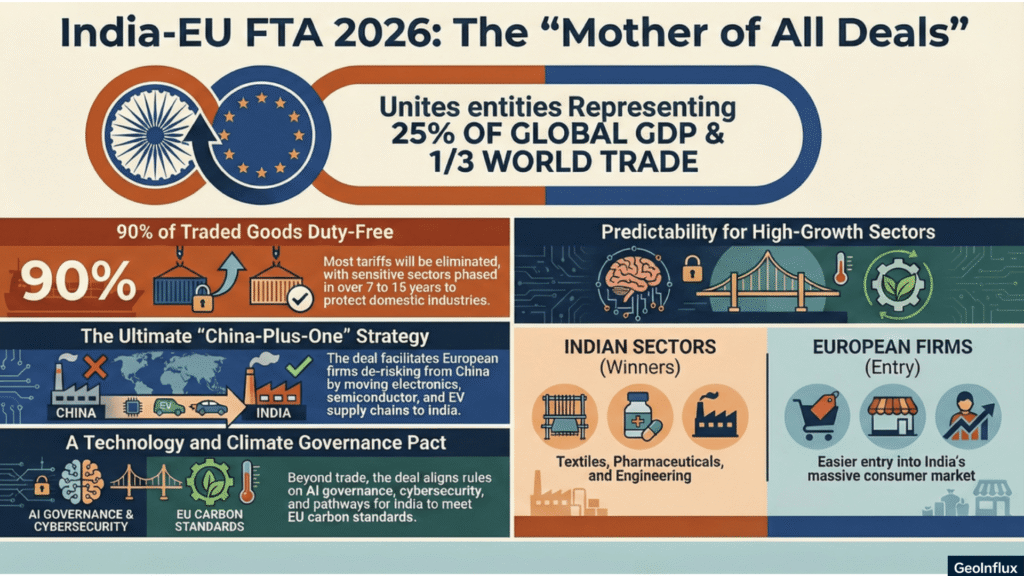
The India–EU Free Trade Agreement 2026 is being referred to as the “mother of all deals” due to its scale, scope, and timing. Together, India and the European Union account for nearly 25 per cent of global GDP and over one third of world trade.
The agreement cuts tariffs, opens services, rewires supply chains, and aligns digital and climate rules. For India, it anchors manufacturing, exports, and strategic autonomy. For the EU, it reduces dependence on China and secures long-term access to the fastest-growing major economy.
This deal is not about trade alone. It is about power, standards, and control in a world where globalisation is fragmenting.
What Is the India–EU Free Trade Agreement?
The India–EU Free Trade Agreement is a comprehensive economic and strategic pact between India and the European Union, aiming to remove long-standing trade barriers and align future economic rules. It covers goods, services, investment, digital trade, sustainability, and supply chain cooperation.
Negotiations began in 2007 and failed repeatedly. What changed is the world. Supply chains broke, geopolitics hardened, and trade became a tool of power. India and Europe now see each other as essential partners in a fragmented global economy.
This post explains what the deal includes, why it matters, and how it reshapes global trade and power.
Why Did the India–EU Free Trade Agreement Take 18 Years to Finalise?
The delay was structural, not procedural.
India and the EU approached trade from opposite directions. The EU wanted regulatory alignment, labour standards, climate rules, and open procurement. India wanted policy space, data sovereignty, and protection for the domestic industry.
Key sticking points included:
- High tariffs on automobiles and wine
- EU carbon and labor conditionalities
- Data localization and digital sovereignty
- Protection of agriculture and dairy
- Market access for services
The breakthrough came after 2023, when global trade priorities shifted from cost to security. The EU needed a China alternative. India needed stable export markets. Strategic alignment replaced ideological differences.
This deal is a product of global instability.
How Does the India–EU Free Trade Agreement Work?
The India–EU Free Trade Agreement is a deep integration pact. It does not just reduce tariffs. It aligns rules.
The agreement operates across five pillars:
- Goods trade liberalisation
- Services and mobility
- Investment protection
- Digital and technology governance
- Sustainability and climate cooperation
Over 90 percent of traded goods will see tariff reductions. Sensitive sectors follow phased schedules from 7 to 15 years. This protects the domestic industry while ensuring long-term market access.
This structure mirrors EU deals with Japan and Vietnam but includes stronger safeguards for India’s development needs.
What Does the India–EU Trade Deal Mean for Indian Manufacturing and Exports?
For India, the biggest gain is predictability.
The EU is India’s second-largest export market. Duty-free access reduces price disadvantages and increases scale. This matters most for:
- Textiles and apparel
- Pharmaceuticals and APIs
- Engineering and machinery
- Chemicals and speciality materials
- Electrical equipment
MSMEs benefit the most because stable access to high-income markets improves financing and long-term contracts. This supports Make in India, Production Linked Incentives, and export-led growth.
This deal locks European demand into India’s manufacturing cycle.
How Will the India–EU FTA Affect European Companies?
For European firms, the agreement offers scale without risk.
India’s domestic market is large, young, and growing. But regulatory friction has been a barrier. The FTA reduces that friction.
European companies gain:
- Lower tariffs and compliance costs
- Easier market entry
- Manufacturing relocation incentives
- Stable investment rules
- Supply chain diversification
Germany, France, and the Nordics see India as a long-term production and consumption base. This deal makes that shift viable.
Why Is the India–EU Free Trade Agreement Geopolitically Important?
Trade is now geopolitics.
The India–EU Free Trade Agreement creates a democratic economic bloc that balances the US–China rivalry. It signals that middle powers and advanced economies are forming their own alignment.
Three strategic shifts are underway:
- Trade blocs replace global markets
- Technology standards replace tariffs as leverage
- Supply chains become instruments of power
India positions itself as a balancing power between the US, the EU, and the Global South. The EU secures a stable Indo-Pacific partner without military commitments.
This is economic statecraft.
How Does the India–EU Economic Partnership Change Digital and Technology Rules?
Digital trade is the quiet centre of the deal.
The agreement includes cooperation on:
- Cross-border data flows
- Platform regulation
- AI governance principles
- Cybersecurity standards
- Digital services access
The EU exports regulatory norms. India exports digital scale. By aligning selectively, India avoids US-style data liberalisation and Chinese-style control.
This makes the FTA a technology governance pact, not a trade formality.
How the India–EU Trade Agreement Rewires Global Supply Chains
European firms are actively de-risking from China. India is the natural alternative.
The FTA reduces friction in moving supply chains to India for:
- Electronics and semiconductor assembly
- EV components and batteries
- Clean energy equipment
- Pharmaceuticals
- Industrial machinery
This creates a multi-node supply chain model. The EU gains resilience. India gains industrial depth and leverage.
What Does the India–EU Trade Deal Mean for Climate and Clean Technology?
Climate rules are embedded in trade.
The EU’s Carbon Border Adjustment Mechanism penalises carbon-intensive imports. The FTA creates pathways for Indian exporters to align standards, access green finance, and integrate into clean value chains.
Winners include:
- Renewable energy manufacturers
- Green steel and aluminum producers
- Hydrogen equipment firms
- Circular economy industries
The deal turns climate pressure into an industrial opportunity.
What Are the Real Risks of the India–EU Free Trade Agreement?
No pillar is complete without friction.
Key risks include:
- Slow ratification across EU member states
- Domestic opposition from sensitive sectors
- Compliance burden on MSMEs
- Regulatory overload
- Political shifts in Europe
Execution will decide outcomes. The design is strong. The test is implementation.
Summary: What Changes After the India–EU Free Trade Agreement?
- Tariffs fall across most sectors
- Services mobility expands
- Digital trade rules align
- Supply chains diversify
- Strategic trust deepens
FAQ
Why Is the India–EU Free Trade Agreement Called the Mother of All Deals?
It links trade, technology, climate, and geopolitics in one framework. Few FTAs operate at this scale and depth.
When Will the India–EU Trade Agreement Come Into Force?
After legal vetting and ratification in India and EU member states. Phased implementation follows over several years.
Which Sectors Benefit the Most?
Textiles, pharmaceuticals, engineering goods, IT services, clean energy, and logistics benefit first.
Does the Deal Hurt Domestic Industry?
Sensitive sectors are protected through phased cuts and exclusions. The focus is on competitive industries.
Is This Deal a Counter to China?
Indirectly. It reduces over-reliance on Chinese supply chains and gives both sides strategic options.
Geoinflux Analysis
The India–EU Free Trade Agreement will not transform trade overnight. It will reshape factories, ports, standards, and contracts over the next decade. That is how structural power works.
RELATED READS
- How India Is Becoming a Global Supply Chain Hub
- Why Europe Needs India in the Indo-Pacific
- The End of Old Globalisation and the Rise of Trade Blocs
Thanks for reading GeoInflux. We exist to make sense of how technology, trade, and power shape the world you live in.
— Kushan Kislay
Published on GeoInflux
Source: GeoInflux analysis
References
- European Commission – EU–India Trade Negotiations
https://policy.trade.ec.europa.eu/eu-trade-relationships-country-and-region/countries-and-regions/india_en - Ministry of Commerce and Industry, Government of India – India–EU Trade Relations
https://commerce.gov.in/international-trade/trade-agreements/india-eu-trade-and-investment-agreement/ - World Trade Organization – India and European Union Trade Profiles
https://www.wto.org/english/res_e/statis_e/daily_update_e/trade_profiles/ - World Bank – India–EU Bilateral Trade Data and Tariff Profiles
https://wits.worldbank.org/CountryProfile/en/Country/IND - Reuters – India and EU Near Historic Free Trade Deal (Summit Reporting)
https://www.reuters.com/world/india/
 2
2
 20
20
 20
20