
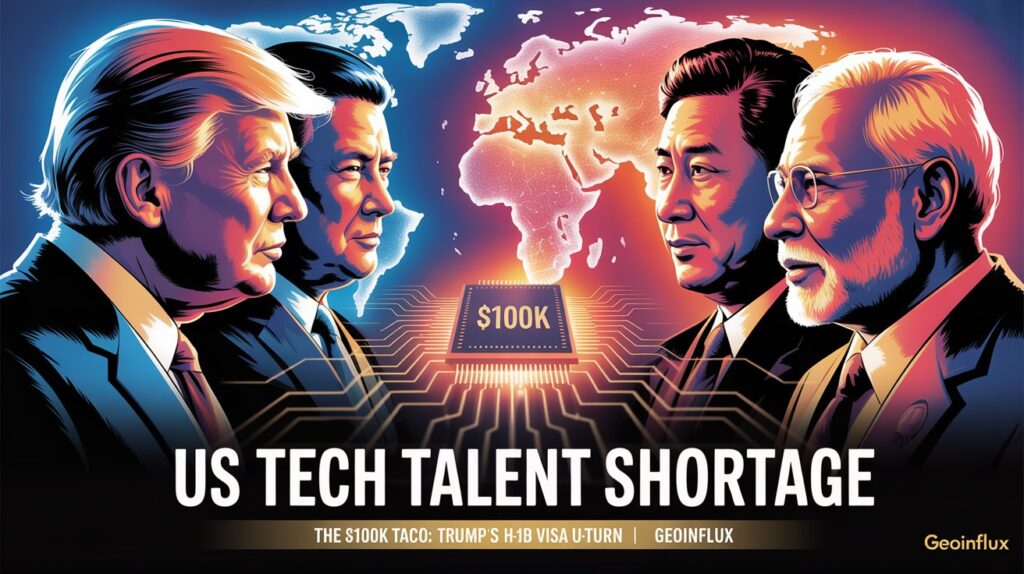

Trump’s $100K H-1B U-Turn stuns Silicon Valley. Is the US Tech Talent Shortage pushing jobs to Canada and China instead?
Quick Take
Donald Trump’s latest Trump H-1B U-Turn has stunned Silicon Valley and global investors. The new rule slaps a $100,000 fee on companies filing H-1B petitions for foreign workers outside the US. The White House calls it a “pro-American jobs” move, but the decision acknowledges a deep US Tech Talent Shortage.
Firms are pivoting to hire students already inside the country or to expand Global Capability Centres (GCCs) in India. Meanwhile, Canada and China are using fast-track visa programmes to lure the skilled workers the US is pricing out.
This policy shift opens a new front in Global Tech Geopolitics, where nations compete not with tariffs but with visa policies and Skilled Worker Migration strategies.
Why Did Trump’s H-1B Visa U-Turn Shock the Global Tech Industry?
The H-1B Visa Policy has long been a pillar of US innovation. Trump’s decision to impose a $100,000 fee on new applications from abroad stunned corporate America and foreign professionals.
Officially, the fee protects US jobs. In practice, the Trump H-1B U-Turn admits that America cannot fill its own high-skill roles in AI, cybersecurity, and data science. By making foreign hires costly, Washington is pushing employers to use F-1 and OPT students already in the US or to outsource entire functions to India and Southeast Asia.
Immigration has become a strategic weapon in Global Tech Geopolitics. Every visa restriction redefines who controls the world’s innovation workforce. For a detailed analysis of how this policy shift connects with digital protectionism and “Project Firewall,” see Trump’s H-1B Visa Fee 2025: Project Firewall.
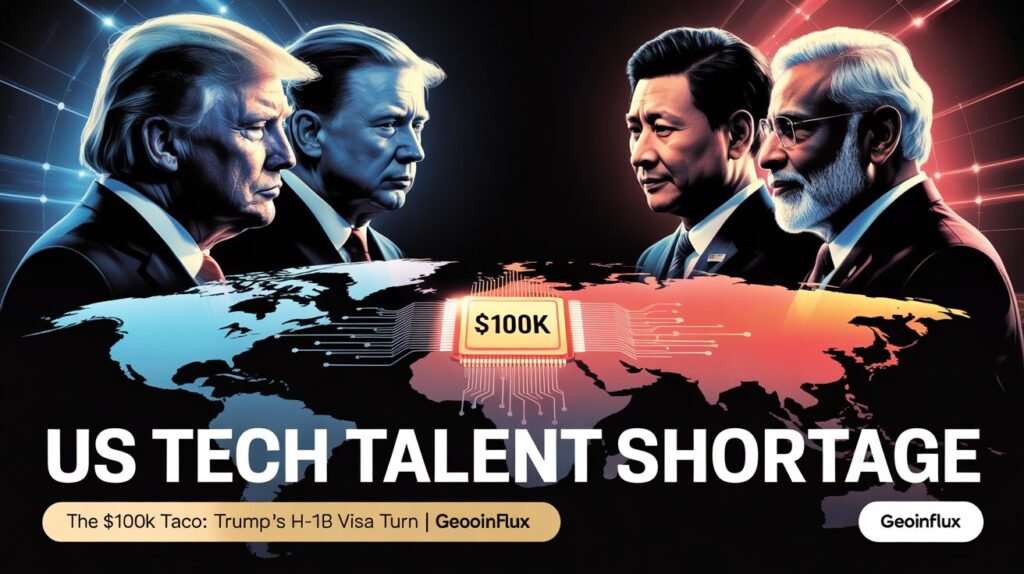
How Does the $100K Fee Expose the US Tech Talent Shortage?
The US Tech Talent Shortage is now structural. Domestic universities produce around 65,000 computer science graduates per year, while industry needs three times that number. Bureau of Labour Statistics data project nearly 380,000 new tech jobs annually through 2032.
More than 70 per cent of H-1B recipients are Indian professionals. If local talent were sufficient, no firm would risk a $100K fee plus salaries and benefits. This deepening US Tech Talent Shortage is pushing employers to move work where talent lives. Global Capability Centres (GCCs) in India and Poland now handle core engineering for US banks and tech giants.
The policy meant to protect US jobs has become a blueprint for outsourcing. It reveals how the H-1B Visa Policy is tied directly to America’s economic competitiveness.
Related Reads
1. US G7 Tariffs on India and China Over Russian Oil Spark Diplomatic Showdown
How Washington’s new energy sanctions have reignited trade tensions with Asia’s biggest economies.
2. 5 Shocking Reasons Why New US Sanctions Shocked India and China into Halting Russian Oil Imports
An inside look at how sanction fatigue is reshaping energy alliances and diplomatic power plays.
3. US Politics: The Hidden Cost of Tech Talent Outflows and Immigration Reform
A breakdown of how America’s shifting immigration stance is fuelling the global Tech Talent Shortage.
How Are Canada and China Turning the H-1B Shock into Opportunity?
Canada’s Fast-Track Plan
Canada moved fast. Its 2025 Tech Talent Strategy offers 10,000 open work permits for current H-1B holders, CA $1.7 billion in AI funding, and permanent-residency eligibility within 18 months. The programme filled in two days. It’s a direct play to absorb talent from the Trump H-1B U-Turn and boost Toronto’s and Vancouver’s tech clusters.
China’s K Visa Challenge
Beijing launched the K Visa on October 1, 2025, offering foreign STEM graduates under 35 years of age residency without employer sponsorship. The K Visa positions China as a serious competitor in Skilled Worker, marking its boldest move yet in Global Tech Geopolitics. It’s part of Beijing’s “Talent First” agenda to rival US innovation capacity by 2030.
Both countries are using visa policy as geopolitical leverage, and the US is helping them do it.
Must Read
4. Sanction Strategy: How Washington Uses Trade Tools to Reshape Global Tech Supply Chains
How US sanctions are no longer about punishment—but about dominating digital trade routes.
5. US Policy Shift: Why High-Skill Immigration Rules Are Turning into National-Security Tools
Exploring the rise of visa rules as instruments of state power and their link to the Trump H-1B U-Turn.
6. Global Sanctions Playbook: When Visa Rules Become Weapons in Tech Rivalries
A closer look at how nations weaponize talent migration policies in the global AI and semiconductor race.
Is India the Biggest Winner or a Hidden Victim?
India remains the world’s largest exporter of high-skill labour and the core source of Skilled Worker Migration to the US. Yet the Trump H-1B U-Turn has reshaped India’s tech economy in unexpected ways.
1. The GCC Boom — More than 1,600 Global Capability Centres operate across India, employing 1.7 million people and forecast to reach 2,000 by 2026. As US visa barriers rise, multinationals redirect investment toward these centres, turning India into a co-innovation hub.
2. The Talent Paradox — Indian graduates now see Canada and China as viable alternatives to the US, signalling a diversification of outbound Skilled Worker Migration. India benefits from capital inflow but loses its best engineers to foreign ecosystems.
To understand how India is attempting to reverse this trend through policy, read India’s Brain Gain Mission: Reversing the H-1B Crisis 2025.
India is the kingmaker in Global Tech Geopolitics, vital to US innovation yet vulnerable to policy swings it does not control.
What Are the Long-Term Geopolitical Implications of H-1B Instability?
- Policy Instability Weakens US Power
- Frequent Trump’s TACO episodes create uncertainty for employers and talent alike. Stability in the H-1B Visa Policy is now a national security issue.
- Soft Power Decline
- America’s image as a “brain magnet” is fading. Each restricted visa dilutes its innovation diplomacy and benefits competitors in Global Tech Geopolitics.
- Market Adaptation
- Tech companies are expanding remote teams abroad and treating immigration as a business risk. Policy chaos turns recruiting strategy into risk management.
- Innovation Shift
- The next wave of AI and biotech breakthroughs could emerge in Toronto, Shanghai, or Bengaluru if the US fails to resolve its US Tech Talent Shortage.
Recap: Actionable Takeaways
| Stakeholder | Key Takeaway | Actionable Step |
|---|---|---|
| US Policymakers | The $100K fee is counterproductive | Reform the H-1B Visa Policy to restore US talent magnetism |
| US Tech Industry | Offshore hiring is accelerating | Partner with universities and advocate for stable Skilled Migration rules |
| Global Talent | US entry is costly and uncertain | Consider Canada’s or China’s fast-track Worker Migration routes |
| India | Gains capital but loses brains | Build domestic innovation capacity to retain talent |
| Global Tech Geopolitics | Talent equals power | Nations that simplify migration will own the next tech era |
FAQs
What is Trump’s new $100K H-1B Visa Policy?
It requires employers to pay a $100,000 fee for foreign petitions filed outside the U.S. This Trump H-1B U-Turn discourages direct hires and deepens the US Tech Talent Shortage.
Why did the administration introduce it?
Officials claim it protects wages. Economists say it’s political symbolism that exposes dependence on foreign experts and fuels the global Skilled Worker.
How are Canada and China responding?
Canada created a Tech Talent fast track; China launched the K Visa, both key moves in Global Geopolitics to absorb US-trained engineers.
What does this mean for Indian professionals?
They still dominate H-1B approvals but face uncertainty. Many are redirecting to Canada or joining India’s GCC network, a new pattern in Worker Migration.
Could this affect America’s innovation leadership?
Yes. If the H-1B Visa Policy remains volatile, the US may lose ground in AI and biotech to countries with predictable visa systems.
End Note
The Trumps’ H-1B U-Turn and $100K fee represent a turning point in Global Tech Geopolitics. By monetizing Skilled Worker Migration, the US is trading short-term politics for long-term loss of talent. Canada, China, and India are ready to capitalize. In today’s world, innovation belongs to nations that welcome brains, not ones that tax them.
Featured Sources & Citations
- Official Reports
- Infrastructure & Migration Policy
- AI & Workforce Reports
- Media Coverage
Thanks For Reading
Thank you for reading this GeoInflux analysis on Trump’s H-1B U-Turn and the shifting dynamics of Global Tech Geopolitics. Every week, we decode how policies, platforms, and power intersect in the digital age.
If you found this insight valuable, share it or follow GeoInflux for more deep-dive reports on AI policy, tech migration, and digital sovereignty. Your engagement helps us bring balanced, fact-driven coverage to a rapidly changing world.
Written by: Kushan Kislay, GeoInflux Analyst
Published on: November 12, 2025
Source Material: Public domain data, government reports, and verified media references
🔗 Visit GeoInflux.com | © GeoInflux 2025 | All Rights Reserved
 2
2
 20
20
 20
20