
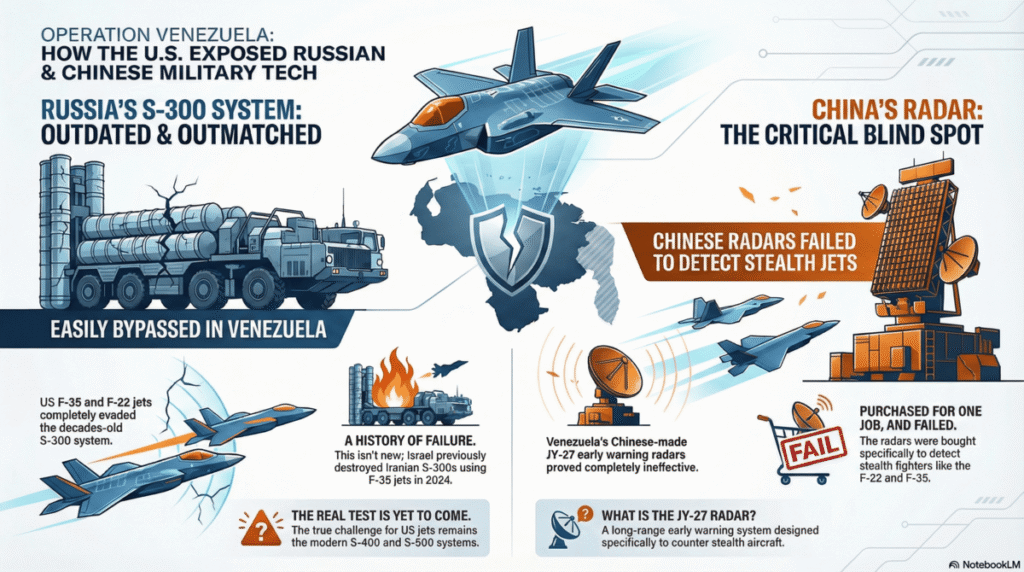

The US raid in Caracas bypassed Russian S-300 air defense and Chinese JY-27 radar, showing how US stealth aircraft and Venezuela oil access now shape geopolitics.
Quick Take
- What happened: The US Air Force conducted a raid in Caracas, Venezuela, capturing President Nicolás Maduro without any US casualties or aircraft losses.
- Why now: This was a decisive US power play, designed to demonstrate its overwhelming military capability and technological superiority on the world stage.
- Who gains: The United States is the primary gainer, securing geopolitical leverage, proving its stealth technology, and paving the way for future access to Venezuelan oil.
- Who loses: Russia and China suffered significant reputational damage as their exported military technology—specifically air defense and early-warning radar—failed spectacularly. Venezuela lost its president and operational sovereignty.
- What changes next: A new, likely US-compliant president will be installed in Venezuela, with a push for US oil companies to begin operations in the country within 18 months.
What Exactly Happened During the US Raid in Caracas?
The US raid in Caracas was executed as a rapid extraction mission inside Venezuela’s capital.

Stealth platforms from the United States Air Force entered Venezuelan airspace without interception.
US stealth aircraft, including the F-35 and the F-22 Raptor, operated over Caracas while Venezuelan air defense units failed to react.
Sonic booms were reportedly used to overwhelm operators and disrupt command awareness rather than destroy physical systems.
Chinook helicopters then inserted Delta Force personnel.
Nicolás Maduro and his wife were captured and transported to the United States.
The US raid in Caracas ended with zero US casualties and no aircraft losses. That outcome was deliberate and highly visible.
Why Does the US Raid in Caracas Matter in Global Tech Geopolitics?
The US raid in Caracas was designed as a geopolitical signal.
By bypassing a defense network built around Russian S-300 air defense and Chinese JY-27 radar, the United States demonstrated uncontested power projection into a defended capital.
Public statements by Pete Hegseth framed the operation as a warning to China and Russia not to challenge US military dominance.
Military credibility now directly affects arms exports, alliance confidence, and deterrence calculations. A visible failure in one country reshapes perceptions far beyond its borders.
How Did Russian S-300 Air Defense and Chinese JY-27 Radar Fail?
The failure was systemic, not isolated.
Venezuela’s Russian S-300 air defense batteries were an older variant, estimated to be 25 to 30 years old. Their vulnerability to fifth-generation aircraft was already established.
Earlier in 2024, Israeli F-35 operations against similar systems in Iran had confirmed this weakness.
During the US raid in Caracas, US stealth aircraft did not destroy the Russian S-300 air defense systems. They bypassed them entirely.
The more consequential breakdown involved Chinese JY-27 radar.
The Chinese JY-27 radar was acquired specifically to detect stealth aircraft and provide early warning to missile batteries.
It failed to detect incoming US stealth aircraft.
Without early warning from the Chinese JY-27 radar, missile units received no targeting data. Command centers lost situational awareness. The entire defense network became ineffective.
This failure defined the operation.
Who Gains Leverage and Who Loses Control After the US Raid in Caracas?
The United States gained leverage across multiple domains.
Militarily, US stealth aircraft validated their effectiveness against a mixed Russian-Chinese defense architecture.
Politically, the United States demonstrated the ability to remove a sitting president from a defended capital.
Economically, the operation positioned Washington to secure Venezuela’s oil access.
Venezuela lost practical sovereignty.
Its leadership was removed by force. A new president, Rodriguez, has been installed. Public resistance is likely, but real constraints on US demands remain uncertain.
Russia and China suffered reputational damage as exporters of military technology.
Was Venezuela Oil Access the Core Strategic Objective?
Post-operation messaging points clearly toward Venezuela oil access.
Claims that the US raid in Caracas was focused on counter-narcotics lack credibility. Most illegal drugs entering the United States do not transit Venezuela.
Statements following the operation emphasized oil.
Donald Trump stated that US oil companies would begin operations in Venezuela within 18 months.
Plans reportedly include reimbursing initial costs using US taxpayer funds. The political shift in Caracas aligns closely with this objective.
How Is the US Raid in Caracas Being Used as Information Warfare?
The US raid in Caracas now functions as an information warfare event.
The vulnerability of the Russian S-300 air defense was already known. Repeating it publicly amplifies doubt in Russian systems.
The failure of Chinese JY-27 radar is more damaging. It was marketed as a counter-stealth solution.
The message targets global arms buyers.
US systems are framed as expensive but effective. Russian and Chinese systems are framed as cheaper but unreliable under pressure.
This framing is designed to influence procurement decisions and long-term strategic alignment. Countries such as India are watching closely.
What Risks and Open Questions Remain After the US Raid in Caracas?
Several uncertainties persist.
- Will Venezuela’s new leadership comply fully with US demands related to Venezuela’s oil access?
- How will the failure of the Chinese JY-27 radar affect future Chinese defense exports?
- Does success against Russian S-300 air defense translate to dominance against more advanced systems?
The US raid in Caracas tested legacy and mid-tier defenses. It did not test peer-level systems.
What Happens Next Strategically?
US oil companies are expected to move quickly, supported by policy signals from Washington.
Economic extraction follows military extraction. The larger military contest remains unresolved.
The true benchmark lies in potential encounters between US stealth aircraft and advanced systems such as the S-400 and S-500.
Those confrontations have not yet occurred.
Reality Check
- The failure of Russian S-300 air defense was predictable.
- The decisive breakdown was Chinese JY-27 radar, acquired specifically to counter US stealth aircraft. Its failure rendered the entire defense network ineffective.
The Caracas raid confirms dominance over older and mid-tier systems. It does not yet prove dominance over the most advanced air defenses in service today.
End Note
The US raid in Caracas shows how technology now decides power outcomes faster than diplomacy. Control of airspace enabled control of leadership, narrative, and Venezuela oil access.
In modern geopolitics, technological failure translates directly into strategic loss.
– GEOINFLUX
FAQs
How did US stealth aircraft succeed during the US raid in Caracas?
US stealth aircraft avoided detection from the outset, denying early warning from Chinese JY-27 radar and neutralizing Russian S-300 air defense without direct engagement.
Which system failed first during the US raid in Caracas?
The Chinese JY-27 radar failed to detect incoming US stealth aircraft, which rendered the Russian S-300 air defense network ineffective.
Why is the Chinese JY-27 radar failure so significant?
The Chinese JY-27 radar was specifically acquired to counter stealth aircraft. Its failure undermines confidence in Chinese counter-stealth claims.
Was Venezuela’s oil access the main goal of the Caracas raid?
Post-operation statements strongly indicate that Venezuela’s oil access is a core objective of the intervention.
Does the Caracas raid prove total US air dominance?
No. It demonstrates dominance over Russian S-300 air defense and current Chinese JY-27 radar, not over advanced peer-level systems.
References and citations
United States Air Force official website
F-35 Lightning II stealth aircraft program overview
F-22 Raptor official fact sheet
Russian S-300 air defense system analysis by CSIS
Chinese JY-27 radar and counter-stealth coverage (Janes Defence)
Venezuela oil reserves and energy profile (U.S. EIA)
Global arms transfers and military export credibility (SIPRI)
 2
2
 20
20
 20
20