
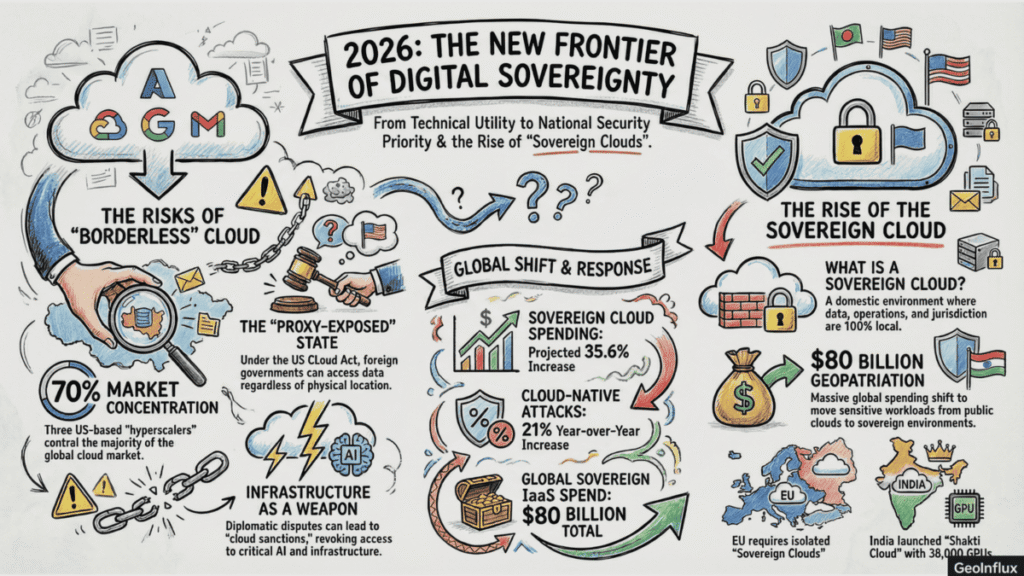

The Emerging National Security Risk of Cloud Infrastructure by 2026: Cloud infrastructure is becoming a “National Security” concern as we approach 2026. Discover how Tech Geopolitics concepts like sovereign cloud, geopatriation, and the influence of Big Tech are reshaping the landscape of digital sovereignty.
Quick Take
The Unbounded and borderless “Public Cloud” is facing a Geopolitical Barrier. As we approach 2026, cloud infrastructure has evolved beyond a mere technical utility. It has become a vital frontier for national security and digital sovereignty. (Why Digital Sovereignty Is Now a National Security Issue in 2026?)
With nations striving to incorporate AI into their defence and public services, the dominance of three US-based hyperscalers, which control over 70% of the global market, poses a “concentration risk” that many perceive as a strategic weakness.
Read more about “How Tech Geopolitics Dramatically Redefined Digital Sovereignty and National Power in 2026? ” Click Here.
The industry is currently experiencing a significant geopatriation trend, with strategic moves to move sensitive workloads from global public clouds to sovereign cloud environments. This shift is propelled by the US CLOUD Act’s regulations on foreign data access and escalating cloud data security risks.
It is predicted that global spending on sovereign IaaS will reach $80 billion this year. Cloud geopolitics now emphasises that without ownership of the servers and their legal jurisdiction, you cannot genuinely secure your national future.
Introduction
In 2026, cloud infrastructure has evolved from a backend convenience to a significant national security concern. This transformation is rooted in a fundamental truth: data serves as the lifeblood of contemporary state power, and the cloud, which hosts this data, represents the “territory” of the digital age.
When a nation’s government records, energy grids, and AI models are stored on servers owned by foreign entities, that nation relinquishes its strategic independence.
In a time when “infrastructure as a weapon” is recognised as a tactical reality, any country lacking a comprehensive sovereign cloud strategy is effectively placing its national intelligence in an environment governed by foreign laws, subject to foreign sanctions, and vulnerable to foreign surveillance.
What is Cloud Infrastructure and Why Does It Matter for National Security?
Cloud infrastructure is the foundational layer of the internet, comprising vast data centres, high-performance GPU clusters, and fibre-optic networks that provide the essential computing power for contemporary society.
In 2026, the cloud serves as the cornerstone for:
- Government Operations: Supporting over 670 million digital health IDs in India and tax systems across Europe.
- Military Resilience: Facilitating real-time processing of battlefield data and analysis of satellite imagery.
- AI Training: Utilising specialised hardware such as NVIDIA H200S and B200S is essential for training the large language models (LLMs) that enhance national productivity.
Because the cloud is where a nation’s digital brain lives, control over this infrastructure is now synonymous with control over national stability. This has made digital sovereignty cloud initiatives the top priority for the G20 this year.
Why Is Cloud Infrastructure a National Security Risk in 2026?
The foremost risk of cloud infrastructure today is strategic dependency. According to Gartner, spending on sovereign cloud solutions is projected to rise by 35.6% in 2026, as organisations become increasingly aware that “global” clouds come with “local” risks.
A significant outage from a single hyperscaler, or the onset of geopolitical conflicts resulting in cloud sanctions, could instantly paralyze entire economies. This “complexity gap” has made it exceedingly difficult for already overburdened cybersecurity teams to maintain visibility, causing a 21% year-over-year increase in cloud-native attacks.
Can Foreign Governments Access Cloud Data?
This represents the core conflict between the US CLOUD Act and the EU Data Act. Although data may be physically stored on servers in locations like Frankfurt or Mumbai, the “control plane” frequently resides in the United States. According to the CLOUD Act, US authorities have the legal power to require US-based providers to release data, regardless of where it is physically located.
In 2026, ‘Data Residency’ will be a myth. Authentic sovereignty depends on Jurisdictional Control, ensuring that local legal authorities are the sole arbiters of data access. In the absence of this control, national data exists in a ‘proxy-exposed’ state, where foreign legal reach overrides physical borders.
What Happens If Cloud Services Are Disrupted or Sanctioned?
We have entered the age of “Blackout Risks.” In 2026, cloud geopolitics includes the use of kill switches. If a nation finds itself on the wrong side of a diplomatic dispute, its access to critical cloud-based AI tools or infrastructure could be revoked. This has led to the rise of Sovereign SASE, an architecture that ensures security enforcement happens within infrastructure owned and operated by the sovereign entity itself, immune to external policy dependencies.
How Big Tech Controls Global Cloud Infrastructure
The power dynamics remain evident. AWS, Microsoft Azure, and Google Cloud continue to hold significant dominance, but their role is evolving from mere “providers” to influential “diplomatic actors.”
- The Market Shift: The market share of European providers has nearly halved over the past decade, prompting initiatives like
- Gaia-X and
- SecNumCloud to reclaim a European Cloud.
- Infrastructure as Diplomacy:
- The United States is increasingly promoting its “Trusted Cloud” framework as a condition for high-tech defense partnerships, creating a digital sphere of influence reminiscent of Cold War alliances.
What Is a Sovereign Cloud and Why Are Countries Building It?
A sovereign cloud is a cloud environment where data, operations, and the legal jurisdiction are all 100% domestic.
Core Goals in 2026:
- Operational Sovereignty: The ability to run and support the cloud without foreign technical assistance.
- Technological Sovereignty: Reducing dependency on foreign-made chips and proprietary software.
- Economic Self-Reliance: Keeping wealth and high-tech jobs within national borders rather than exporting data-processing fees to Silicon Valley.
How Different Regions Are Responding to Cloud Security Risks
United States
The United States leverages its cloud supremacy as a key pillar of its Economic Strategy. By 2026, the focus will be on implementing Zero-Trust mandates for all federal cloud contractors to reduce the risks of Shadow Agents posed by AI-driven attacks.
European Union
With the EU Data Act fully implemented as of September 2025, Europe has required cloud providers to safeguard against unauthorized access to non-personal data from third countries. As a result, U.S. hyperscalers have been compelled to create EU Sovereign Clouds that are both physically and logically isolated.
India
India is at a Sovereign AI tipping point. In February 2026, India launched its first homegrown generative model, supported by a National AI infrastructure of 38,000 GPUs. Partnerships between Yotta and global firms like Gorilla Technology are building Shakti Cloud, ensuring Indian data stays under Indian law.
How Cloud Infrastructure Links to Digital Sovereignty and AI Power
Cloud is the “Fuel” for the AI Engine. You cannot achieve Sovereign AI without a Sovereign Cloud. If your national AI model relies on foreign servers for training, your algorithmic intellectual property is fundamentally at risk. By 2026, the shift from viewing the cloud as mere storage to recognizing it as a compute powerhouse will establish it as the most critical asset in the global AI competition.
Recap / Summary
Key Takeaways: Cloud as a National Security Risk
| Risk Factor | 2026 Impact | Strategic Response |
| Foreign Dependence | High (Kill-switch risk) | Geopatriation to local providers. |
| Data Access Laws | Legal exposure (CLOUD Act) | Sovereign Cloud with local jurisdiction. |
| Big Tech Dominance | Market monopoly/Lock-in | Open-source stacks and multi-cloud. |
| AI Vulnerability | Model IP leakage | Sovereign AI on national compute. |
FAQs
Why is cloud infrastructure a national security issue in 2026?
Cloud infrastructure serves as the cornerstone of a nation’s digital resilience. It supports critical information, ranging from military intelligence to public health records. Therefore, dependence on foreign-owned cloud services poses a significant risk, as a foreign government might gain access to this data or disable vital services during a geopolitical crisis.
What is “Geopatriation” in the context of cloud?
Geopatriation is the trend of moving data and workloads from global hyperscale clouds back to local, geopolitically aligned, or sovereign cloud environments. It is driven by the need to minimize “jurisdictional risk” and ensure data remains under national control.
Can the US government access data stored in a sovereign cloud?
If the sovereign cloud is operated by a US-based company, the US CLOUD Act may still allow for data access requests. However, true “Sovereign Clouds” in 2026 use independent local operators and “confidential computing” to ensure that even the provider cannot access the data, making it immune to foreign subpoenas.
Which countries are leading in sovereign cloud infrastructure?
Europe (through Gaia-X and Germany’s T-Cloud), India (via the IndiaAI Mission and Yotta’s Shakti Cloud), and China (with its entirely domestic ecosystem) are currently at the forefront of creating sovereign alternatives to global public clouds.
Is cloud storage safer than local on-premise storage?
From a technical standpoint, cloud providers typically offer superior security tools. However, when viewed through the lens of national security, the concept of “safety” also encompasses “availability” and “jurisdiction.” If a cloud service can be disabled by a foreign entity, it is deemed less “safe” compared to a locally managed server, even if the latter presents more challenges in terms of defense.
Featured Sources & Citations Box
- Official Reports: MeitY IndiaAI Mission Update (March 2026), Gartner: Forecast Analysis: Sovereign Cloud IaaS (Feb 2026).
- Tech Analysis: Cloudflare 2026 Threat Report
- Geopolitics: Forbes: Geopolitics is Fracturing the Cloud (Mehta, 2026).
End Note
The cloud has transcended its role as a mere utility; it has become the strategic advantage in 21st-century warfare and wealth. As we move into 2026, nations that do not secure their own digital “territory” will risk becoming mere tenants in a world where the landlords possess all the power.
Thank you for following GeoInflux. We are dedicated to providing the analytical depth needed to understand the new digital world order.
Author: GeoInflux Editorial Team
Date: March 22, 2026
 2
2
 20
20
 20
20






Pingback: Is Pakistan Mediation Israel-Iran War Fake Exposed? Fact Check March 2026 | Geoinflux GeoInflux
Pingback: AI Latest News April 2026: AI Infrastructure Race, Agentic AI Systems, AI Chip Competition Explained GeoInflux
Pingback: India AI Mission: Will India Lose 2 Million Tech Jobs Or Create 4 Million New Ones By 2031? AI Tech Workforce Future Explained GeoInflux