
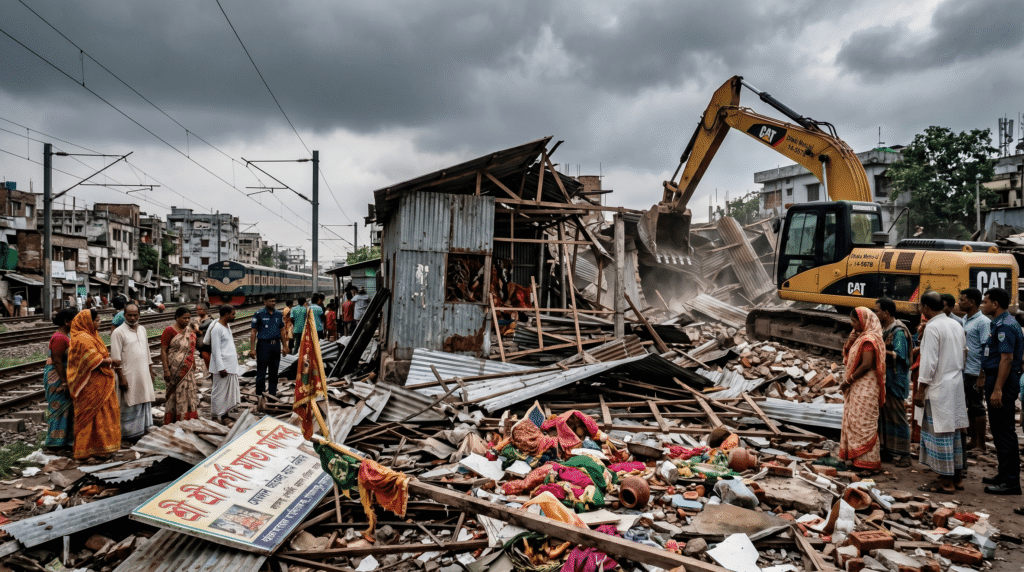

The reported demolition of a Durga temple in Dhaka has triggered wider debates around minority security, India-Bangladesh relations, migration politics, and regional instability. Here’s why the controversy matters beyond Bangladesh in 2026.
Quick Take
The controversy surrounding the reported demolition of a Durga temple in Dhaka has evolved far beyond a local civic or administrative issue. Across India and Bangladesh, the incident has triggered debates around minority security, religious identity, political instability, and regional geopolitics. The timing is especially sensitive because India-Bangladesh relations are already under pressure from border tensions, migration concerns, and rising political polarization in eastern India. For many observers, the issue reflects a deeper anxiety about the future of minority communities and the changing political climate inside Bangladesh.
What Happened in Dhaka?
Reports surrounding the demolition of a Durga temple in Dhaka quickly spread across Indian and Bangladeshi media platforms, triggering political reactions and intense discussion online. While local authorities reportedly framed the action around administrative or land-related concerns, critics argued that the symbolism of demolishing a Hindu religious structure in the middle of an already tense political atmosphere would inevitably create wider backlash.
The controversy gained traction because religious sites in South Asia are rarely viewed only as physical structures. They are deeply tied to identity, historical memory, and political narratives. As videos and images circulated online, the issue rapidly moved from local reporting into a larger geopolitical conversation involving India-Bangladesh relations and minority rights.
In India, the incident became especially sensitive in states like West Bengal and Assam, where discussions around migration, border security, and demographic politics are already highly polarized. This is one reason why the Dhaka temple controversy received attention far beyond Bangladesh itself.
Why Are Hindu Religious Sites in Bangladesh Politically Sensitive?
The emotional reaction surrounding the Dhaka temple controversy cannot be understood without looking at history.
Hindu religious sites in Bangladesh carry deep historical and symbolic significance because they are connected to centuries of cultural heritage and also to traumatic memories of partition, communal violence, and political upheaval. Many families across eastern India and Bangladesh still carry historical connections linked to migration and displacement during the partition era and the 1971 Bangladesh Liberation War.
One of the most important historical examples is the Ramna Kali Temple, which was destroyed during the 1971 conflict. The temple later became a symbol of both destruction and resilience within Bangladesh’s Hindu community. Another major spiritual site is Dhakeshwari Temple, widely regarded as one of the most important Hindu temples in Bangladesh.
Because of this historical background, incidents involving temples often trigger much larger political and emotional reactions than a normal civic dispute would. They are interpreted through the lens of identity, security, and historical continuity.
Latest Posts
- Why India-Bangladesh Border Tensions Are Rising Again in 2026?

- Can You Get a High-Paying Tech Job in the AI Era of Mass Layoffs with Free MIT Courses? (2026 Guide)

- India’s Rotating Detonation Engines Breakthrough: Is This the End of Jet Engines?

- Trump NATO Exit Strategy: The Secret Prelude to an Israel-Turkey War in 2026?
- BLA Naval Attack Jiwani 2026: The Saudi-Pakistan SMDA Activation and UAE Debt Crisis Explained

- The Global AI Race 2026: WhyAI Sovereignty is the New Oil

How Is This Connected to Wider India-Bangladesh Relations?
The timing of the controversy is important. India and Bangladesh are already facing growing tensions around:
- border security
- illegal immigration
- nationality verification
- political instability
- minority concerns
These issues have intensified further after recent political developments inside Bangladesh and increasing debates in India over infiltration and border management.
The recent rise in India-Bangladesh border tensions is also adding a larger geopolitical context to developments unfolding inside Bangladesh. Issues related to border security, migration, political instability, and minority concerns are increasingly becoming interconnected across the region.
As New Delhi sharpens its focus on infiltration and verification mechanisms, incidents inside Bangladesh are now being viewed through a wider strategic lens. Read our detailed analysis on India-Bangladesh Border Tensions 2026 to understand how migration, border politics, and regional security are reshaping India-Bangladesh relations.
For many observers in India, incidents involving Hindu religious sites are now increasingly connected to broader concerns about regional stability and the future trajectory of Bangladesh’s internal politics.
At the same time, Bangladesh remains strategically important for India because:
- it is a major regional partner
- eastern India shares deep economic ties with Bangladesh
- border stability affects trade and security
- instability can impact the wider South Asian region
This is why even local controversies can quickly evolve into sensitive diplomatic issues.
Is a China-Pakistan-Bangladesh Strategic Axis Emerging?
Another important geopolitical concern is the growing discussion around closer strategic coordination between China, Pakistan, and Bangladesh.
Recent diplomatic interactions and trilateral discussions have triggered debate among Indian strategic analysts about whether South Asia is entering a new phase of regional alignment. While these developments remain diplomatically nuanced, many observers believe India is becoming increasingly cautious about expanding Chinese influence in its eastern neighborhood.
For New Delhi, Bangladesh is not only a neighboring country. It is also strategically important for:
- Bay of Bengal security
- northeastern connectivity
- trade routes
- regional balance of power
This explains why political instability or anti-India sentiment inside Bangladesh immediately attracts strategic attention in India.
The broader concern is not simply about one isolated incident. It is about whether South Asia is slowly moving toward more polarized geopolitical blocs in the coming decade.
Why Social Media Is Amplifying These Incidents
One major difference in 2026 compared to previous decades is the role of digital amplification.
Today, incidents involving religion, borders, and identity spread across social media within minutes. Political influencers, media outlets, and online activists rapidly shape narratives before governments can even respond officially.
This creates a dangerous cycle:
- local incident
- viral outrage
- political polarization
- diplomatic pressure
- geopolitical framing
In South Asia, where identity politics already remains highly emotional, digital amplification significantly increases the political impact of symbolic incidents.
For governments, managing perception is now almost as important as managing the actual ground situation.
Strategic Implications
The Dhaka temple controversy reflects a broader regional shift where identity, security, and geopolitics are becoming increasingly interconnected.
Several important implications are emerging.
First, minority-related incidents inside Bangladesh are likely to receive stronger political attention inside India, especially in border states like West Bengal and Assam.
Second, India-Bangladesh relations could become more vulnerable to public sentiment and social media-driven pressure campaigns.
Third, border politics and migration debates are increasingly merging with discussions around identity and civilizational heritage.
Fourth, regional governments across South Asia are entering an era where domestic events can quickly transform into geopolitical narratives with cross-border consequences.
Finally, India is increasingly shifting toward a more transactional and security-focused regional strategy. This means future diplomacy in South Asia may become more strongly tied to border stability, migration control, and strategic reciprocity.
Despite these tensions, both India and Bangladesh still have strong economic and strategic incentives to maintain stability and avoid serious diplomatic escalation.
FAQ
Why did the Dhaka temple controversy become so significant?
The issue became larger because it connected with existing debates around minority security, migration, border tensions, and political instability in the region.
Why are Hindu temples in Bangladesh politically sensitive?
These temples carry historical, religious, and emotional significance linked to partition history, migration, and the 1971 conflict.
Is this affecting India-Bangladesh relations?
While both countries continue maintaining diplomatic ties, incidents like these can increase political pressure and public tensions on both sides.
Why is social media making such incidents bigger?
Digital platforms rapidly amplify emotional and political narratives, turning local events into regional controversies within hours.
External References
- India Ministry of External Affairs
- Ramna Kali Temple History
- Dhakeshwari Temple
- Observer Research Foundation
- Carnegie Endowment for International Peace
End Note
The controversy surrounding the Dhaka temple demolition highlights how rapidly local incidents can evolve into wider geopolitical debates in South Asia. In a region shaped by historical memory, migration, identity politics, and border sensitivities, symbolic events often carry consequences far beyond their immediate location.
As India and Bangladesh navigate a politically sensitive phase in their relationship, issues involving religion, minority security, border politics, and regional strategic competition are likely to remain deeply interconnected in the years ahead.
 2
2
 20
20
 20
20





Some truly excellent articles on this website , appreciate it for contribution.
Outstanding post, you have pointed out some good details , I besides believe this s a very wonderful website.