


Is DHRUV64 India’s breakthrough in chip independence? This GeoInflux explainer shows how the indigenous 64-bit microprocessor strengthens India’s tech sovereignty, security, and India’s position in chip geopolitics.
Quick Take: Why DHRUV64 Matters Right Now
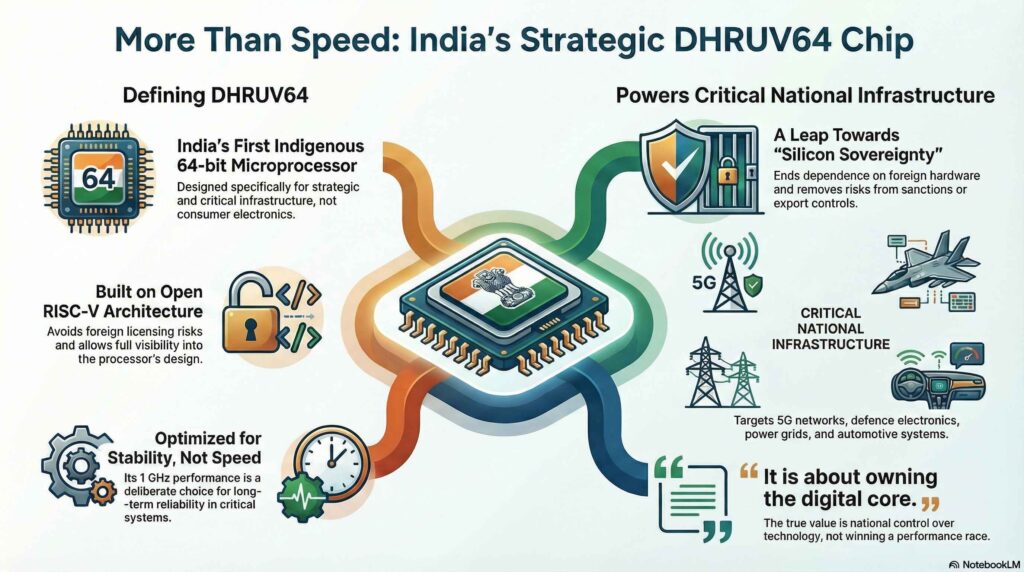
India has crossed a critical threshold in semiconductor strategy. DHRUV64 is the first fully indigenous 64-bit microprocessor designed by the Centre for Development of Advanced Computing.
It runs on RISC-V Architecture, an open instruction set. This removes dependence on foreign processor licenses such as ARM and x86.
This chip is not meant for smartphones or gaming laptops. DHRUV64 is built for 5G infrastructure, defence electronics, automotive systems, and industrial control networks.
At 1.0 GHz dual core, the focus is not on speed. The focus is on reliability, auditability, and long service life. In today’s geopolitical climate, controlling the processor is a strategic power.
Why Processor Ownership Defines National Power
For decades, India depended on foreign processors to run telecom networks, satellites, military platforms, and power grids. India controlled the software but not the core compute layer.
Early indigenous efforts like the Vikram processor, India’s first 32-bit chip, showed intent but lacked ecosystem depth and deployment scale.
DHRUV64 marks the shift from symbolic launches to deployment-grade silicon. It shows that India can design, validate, and secure a 64-bit processor ready for real-world use.
This transition is not about performance charts. It is about sovereignty and control.
Why The Dhruv64 Microprocessor Matters For India’s Tech Sovereignty
India consumes nearly 20 per cent of global semiconductors, yet for decades owned almost none of the processor IP powering its critical systems.
Strategic independence from foreign choke points
By avoiding ARM and x86, India reduces exposure to export bans, licensing suspensions, and remote disablement risks. Processor control has become central to modern chip geopolitics, especially in the age of AI and digital warfare.
Lower costs and a stronger domestic ecosystem
Because the RISC-V Architecture is open, Indian companies avoid recurring royalty payments. This directly supports India’s growing fabless semiconductor startup ecosystem, including firms like Mindgrove.
Built for infrastructure, not hype
DHRUV64 uses a 28 nm process, widely preferred for defence, railways, power systems, and telecom because it delivers predictable performance over long lifecycles.
From university labs to national platforms
Earlier processors, such as Shakti and Ajit, proved academic capability. DHRUV64 converts that knowledge into a national platform aligned with India’s semiconductor design localisation push.
How RISC-V Architecture Strengthens India’s Digital Sovereignty
True chip sovereignty begins at the instruction set, the basic language a processor understands. If a country does not control this layer, it does not fully control its digital systems, no matter where the chip is assembled.
RISC-V changes that balance. At its core, RISC-V is an open instruction set governed by RISC-V International. No single company or government owns it. This is why it matters for India.
Freedom from foreign control
Most processors today rely on ARM or x86, both controlled by foreign corporations operating under foreign legal systems. Access, licensing terms, or features can change due to geopolitics, sanctions, or commercial pressure.
With RISC-V, India does not need approval to design, modify, or deploy processors. There are no license shutdowns, no geopolitical veto points, and no external dependencies at the instruction level. This alone removes a major strategic risk.
Full visibility and security assurance
Closed processor architectures operate as black boxes. Governments must trust that there are no hidden functions, backdoors, or undocumented features.
RISC-V allows full inspection of the processor design. Indian agencies can audit every instruction, logic block, and security feature. For defence systems, telecom networks, and power infrastructure, this level of visibility is critical.
It shifts trust from foreign vendors to domestic verification.
Customisation for National Needs
Open architecture allows custom extensions. India can design processors with features tailored for local requirements such as secure communications, critical infrastructure resilience, or long lifecycle support.
This flexibility is impossible with tightly controlled proprietary instruction sets. RISC-V lets India shape hardware around policy goals, not market trends.
A foundation for a domestic chip ecosystem
RISC-V lowers entry barriers for startups, universities, and public-sector labs. Companies do not need massive licensing budgets to begin designing processors.
This is why RISC-V fits naturally with India’s push for fabless semiconductor startups, indigenous IP creation, and localised chip design. It turns processor development into an ecosystem activity, not a monopoly.
Reducing exposure to global chip coercion
Semiconductors are now used as geopolitical tools. Export controls, technology bans, and supply-chain pressure are part of modern power politics.
By adopting RISC-V, India reduces exposure to these pressure points. It does not eliminate all risks, but it removes one of the most sensitive choke points, the instruction set itself.
Strategic alignment without bloc dependence
China is also moving toward RISC-V, largely to bypass US restrictions. India’s path is different. It is using RISC-V to stay non-aligned, not to mirror any bloc.
This gives India strategic flexibility. It can work with Western firms, Asian partners, and domestic startups without locking itself into one technology camp.
Why this matters beyond chips
Digital sovereignty today extends beyond hardware. Processors sit under AI systems, telecom networks, satellites, and defence platforms.
By controlling the instruction set through RISC-V, India strengthens sovereignty across all these domains. DHRUV64 is the first real expression of this strategy in silicon.
In simple terms, RISC-V gives India something it never had before. “The ability to decide how its machines think.”
Is a 1 GHZ Indignous 64-Bit Processor Actually Competitive?
At first glance, a 1 GHz processor looks underpowered. Modern smartphones run at 3 GHz or more. Laptops push even higher. This comparison, however, is misleading.
DHRUV64 is not designed to win a speed race. It is designed to survive, remain trusted, and operate predictably in critical systems.
Different markets follow different rules
Consumer processors are built for peak performance, short upgrade cycles, and aggressive power optimisation. Infrastructure processors follow a different logic.
Railway control systems, telecom base stations, power grids, automotive controllers, and defence electronics do not need extreme speed. They need stability, determinism, and reliability.
A 1 GHz 64-bit processor is more than sufficient for these tasks. What matters is that the processor behaves the same way every time, under all conditions.
Why 28 nm and 1 GHz still make strategic sense
DHRUV64 is built on a 28 nm fabrication process, which some critics label as outdated. In reality, 28 nm remains a global standard for infrastructure-grade electronics.
Reasons this node is preferred
- Proven reliability across temperature and voltage extremes
- Lower failure rates over long operating periods
- Easier certification for defence, automotive, and industrial use
- Reduced vulnerability to supply shocks compared to bleeding-edge nodes
Many global defence and telecom systems still rely on similar or older nodes because reliability matters more than raw performance.
Long lifecycle beats short-term speed
Infrastructure systems are expected to last 10 to 15 years. Consumer chips are replaced every two to three years.
A stable 1 GHz processor with predictable behaviour is easier to support, patch, and secure over a long lifecycle. This reduces maintenance costs and operational risk.
For national infrastructure, this matters far more than headline benchmarks.
Security and auditability over performance
Higher clock speeds increase complexity. More complexity increases attack surfaces.
DHRUV64 trades peak speed for auditability and security. Every instruction path is easier to verify. This is critical for defence systems, telecom networks, and government infrastructure, where trust is non-negotiable.
Performance is a roadmap, not a starting point. India is not stopping at 1 GHz. The Centre for Development of Advanced Computing (CDAC) has already outlined the next steps.
- Dhanush at 1.2 GHz with a quad-core design
- Dhanush+ at 2.0 GHz on a 14 nm process
This shows intent and continuity. India is building capability step by step instead of chasing unrealistic benchmarks at the start.
What competitiveness really means in geopolitics
In chip geopolitics, competitiveness is not only about speed. It is about control.
A processor that cannot be sanctioned, remotely restricted, or license-disabled is competitive in ways consumer chips are not.
DHRUV64 competes on sovereignty, reliability, and trust. In the infrastructure and defence domain, those factors outweigh raw performance.
Bottom line
A 1 GHz indigenous 64-bit processor is competitive where it is meant to be competitive. For India’s strategic systems, DHRUV64 delivers what matters most. “Control. Stability. Sovereignty.”
What Dhruv64 Signals In Global Tech Geopolitics
Semiconductors are no longer neutral technology. They are instruments of power. Countries that control chips control data, defence systems, AI models, and critical infrastructure. DHRUV64 must be read in this context.
It sends three clear geopolitical signals.
- India is no longer comfortable with chip dependence: For years, India accepted a fragile position in the global tech order. It designed software, hosted R&D centres, and consumed large volumes of chips, but it did not own the processor layer.
- DHRUV64 marks a change in posture. India is no longer satisfied being a back-end participant in the global chip supply chain. It wants control over the most sensitive layer, the CPU itself.
- This matters because processor dependence limits strategic choices. Export controls, licensing pressure, or diplomatic disputes can quickly turn technology into leverage. DHRUV64 reduces that vulnerability.
- A non-aligned path between the US and China: Global chip geopolitics is increasingly split between two blocs. On one side are US-led ecosystems built around proprietary architectures and export controls. On the other is China’s push for self-reliance under heavy state direction.
- By adopting RISC-V and building DHRUV64, India avoids locking itself into either bloc. It is not rejecting Western technology, nor is it copying China’s closed model. Instead, it is keeping strategic flexibility.
- This non-aligned silicon approach allows India to cooperate with multiple partners while retaining control over its core compute layer.
- Computing power is now national power: In earlier eras, oil, steel, and shipping defined power. Today, it’s Computing.
- Processors sit under AI systems, surveillance platforms, satellites, drones, telecom networks, and financial infrastructure. A country that does not control compute cannot fully control these systems.
- DHRUV64 signals that India understands this shift. It is treating processors as strategic infrastructure, not commercial components.
- This is especially important as AI models grow larger and more dependent on secure, trusted hardware.
Economic value retention inside India
India’s semiconductor market is projected to approach $110 billion by 2030. Without indigenous IP, much of this value flows out through royalties, licenses, and imported systems.
DHRUV64 ensures that a portion of this value stays within India. It supports local design houses, startups, system integrators, and long-term industrial capability.
India is choosing a third path. This is not protectionism. It is strategic value retention.
Policy becoming hardware
For years, India announced semiconductor ambitions through policy documents and incentive schemes. DHRUV64 is policy made real.
It aligns directly with the objectives of the India Semiconductor Mission, which aims to give India control over chip design, validation, and eventually manufacturing.
Geopolitically, this matters because it signals seriousness. Countries take notice when policy turns into working silicon.
A message to partners and competitors
To partners, DHRUV64 signals reliability. India wants to be a long-term technology partner with its own capabilities, not just a market.
To competitors, it signals intent. India is entering the strategic chip space gradually but deliberately.
This does not make India a chip superpower overnight. But it tells the world that India has started playing the long game.
Why this matters beyond DHRUV64
The real signal of DHRUV64 is not the chip itself. It is continuity. It shows that India is willing to invest years, not quarters, into building sovereign technology. That mindset shift is the most important geopolitical signal of all.
In simple terms, DHRUV64 tells the world one thing clearly. India intends to control its digital future.
Strategic Insights: What Leverage DHRUV64 Gives India
DHRUV64 strengthens India’s position in defence procurement, telecom security decisions, and industrial automation planning.
It creates a trusted base for future sovereign hardware stacks, reducing long-term dependence on foreign compute.
Recap: What Dhruv64 Delivers
- Speed: 1.0 GHz dual core
- Architecture: RISC-V open standard
- Use cases: 5G, defence, automotive, industrial systems
- Sovereignty impact: No foreign CPU IP royalties
- Next phase: Dhanush+ at 2.0 GHz on 14 nm
FAQs
What is DHRUV64, and why is it important for India?
DHRUV64 is India’s first fully indigenous 64-bit microprocessor designed for strategic and infrastructure systems. Its importance lies in control, not consumer performance.
Until now, India relied on foreign processor architectures for critical systems. This created long-term risks related to export controls, licensing pressure, and limited security transparency. DHRUV64, built on RISC-V, removes these risks and gives India ownership of its processor logic.
In geopolitics, controlling the processor means controlling defence platforms, telecom networks, and industrial infrastructure.
How does DHRUV64 strengthen India’s tech sovereignty?
Tech sovereignty means controlling the digital systems that power a nation’s economy and security. DHRUV64 strengthens this control at the most sensitive layer.
By avoiding foreign-owned instruction sets, India reduces exposure to sanctions and supply-chain coercion. Full audit access also improves trust in defence and telecom hardware.
In short, DHRUV64 turns chip design into a strategic asset rather than a vulnerability.
Why did India choose RISC-V instead of ARM or x86?
India chose RISC-V because it removes gatekeepers. ARM and x86 are controlled by foreign companies and shaped by foreign policy environments.
RISC-V is open. India can design, modify, and deploy processors without paying royalties or seeking approval. This aligns better with long-term national priorities and security needs.
Is a 1 GHz processor enough for modern systems?
For infrastructure systems, yes.
Railways, power grids, telecom base stations, and defence platforms prioritise stability and reliability over peak speed. A 1 GHz processor on a stable node meets those needs.
Performance upgrades are already planned through the Dhanush roadmap.
How is DHRUV64 different from earlier Indian processors?
Earlier processors like Vikram, Shakti, and Ajit proved technical capability but lacked large-scale deployment readiness.
DHRUV64 is validated for real-world use. It integrates lessons from earlier projects into a national design platform aligned with India’s semiconductor strategy.
Where will DHRUV64 be manufactured?
Design and validation are Indian. Manufacturing is expected to shift toward domestic facilities as India’s fabrication ecosystem matures under the India Semiconductor Mission.
End Note: Why DHRUV64 Matters
DHRUV64 is not about beating global consumer chips. It is about control, resilience, and strategic independence. This marks the moment India began owning its digital core.
Thank you for reading GeoInflux.
This piece examined DHRUV64, RISC-V, and India’s push for tech sovereignty through the lens of geopolitics, security, and long-term power. The goal is to move beyond headlines and explain why processors, not just policies, now shape national strength.
If you found this analysis useful, explore the related GeoInflux articles linked above for deeper context on India’s semiconductor ecosystem, fabless startups, and chip geopolitics.
Kushan Kislay
GeoInflux| Tech Geopolitics and Strategic Technology Analysis
Featured Sources & Citations
🏛️ Official Institutions
- Centre for Development of Advanced Computing: India’s lead advanced computing agency behind DHRUV64 and the Dhanush processor roadmap.
- Ministry of Electronics and Information Technology: Primary policymaker for semiconductor self-reliance, Digital India, and electronics manufacturing.
- India Semiconductor Mission: ₹76,000 crore national program driving chip design, validation, and manufacturing in India.
🎓 Academic & Research Ecosystem
- IIT Madras: Home of the Shakti processor program and India’s most advanced academic semiconductor pipeline.
- IIT Bombay: Centre for Ajit processor research and early indigenous CPU development.
🧠 Architecture & Standards
- RISC-V International: Global open instruction set organisation enabling non-aligned and sovereign silicon strategies.
🌐 GeoInflux Context & Analysis
- India’s semiconductor design localisation strategy
- Fabless semiconductor startups and the Mindgrove case
- Chip geopolitics, AI power, and compute sovereignty
- Vikram processor and India’s early indigenous chip journey
Citations
- SOURCE SNAPSHOT: C-DAC
- India’s premier advanced computing agency leading indigenous processor design through DHRUV64 and the upcoming Dhanush CPU family.
- SOURCE SNAPSHOT: INDIA SEMICONDUCTOR MISSION
- The backbone of India’s chip sovereignty push is linking policy incentives with long-term semiconductor capability building.
- SOURCE SNAPSHOT: RISC-V INTERNATIONAL
- The open architecture body allows countries like India to bypass proprietary chip choke points and licensing risks.
- SOURCE SNAPSHOT: IIT MADRAS
- India’s most critical academic hub for processor research, deep-tech semiconductor startups, and chip talent development.
- SOURCE SNAPSHOT: GEOINFLUX SEMICONDUCTOR ANALYSIS
- Independent analysis connecting chips, geopolitics, AI power, and national sovereignty.
 2
2
 20
20
 20
20






pgfortunebr has a killer selection of PG Soft games. Loads of different slots to try and a good chance of winning something. Give a whirl!
Pingback: AI Geopolitics: Is AI Reshaping Global Power In 2025? 5 Shocking Global AI Power Shift That Changed Everything GeoInflux