


PM Modi’s INS Vikrant declaration has redefined India’s naval power. Can the Indian Navy outpace China’s Blue Water Navy by 2035 and truly become the Guardian of the Indian Ocean? Explore the strategy, rivalry, and future of maritime security in Asia.
India’s naval strategy has entered a new era. PM Modi’s INS Vikrant declaration signals a bold maritime doctrine aimed at countering China’s Blue Water ambitions. The Indian Ocean, home to 66% of global oil trade, is now the defining stage of Asian power politics.
Also Read: India’s Secret Weapon: DRDO Cracks PL-15E Tech for Astra Mark 2 , Reverse-Engineering | Geoinflux
With INS Vikrant leading the fleet, India’s quest for a Blue Water Navy by 2035 is both a symbol of sovereignty and a race against time. The outcome will determine who truly commands the world’s most vital sea lanes.
What Did PM Modi’s INS Vikrant Declaration Signify for India’s Naval Identity?
When Prime Minister Narendra Modi celebrated Diwali aboard INS Vikrant, India’s first indigenous aircraft carrier, it wasn’t just a ceremonial gesture. His statement that the Indian Navy is the Guardian of the Indian Ocean marked a powerful declaration of sovereignty and intent.
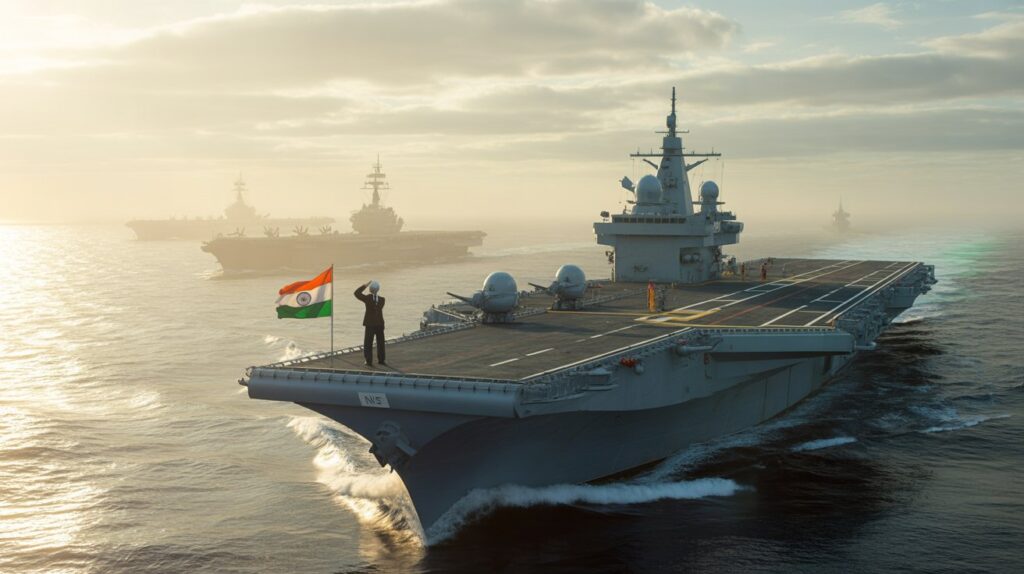
It positioned India not only as a continental power but as a maritime guardian in a region fast becoming the world’s most contested waterway. The symbolism was unmistakable: India’s naval ambitions have moved beyond coastal defense to strategic projection.
For Beijing, this statement echoed across power corridors as a challenge. The Indian Ocean, which carries over 66% of global oil supply and half of the world’s container shipments, is no longer a neutral highway, it’s a geopolitical battlefield.
Why Is the Indian Ocean a Global Geopolitical Flashpoint?
The Indian Ocean region (IOR) has quietly become the epicenter of 21st-century geopolitics. Its importance lies in both geography and economics:
- 66% of global oil passes through its sea lanes.
- 50% of global container trade traverses its waters.
- It connects the Middle East, Africa, South Asia, and Southeast Asia — regions central to global energy and trade.
This is why American naval strategist Alfred Thayer Mahan once observed:
“Whoever controls the Indian Ocean dominates Asia.”
For India, this isn’t just theory, it’s national security. The Indian Navy’s mission as the Indian Ocean Guardian directly safeguards the arteries of world commerce and ensures freedom of navigation. Its growing assertiveness reflects a shift from passive protection to active deterrence.
How Does INS Vikrant Reflect India’s Naval Transformation?
When PM Modi commissioned INS Vikrant, it symbolized more than technological achievement , it was a declaration of Atmanirbhar Bharat at sea.
India now operates two aircraft carriers:
- INS Vikramaditya (Russian-origin)
- INS Vikrant (indigenously designed and built)
This dual-carrier capability signals a historic leap. It means the Indian Navy can project sustained power in both the Arabian Sea and the Bay of Bengal simultaneously.
Modi’s presence aboard Vikrant, during a national festival, tied cultural pride to defense innovation, a powerful political and strategic message.
The ship itself, equipped with MiG-29K fighters, Ka-31 helicopters, and modern radar systems, showcases India’s growing shipbuilding prowess.
Can the Indian Navy Rival China’s Blue Water Navy by 2035?
The key question shaping India’s maritime future is whether it can match China’s naval expansion by 2035.
India’s Strategy:
- Accelerated Fleet Expansion: One new ship or submarine every 40 days.
- Massive Domestic Shipbuilding Push: 60+ vessels under construction in Indian yards.
- Nuclear-Powered Submarines: Expansion of the Arihant-class SSBN program.
- Long-Range Maritime Patrols: Increasing deployment of P-8I Poseidon aircraft and MQ-9B SeaGuardian drones.
China’s Lead:
China’s People’s Liberation Army Navy (PLAN) already operates:
- 3 active aircraft carriers
- Over 350 warships
- The world’s largest submarine fleet (by count)
Beijing’s objective is clear, transform the China Blue Water Navy into a force capable of global reach, securing supply routes and asserting dominance across the Indian Ocean and beyond.
India’s challenge is to sustain its modernization pace while ensuring indigenous capability, not dependence on foreign suppliers.
By 2035, the Indian Navy vs China Navy race will likely define the balance of power in Asia.
How Is China Expanding Its Presence in the Indian Ocean?
China’s approach to the Indian Ocean is both strategic and psychological. Official Chinese rhetoric, “The Indian Ocean is not India’s Ocean” encapsulates its goal: to normalize the PLA Navy’s presence in India’s maritime backyard.
Beijing has:
- Renamed undersea features in Mandarin — a symbolic step toward territorial narrative control.
- Invested in port projects under the Belt and Road Initiative (BRI) — Gwadar (Pakistan), Hambantota (Sri Lanka), and Kyaukpyu (Myanmar).
- Established a permanent base in Djibouti, near the Horn of Africa.
This Djibouti military base China operates is a major milestone. It enables sustained naval operations far from home, with logistics and refueling capacity — effectively marking the birth of a true China Blue Water Navy.
Analysts expect full operational capability between 2026–2027, aligning with the deployment of China’s fourth aircraft carrier.
What Is a Blue Water Navy and Why Does It Matter?
A Blue Water Navy is one capable of operating across the deep oceans, not limited to coastal waters. It requires:
- Aircraft carriers
- Long-range supply chains
- Nuclear submarines
- Global logistics networks
Both India and China aspire to this status — but for different reasons.
- China seeks to secure trade routes and project influence through the Maritime Silk Road.
- India aims to protect its neighborhood and maintain balance against external encroachment.
This race for maritime supremacy is as much about prestige and perception as it is about warships. Whoever achieves sustained blue-water capability first will shape Asia’s maritime order.
What Are the Future Scenarios for Maritime Security in the Indian Ocean?
The Indian Ocean Region (IOR) is at a strategic crossroads. Three outcomes seem plausible:
- Stable Deterrence: India and China maintain balance through mutual deterrence, preventing direct conflict.
- Proxy Naval Rivalry: Increased competition via smaller states, naval bases, and strategic choke points like the Strait of Malacca.
- Open Power Contest: Frequent face-offs, gray-zone operations, and maritime brinkmanship.
The Indian Navy’s modernization, coupled with strategic partnerships with the U.S., France, and Japan, will be crucial in preserving regional order.
The PM Modi INS Vikrant declaration symbolically positions India as a custodian of maritime freedom — but sustaining that role will demand continuous investment, indigenous R&D, and strategic patience.
Recap: What Does “Indian Ocean Guardian” Mean in Practice?
| Element | Description |
|---|---|
| Concept | India as the primary security provider in the Indian Ocean Region (IOR) |
| Symbolism | PM Modi’s Diwali visit to INS Vikrant |
| Capability Goal | Achieve Blue Water Navy status by 2035 |
| China Factor | Counter PLAN expansion and Djibouti base |
| Strategic Priority | Protect trade routes and assert sovereignty |
| Global Impact | Influence freedom of navigation, trade security, and Indo-Pacific stability |
FAQs
1. Why did PM Modi call the Indian Navy the “Guardian of the Indian Ocean”?
PM Modi’s statement aboard INS Vikrant signifies India’s intent to secure vital sea lanes and project strength in the Indian Ocean. It reinforces India’s identity as a maritime power and a stabilizing force in a region increasingly contested by China’s expanding influence.
2. What makes the Indian Ocean so important for global trade?
The Indian Ocean carries nearly two-thirds of the world’s oil shipments and half of its container cargo. It’s the primary route connecting Middle Eastern energy suppliers to Asian consumers, making its security crucial for global economic stability.
3. How does INS Vikrant enhance India’s naval capabilities?
INS Vikrant adds operational flexibility, enabling India to maintain presence across both flanks of its coastline. Its indigenous design reflects India’s growing shipbuilding capability and commitment to self-reliance in defense production.
4. What is the “China Blue Water Navy,” and why is it significant?
The term refers to China’s ambition to operate a global naval force capable of long-duration missions. It underpins Beijing’s goal to secure trade routes and establish military influence across international waters, including the Indian Ocean.
5. How does the Djibouti military base fit into China’s strategy?
China’s Djibouti base provides logistical support for naval operations far from home. It enables continuous deployment in the Indian Ocean and marks Beijing’s transition from a regional to a global maritime actor.
6. Can India close the naval capability gap with China by 2035?
India’s rapid naval modernization — including new destroyers, submarines, and aircraft — is narrowing the gap. However, matching China’s scale will require sustained investment and technological self-reliance.
7. What does “Blue Water Navy definition” mean in the Indian context?
For India, achieving Blue Water capability means protecting its interests beyond the subcontinent — from the Strait of Hormuz to the Malacca Strait — ensuring trade and security are not compromised by external powers.
End Note
PM Modi’s INS Vikrant declaration wasn’t just rhetoric; it was a roadmap for India’s maritime century. The Indian Navy’s transformation reflects national ambition and strategic foresight — a recognition that the Indian Ocean’s control will shape not just India’s destiny, but global stability itself.
Whether India successfully balances China’s growing power or succumbs to external pressure will depend on one factor: the Guardian’s resolve.
Related Reads
- India and the QUAD: Balancing China Without Burning Bridges
- Doval, Jaishankar, and Russia: India’s Diplomatic Pivot in 2025
- India’s AI Ascent: NexGen’s Bold Pivot for Digital Sovereignty
- India–Russia Trade in a Sanctioned World: Strategic Energy Deals Redefine Ties
References
- Indian Navy Official Website – Naval Modernization Programs
- Ministry of Defence Annual Report 2024–25 (PDF)
- U.S. Naval War College: Alfred Thayer Mahan’s Maritime Strategy (PDF)
- China’s Djibouti Base and PLAN Strategy – RAND Corporation (PDF)
- World Bank: Global Trade Statistics by Maritime Routes (PDF)
Thank you for reading this GeoInflux analysis. At GeoInflux, we take pride in being an independent and experienced geopolitical news platform, powered by a dedicated team of analysts, researchers, and global affairs enthusiasts. Our goal is to deliver clear, factual, and unbiased insights on the forces shaping world politics.
We appreciate your trust and readership. Stay connected with us for more in-depth coverage, strategic breakdowns, and credible reporting on global developments.
— The GeoInflux Editorial Team
 2
2
 20
20
 20
20







Pingback: 8 Critical Insights Into Russia Nuclear Drills Following Trump-Putin Meeting Cancelled And Sineva ICBM Missile Test GeoInflux
Pingback: 7 Shocking Taiwan US Military Ties Developments That Threaten To Ignite China-Taiwan Tensions GeoInflux
Pingback: 5 Shocking India's Missile Defense Moves That Terrify China's Hypersonic Missiles And Ignite The India-China Conflict GeoInflux