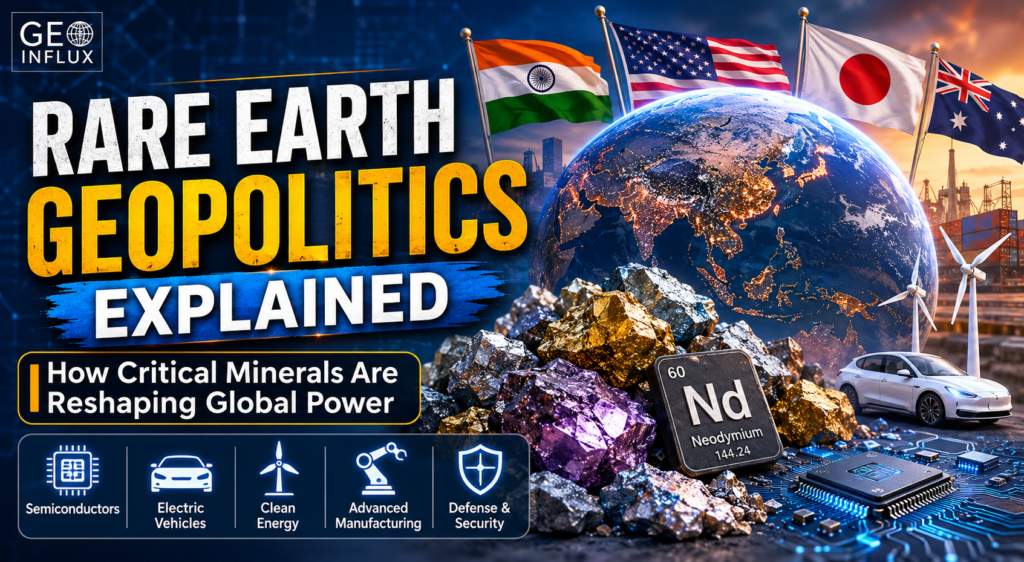

Rare earth minerals are becoming central to global strategic competition as countries race to secure supply chains critical for semiconductors, EV batteries, defense systems, and clean energy infrastructure.
Quick Take
Rare earth minerals are no longer just industrial resources buried deep underground. They now sit at the center of global competition over Technology, Manufacturing, Infrastructure, and Economic Security.
From semiconductors and AI hardware to electric vehicles, renewable energy systems, and defense manufacturing, advanced economies depend heavily on stable access to critical minerals. This growing dependence is pushing governments to rethink about supply chains, reduce strategic vulnerabilities, and build new resource partnerships.
As countries race to secure long-term industrial resilience, control over Rare Earth Processing and Critical Mineral Infrastructure is becoming an increasingly important source of geopolitical influence.
Why Are Rare Earth Minerals Suddenly So Important?
Rare earth minerals were once viewed mainly as industrial inputs used in specialized manufacturing. Today, they play a much larger role because modern technologies depend heavily on them.
These minerals are used in semiconductors, electric vehicles, advanced batteries, wind turbines, smartphones, robotics, missile systems, and other high-performance technologies. As countries expand digital infrastructure, clean energy systems, and advanced manufacturing capacity, demand for critical minerals continues to grow.
This rising dependence has changed how governments view rare earth supply chains. What was once a resource issue is now increasingly becoming part of the broader conversation around Technology and Infrastructure Geopolitics.
The issue is no longer only about mining or commodity trade. It is increasingly tied to industrial continuity, technology production, and long-term economic security. A major disruption in supply can now affect manufacturing capacity, infrastructure expansion, and broader strategic planning at the same time.
Why Is China Central to the Rare Earth Supply Chain?
China holds a dominant position in the global rare earth ecosystem, especially in processing and refining capacity. This distinction is important because extracting rare earth minerals is only one part of the supply chain. Raw materials must still be processed into usable industrial inputs before they can support manufacturing and technology production.
Over time, China invested heavily in refining infrastructure while many other countries became increasingly dependent on imported processing capacity. That concentration gradually created long-term strategic concerns for governments relying on stable mineral access.
The broader concern is not simply resource availability. It is supply chain dependence. Many governments worry that relying too heavily on a concentrated processing ecosystem could create future vulnerabilities during geopolitical crises, trade disputes, or supply disruptions. As competition over advanced industries intensifies, reducing that exposure has become a growing policy priority.
This explains why countries are now investing more aggressively in supply chain diversification, domestic refining capacity, and critical mineral partnerships.
How Do Rare Earth Minerals Affect Technology and Infrastructure?
Rare earth minerals now support many of the systems shaping modern economic power. Semiconductor manufacturing depends on highly specialized materials and resilient semiconductor supply chains.. Electric vehicle production requires processed critical minerals at scale. Renewable energy infrastructure also relies heavily on mineral-intensive technologies used in batteries, turbines, and energy systems.
The same pattern extends into digital infrastructure. Datacenters, telecommunications hardware, industrial automation systems, and advanced computing infrastructure all depend on manufacturing ecosystems supported by stable mineral access. As countries are increasingly investing more heavily in the AI infrastructure race and digital expansion, reliable mineral supply chains become even more important.
This is why critical minerals are no longer treated as ordinary commodities. They increasingly influence industrial competitiveness, infrastructure growth, technology production, and long-term economic preparedness. In many ways, rare earth supply chains are becoming part of the foundation underneath modern technological and industrial power.
Why Are Governments Building Critical Mineral Alliances?
As supply chain risks grow, governments are moving beyond traditional trade dependence and building more structured partnerships around critical resources. This shift is already visible across multiple regions. The United States, Japan, Australia, India, and several European countries are expanding cooperation on mineral supply chains, refining infrastructure, and industrial resilience.
The goal is not simply resource access. Countries are trying to reduce vulnerability by diversifying supply networks and strengthening long-term supply security. That explains the growing focus on:
- critical mineral agreements
- refining investments
- strategic stockpiles
- infrastructure partnerships
- supply chain diversification
The recent QUAD Energy Security Initiative and accompanying rare earth cooperation fit directly into this broader trend.. Energy security, infrastructure resilience, and critical mineral supply chains are increasingly becoming part of the same larger geopolitical conversation.
Why Is Rare Earth Geopolitics Becoming More Important for India?
India’s growing interest in critical minerals is closely tied to its industrial and infrastructure ambitions. As the country expands manufacturing capacity, digital infrastructure, clean energy deployment, and advanced industrial production, dependable access to critical supply chains becomes increasingly important.
At the same time, global efforts to diversify mineral supply chains could create new opportunities for India in refining, processing, and strategic resource partnerships. This opportunity matters beyond economics alone.
Countries that help shape future supply chain ecosystems may gain greater influence within emerging industrial and infrastructure networks. This gives rare earth policy growing geopolitical significance for India as global competition increasingly shifts toward supply chain resilience and industrial preparedness.
Could Rare Earth Supply Chains Become the Next Major Strategic Battleground?
There are growing signs that critical minerals may become one of the defining geopolitical competition areas of the coming decade. Modern strategic competition increasingly revolves around industrial capacity, infrastructure resilience, supply chain control, and advanced technology ecosystems. Rare earth minerals now sit at the intersection of all four.
That does not mean a traditional resource conflict is inevitable. However, governments are clearly competing more aggressively over:
- processing dominance
- industrial self-sufficiency
- supply chain influence
- strategic resource partnerships
- infrastructure control
The direction of global competition is becoming increasingly clear. Countries are no longer focused only on who manufactures advanced technologies. They are also competing over who controls the materials, processing systems, and industrial infrastructure needed to sustain those technologies at scale.
This shift is quietly reshaping global power dynamics in ways that could become even more important over the next decade.
Key Takeaways
| Development | Why It Matters |
|---|---|
| Rare earth minerals power advanced technologies | Semiconductors, EVs, defense systems, and clean energy infrastructure depend on them |
| China dominates much of the processing ecosystem | Creates long-term supply chain dependence concerns |
| Governments are diversifying supply chains | Infrastructure and industrial resilience are becoming major policy priorities |
| Critical minerals now influence technology ecosystems | Rare earths increasingly support digital and industrial infrastructure |
| Strategic competition is expanding into resource ecosystems | Control over supply chains is becoming a major geopolitical advantage |
FAQs
Why are rare earth minerals strategically important?
Rare earth minerals are essential for technologies such as semiconductors, electric vehicles, renewable energy systems, advanced batteries, and defense equipment. Because modern economies depend heavily on these industries, governments increasingly view stable mineral access as strategically important.
Does China control all rare earth minerals?
No. Rare earth resources exist in multiple countries. However, China maintains a dominant position in processing and refining capacity, giving it major influence within global supply chains.
Why are countries trying to diversify rare earth supply chains?
Many governments worry that relying too heavily on concentrated processing networks could create future supply risks during geopolitical crises or trade disruptions. Diversification is seen as a way to improve long-term supply security and reduce vulnerability.
How do rare earth minerals affect digital infrastructure?
Digital infrastructure depends on hardware manufacturing, advanced electronics, industrial systems, and energy infrastructure that require critical minerals. This makes rare earth supply chains increasingly important for AI infrastructure, datacenters, and broader digital expansion.
Why is the QUAD discussing rare earth cooperation?
The QUAD’s growing focus on critical minerals reflects wider concerns around industrial resilience, infrastructure security, and dependable supply chains. Rare earth cooperation is increasingly connected to broader economic and technological preparedness.
Related Reads
- How Tech Geopolitics Is Redefining Digital Sovereignty
- QUAD Energy Security Initiative Explained
- India’s AI Infrastructure Race and Strategic Compute Competition
Featured Sources & Citations
- International Energy Agency (IEA) critical minerals analysis
- US Geological Survey (USGS) rare earth data
- International Energy Agency clean energy supply chain reports
- World Bank critical minerals research
- UNCTAD supply chain and trade reports
End Note
Rare earth geopolitics is no longer a niche industrial topic. It has become part of a much larger competition over infrastructure resilience, industrial capacity, and technological influence.
As countries race to secure critical supply chains, control over strategic minerals may increasingly shape economic power, industrial strength, and geopolitical influence in the years ahead.
Thank you for reading GeoInflux. As global competition increasingly expands into infrastructure, supply chains, and advanced technologies, critical minerals are becoming too important to ignore. Stay with GeoInflux for deeper coverage of strategic infrastructure, technology, and shifting global power dynamics.
 2
2
 20
20
 20
20