

Rotating Detonation Engines Breakthrough: Discover how Deipro Pulse Aerospace is building India’s first Rotating Detonation Engine (RDE), a supersonic propulsion breakthrough for defense.
Quick Take
India is currently witnessing a paradigm shift in its aerospace and defense sector. While the nation has long relied on global players for high-end propulsion technology, a domestic startup is now engineering a solution that could put India at the forefront of the next generation of flight.
Deipro Pulse Aerospace, led by veteran defense analyst Saurav Jha, is developing India’s first Rotating Detonation Engine (RDE), a technology that moves beyond traditional combustion to harness the power of supersonic shockwaves.
The Architect of Innovation: From Journalist to Engineer
The story of Deipro Pulse is as much about human capital as it is about hardware. The startup was co-founded by Saurav Jha, a name synonymous with strategic depth in the Indian defense community. As the founder of the Delhi Defence Review, Jha spent years documenting the critical gaps in India’s military-industrial complex.
However, in a rare move for a civilian analyst, Jha transitioned from writing about aerospace to building it. Having advised the Government of India and major strategic firms, his expertise is now focused on a “deep-tech” mission. The startup recently secured ₹25 crore in funding from Alpha Fund, signalling strong investor confidence in India’s ability to produce high-stakes sovereign technology.
Understanding the Breakthrough: What is a Rotating Detonation Engine?
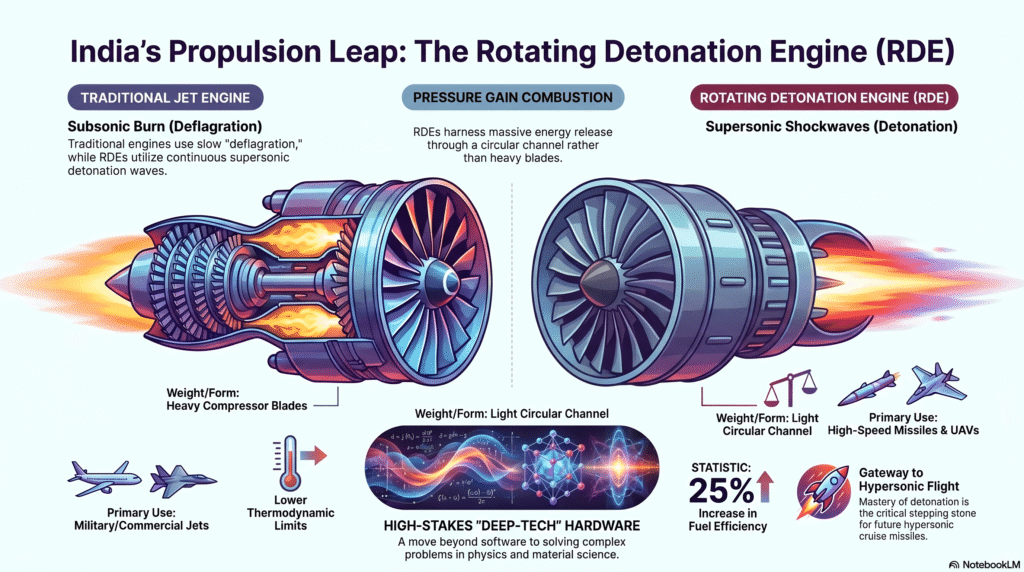
To appreciate why the Rotating Detonation Engine is a revolutionary leap, we must compare it to the “deflagration” process used in standard jet engines.
1. The Conventional Method: Deflagration
In a standard jet engine, air is sucked in, compressed by heavy spinning blades, and mixed with fuel. The resulting burn is a relatively slow, controlled process called deflagration. It is constant and steady, much like a candle flame. While reliable, this method has reached its thermodynamic efficiency limits.
2. The RDE Method: Detonation
An RDE operates on an entirely different physical principle: detonation. Instead of a slow burn, it uses a supersonic shockwave that travels around a circular channel.
- Supersonic Combustion: The shockwave slams into the fuel-air mixture, igniting it almost instantly.
- Instant Energy Release: This process happens faster than the speed of sound, releasing massive amounts of energy with significantly more pressure and force than a standard engine.
Strategic Impact: Why RDE is the Future of Indian Defense
The development of a functional Rotating Detonation Engine by Deipro Pulse Aerospace has significant implications for India’s strategic autonomy and the Integrated Defence Staff (IDS) requirements.
- Enhanced Fuel Efficiency: RDEs are theoretically 25% more efficient than traditional gas turbines, allowing for longer-range missions for missiles and drones.
- Compact Power: Because they don’t require the massive, heavy compressor blades found in traditional jets, these engines can be smaller, lighter, and faster.
- Hypersonic Potential: Mastery of detonation-based propulsion is a critical stepping stone toward reliable hypersonic cruise missiles and high-speed interceptors.
Future Outlook: A New Era for Indian Startups
The success of Deipro Pulse reflects a broader trend in the Indian Startup Ecosystem: the move toward “Deep Tech.” No longer content with just software or services, Indian entrepreneurs are now tackling the hardest problems in physics and material science. By moving from deflagration to detonation, India isn’t just catching up; it is attempting to leapfrog existing global standards.
Key Takeaways & Summary
| Feature | Traditional Jet Engine | Rotating Detonation Engine (RDE) |
| Combustion Type | Deflagration (Subsonic Burn) | Detonation (Supersonic Burn) |
| Key Component | Heavy Compressor Blades | Circular Detonation Channel |
| Efficiency | Lower (Thermodynamic Limits) | Higher (Pressure Gain Combustion) |
| Primary Use | Commercial & Military Jets | High-Speed Missiles & Future UAVs |
Frequently Asked Questions
What is a Rotating Detonation Engine (RDE)?
An RDE is a next-generation engine that uses a continuous supersonic detonation wave to burn fuel. This is much more powerful and efficient than the slow combustion process used in today’s aircraft.
Who is building India’s first RDE?
Deipro Pulse Aerospace, a startup co-founded by defense expert Saurav Jha, is currently leading the development of this technology in India.
How is RDE different from a normal jet engine?
A normal engine burns fuel slowly (deflagration), while an RDE uses a shockwave to explode the fuel-air mixture at supersonic speeds (detonation), creating more thrust with less fuel.
Why is this important for India?
It reduces dependence on foreign engine technology and provides the Indian military with more advanced, efficient, and faster propulsion systems for defense hardware.
Related Articles
- How Tech Geopolitics Dramatically Redefined Digital Sovereignty and National Power in 2025?
- AI Geopolitics: Is AI Reshaping Global Power in 2025? 5 Shocking Global AI Power Shift That Changed Everything
- Why DHRUV64 Matters More Than You Think: The Bold Indigenous 64-Bit RISC-V Chip Powering India’s Tech Sovereignty
Verified Industry References
- IAN Alpha Fund Official Announcement: IAN Alpha Fund Invests ₹25 Crore in D-Propulse Aerospace (Detailed breakdown of the ₹25Cr investment and strategic vision).
- Startup Technical Portfolio: D-Propulse Official Technology Page (Technical specs on the 2.5kN and 5kN RDE engines and Mach 5+ targets).
- Business Analysis: Business Standard: IAN Alpha Fund invests ₹25 crore in D-Propulse (Context on the $100 billion global market potential for RDE by 2035).
- Defense Sector Coverage: Indian Start-up D-Propulse Successfully Tests RDE (Details on the successful trial of the 5 kN combustor and mentorship from Dr. V.K. Saraswat).
- Company Profile: Tracxn: Deeppropulse Aerospace Private Limited (Founding details, leadership, and registration information).
 2
2
 20
20
 20
20






Pingback: How Tech Geopolitics Dramatically Redefined Digital Sovereignty And National Power In 2025? GeoInflux